

Shortly after U.S. President Donald Trump announced that an agreement with Iran was ready on the night of May 23, Iranian Foreign Ministry Spokesperson Esmaeil Baghaei wrote a striking and exceptional nationalist post on the “X” platform. Facing those whom Baghaei implicitly labels as the “New Romans” (the Americans and the Israelis), he did not summon the vocabulary of traditional religious discourse about Karbala, Khaybar, or Islamic Resistance. Instead, he resorted to Iran’s pre-Islamic history, invoking the Parthians and the Sassanids in the face of ancient Rome.
Baghaei wrote that throughout history, Iranians have stood up to invaders, pointing to the Battle of Carrhae in 53 BC. He stated that the Iranian/Parthian commander, Surena, with fewer forces and limited resources, crushed the armored Roman legions in a brilliant “asymmetric victory.” He added that Marcus Crassus, one of Rome’s wealthiest and most powerful men, was killed in the battle, shattering the myth of Rome’s invincibility and ending its dream of eastward expansion on the battlefield. Baghaei concluded by noting that history repeats itself for those who refuse to study it or respect its lessons.
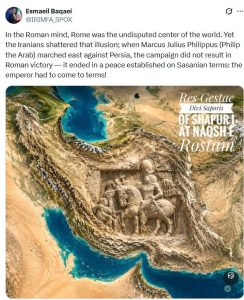
In another post regarding a different event connected to a Sassanid victory this time, Baghaei wrote: “In Roman thought, Rome was the undisputed center of the world. However, the Iranians shattered this illusion; when Marcus Julius Philippus (Philip the Arab) marched eastward against Persia, the campaign did not result in a Roman victory, but rather ended in a peace based on Sassanid terms: the Emperor had to submit!”
The political implication seems clear: Baghaei implicitly draws a comparison between ancient Rome and the current American-Israeli power. In contrast, the Iranian discourse positions itself as the symbolic heir to the ancient Persian power, even if its current regime is founded on Shia religious legitimacy.
In the first post, Baghaei refers to the Battle of Carrhae (Harran) in 53 BC. In the second, he refers to Philip the Arab and his peace treaty with Shapur I on Sassanid terms—a chapter in a series of victories for Shapur that later culminated in the capture of Emperor Valerian near Edessa in 260 AD.
Carrhae 53 BC
The Battle of Carrhae, or Harran, is one of the most famous defeats in Roman history and one of the most vividly recalled victories in ancient Iranian memory. It demonstrated the ability of a smaller Parthian army to crush a heavily armored, ostensibly superior Roman force led by one of Rome’s most powerful men: Marcus Licinius Crassus. The battle took place in 53 BC near the city of Carrhae, modern-day Harran, within Mesopotamia. In modern Arabic sources, this series of wars, including Carrhae, was covered in detail by researcher Hivi Parwari in the book The Roman-Parthian War(published by Dar Tammuz), and briefly discussed by scholar Homa Katouzian in his book The Persians (published by Jadawel Publishing).
The battle ended in a Roman catastrophe. Crassus was killed during chaotic negotiations with Surena, and most of his army was destroyed or captured. In a highly symbolic historical detail, Surena sent Crassus’s head and hands to King Orodes II, who was watching a theatrical play at the time; because the performance required a severed head as a prop, the king ordered the use of Crassus’s head.
Among the most important outcomes of the battle was that it established the Euphrates River as a border between two massive worlds: Rome to the west, and the Iranian Parthian power to the east. Centuries later, when war broke out between the Safavids and the Ottomans, Shah Ismail drew his envisioned map of his state’s borders, bounded to the west by the Euphrates River.
For this reason, the battle is present in modern Iranian discourse due to the similarity between its ancient and contemporary symbolism: a major Western power advancing with confidence, only to collide with an adversary that knows its terrain and excels in maneuver warfare and attrition. Politically, this is the exact meaning the Iranian spokesperson intended to invoke.
The Battle of Edessa
Nearly three centuries after Carrhae, the Roman-Iranian confrontation returned in a new form. The Parthian Empire had fallen, replaced by the Sassanid Empire—a more centralized and ambitious power led by kings who sought to reclaim the imperial legacy. In this context emerged Shapur I, the second Sassanid king, who ruled in the third century AD and waged a series of wars against Rome, making him one of its most prominent adversaries in the East.
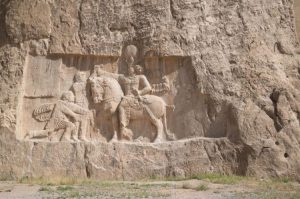
Roman accounts suggest Emperor Gordian III led a campaign to the East but died during it. However, the Sassanid narrative states that Shapur defeated the Roman army at the Battle of Misiche in 244 AD, where Gordian was killed, and that his successor, Philip the Arab, came to Shapur begging for peace, paying 500,000 denarii as part of the terms. This text is preserved in Shapur’s famous inscription on the Ka’ba-ye Zartosht: “Philip the Caesar came to us seeking terms, paid us 500,000 denarii as a ransom for his life, and became our tributary.”
In his rock reliefs, particularly at Naqsh-e Rostam, Shapur appears on horseback in a victor’s stance, with a Roman emperor kneeling before him asking for peace or showing submission. The scene is also linked to the memory of capturing another emperor: Philip the Arab is mentioned by name, having been forced to request peace and pay 500,000 denarii, while Valerian was captured near Edessa in 260 AD, marking one of the greatest humiliations in Rome’s history.
The Persian Nationalism of the “The Guardian Jurist”
On June 24, 2025, the 12-Day War against Iran ended with U.S. President Donald Trump announcing a truce that held for less than a year, with the resumption of hostilities on February 28, 2026. However, since the 12-Day War, Iran has undergone an ideological shift that is flexible and non-revolutionary, as it is a change brought about by the regime itself, for itself. Openness toward the history of Greater Iranshahr—ancient, pre-Islamic Iran—has become part of the public discourse and has found its place in Iranian public spaces.
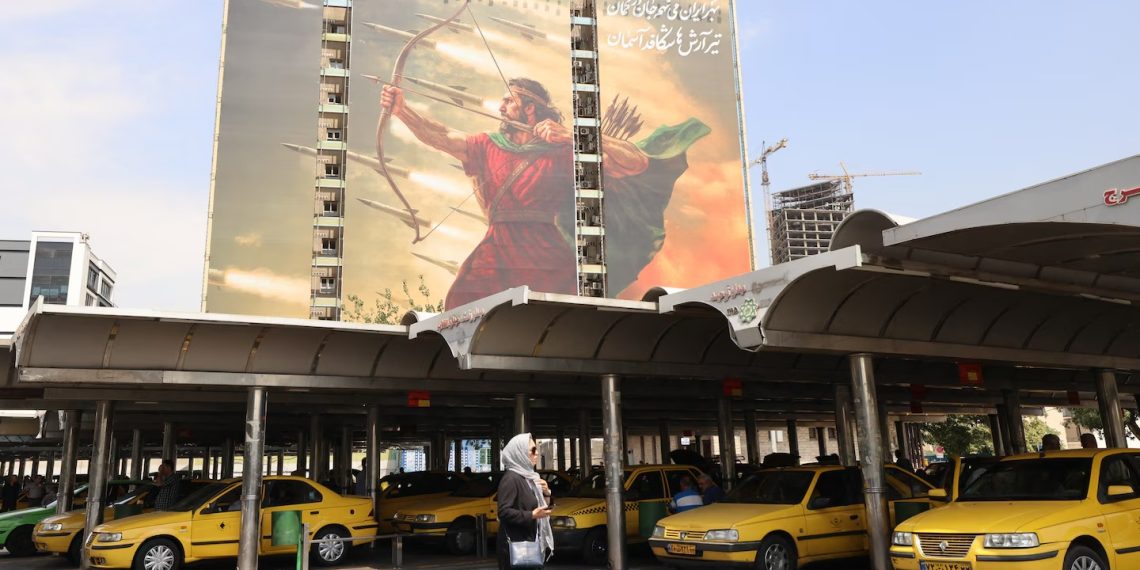
On July 16, 2025, a correspondent for the “Geti” agency captured a photo of a billboard erected after the 12-Day War in Tehran’s Vanak Square, featuring the legendary Persian archer Arash. The billboard contained an excerpt from a Persian poem stating: “For the sake of Iran, I place my soul in the bow… Arash’s arrow pierces the sky.” This poetic phrase in Persian is inspired by the most famous poem that revived Arash, written by the great poet Siavash Kasraie in 1959. Kasraie had written the poem in memory of Khosro Roozbeh, a leader in the military wing of the Tudeh Party, who was executed by the Shah’s regime in 1958.

The epic Persian heritage, including Ferdowsi’s Shahnameh, helped keep Arash’s name alive in the Iranian collective memory. Although Arash was not a central hero in the Shahnameh like Rostam, Zal, or Sohrab, he was mentioned in the initial mythical era of Iran’s history within the epic, which Ferdowsi completed in 1010 AD and dedicated to Sultan Mahmud of Ghazni. Arash’s name appeared in a single incident and he was not among the core protagonists like Rostam and Sohrab. Despite this, Kasraie captured a heavy symbol of Iranian/Persian nationalism embodied by Arash in his poem.
In Iranian mythological memory, Arash the Archer appears at a moment of defeat and brokenness. The war between Iran and Turan—the legendary enemy from the East in the ancient Iranian imagination—had dragged on. The country was exhausted, the land grew narrow for its people, and the borders themselves became a matter of dispute. The existential question of that phase became: Where does Iran begin? And where does it end?
At that moment, it was agreed that the borders would be determined by a single arrow shot. Wherever the arrow fell, there the land of Iran would end. Here stepped forward Arash, an archer who was neither a crowned king nor a commander, but a man of the people.
Arash climbed a high mountain—most famously Mount Damavand in the Tabaristan region—and drew his bow at dawn. Before releasing the arrow, he poured into it everything he possessed: his strength, his breath, his life, and his soul. The shot was a complete sacrifice.
The arrow flew far, crossing mountains and plains, until it reached the furthest possible extent, and there, the borders of Iran were redrawn. However, Arash did not survive the shot. In some narratives, his body tore apart, and in others, he vanished; in the deepest symbolic sense, he became a part of the land he saved. He paid with his life so that the country could reclaim its dignity from the Turan invasion.
Consequently, Arash remained a highly compelling symbol in Iranian culture: he is not Rostam, the hero of supernatural strength and epic duels, but the hero of a single, brief, and eternal event. From this stems his contemporary political value, which led the regime of the “The Guardian Jurist” to summon him at a moment of vulnerability. On the billboard in the Tehran square, Iranian missiles were launching alongside Arash’s arrow. Iran had fired hundreds of missiles at Israel during the 12-Day War, so invoking Arash from the Shahnameh served as an endorsement of Iran’s missile program.
Following the publication of the billboard, Washington Post journalist Yeganeh Torbati interpreted it as a sign of a slow but continuous shift—a transition from the insular religious Shia symbolism in which the Islamic Republic regime had entrenched itself since 1979, toward an openness to ancient history. This is the very history that the Pahlavi regime had brought to light in its modern form regarding Persian grandeur, peaking in the 1971 celebration of the 2,500th anniversary of the founding of the Persian Empire, which was considered one of the most expensive and heavily attended events in history.
The Search for Cyrus
Since 1979, the regime’s legitimacy has been built on the Islamic Revolution, the Velayat-e Faqih (The Guardianship Jurist), political Shiism, and Palestine. Kings like Cyrus, Darius, the Parthians, and the Sassanids had no place in political-historical discourse. Therefore, pre-Islamic Persian history remained a sensitive issue, yet it was never far from debate and dilemma for the Guardianship Jurist’s regime.
In 2015, Menachem Merhavy, a researcher at the Hebrew University, published a study in the journal Iranian Studies on the religious deployment of national symbols in Iran, titled “In Search of Cyrus the Great.” The core idea was to study the debate surrounding Cyrus the Great in Iran over four decades, viewing it as a mirror of the conflict between the religious-Islamic component and the nationalist-Persian component in defining Iranian identity.
According to Menachem Merhavy, the figure of Cyrus, founder of the Achaemenid dynasty, turned into a testing ground for this tension. For Iranian nationalists, Cyrus represents a symbol of greatness, tolerance, and the ancient imperial state. For segments of the clergy and the Islamist current, however, Cyrus remained an ambiguous symbol because he was associated with the monarchical past that the Islamic Republic wanted to break away from, and with Shah Mohammad Reza Pahlavi’s use of Achaemenid history to build his own legitimacy, particularly during the 2,500-year celebrations.
Certain factions within the Islamic Republic did not abandon Cyrus to the nationalist movements; rather, they attempted to reinterpret him religiously, transforming Cyrus into a figure that could be integrated into the Islamic religious imagination. One of the prominent forms of this interpretation is the attempt to link Cyrus to the figure of “Dhu al-Qarnayn” mentioned in the Quran. In this manner, he is reinterpreted to serve the identity of the Islamic Republic.
The study, along with other literature on the subject, points out that the era of former President Mahmoud Ahmadinejad represented a significant moment in the attempt to introduce ancient Iranian symbols into the discourse of the Islamic Republic. Ahmadinejad frequently referenced Cyrus, and his name was also linked to the exhibition of the Cyrus Cylinder in Tehran in 2010, when the clay cylinder was loaned from the British Museum after tension and debate. The last time the British Museum had allowed the cylinder to be loaned prior to that was in 1971, during the Shah’s legendary anniversary celebration of the founding of the Achaemenid Empire.
During the event, Ahmadinejad placed a Palestinian-style keffiyeh—the type used by the Basij—around the shoulders of an actor dressed as Cyrus the Great. In a report titled “Cyrus the Great Becomes a Member of the Basij,” the Fars News Agency reported that all foreign ambassadors and other guests present at the ceremony stood up when Ahmadinejad draped the keffiyeh over Cyrus the Great.
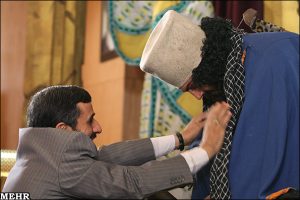
Following Ahmadinejad’s tenure, Persian symbols receded in official discourse, and subsequent leaders avoided resurrecting nationalist Zoroastrian symbols in the manner Ahmadinejad did. Yet, the regime could not entirely ignore pagan/Magian Iran—descriptions that align with the ideology of the ruling religious regime, despite its keenness to avoid expressing this in official rhetoric.
In her July 2025 article, Washington Post journalist Yeganeh Torbati traced how Iranian leaders resort to pre-Islamic eras to stir nationalist sentiment. Iran’s Supreme Leader, Ali Khamenei, has frequently expressed his disdain for the pre-Islamic past when the country was ruled by kings, describing that era as a time of “illusions, not a source of pride,” plagued by corruption and dictatorship.
Therefore, it marked a striking shift in tone when Khamenei, in a speech delivered just days after the first Israeli attack on Iran, repeatedly praised the country’s “ancient civilization” and boasted that Iran possesses a “cultural and civilizational wealth” far greater than that of America.
By emphasizing Iran’s cultural identity rather than its religious identity, Khamenei sought to rally a population that was not only shaken by 12 days of Israeli strikes but had also become, to a large extent, resentful of the ruling clerics and the religious ideology that dictates how society is managed. Khamenei’s statements represented the highest possible level of utilizing nationalism, as described by author Yeganeh Torbati.
This attempt to capitalize on Iran’s millennia-old civilization was not an isolated event. A billboard was erected in Tehran praising an ancient Persian king, while another in the capital displayed the mythical figure “Arash the Archer” accompanied by a barrage of missiles. A third billboard in the city of Shiraz—quoting a rock relief near the ruins of the ancient city of Persepolis (Takht-e Jamshid)—depicted Israeli Prime Minister Benjamin Netanyahu in the guise of Roman Emperor Valerian, kneeling before the victorious Persians.
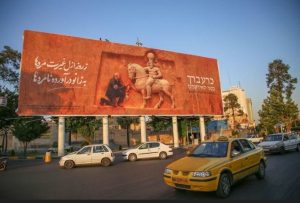
Commenting on these displays, Ali Ansari, a historian at the University of St Andrews in Scotland, told The Washington Post: “Adopting all these things means admitting that the ideology of the Islamic Revolution has failed.” He added that although the government had used nationalist themes before, it had never occurred “on this exact scale, nor with this exact intensity, nor when they were in this much trouble.”
Hossein Gazian, a sociologist and pollster who worked in Iran and now lives in the United States, said it was unsurprising that Iranian leaders frame their battle against Israel and the United States in nationalist terms to gain popular support. He added that the Iranian government is willing to adapt its ideology, including reducing the emphasis on religion, when necessary.
This discourse does not sit easily with the dominant ideology of the Islamic Republic, which advocates for a rupture with Iran’s monarchical past and the shaping of society according to a specific Islamic vision. It also reflects concessions to the popular mood, which has distanced itself from religion in recent years.
On the Ruins of Persepolis
On September 20, 2025, The Financial Times published a report on changing cultural trends following the 12-Day War, noting the significant losses suffered by Iran and the regime’s fear of collapsing before a popular revolution. Amid the ruins of Persepolis, Iranian officials, diplomats, and local residents listened to an Armenian orchestra playing classical music and the national anthem, “Ey Iran.”
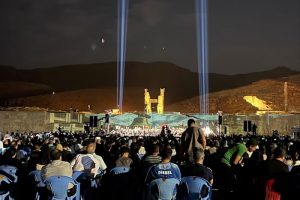
Such events are rare in Iran, where the Shia Islamic Republic’s relationship with music and pre-Islamic heritage celebrations has always been complex. Supreme Leader Ali Khamenei, who visited Persepolis, previously described the Achaemenid capital as an “architectural masterpiece” but also a place that “lacks spirituality and symbolizes tyranny.” Nonetheless, Iran’s rulers have begun not only to tolerate such events but also to organize them as part of a campaign to win over a population disillusioned by economic hardships and a destructive war.
However, the campaign to take refuge in nationalist Zoroastrian history does not pass without resistance. At the Persepolis concert, Nadereh Rezaei, the Deputy Minister of Culture and the highest-ranking woman in the artistic establishment, sat in the front row, standing out among the male officials. The following day, she was dismissed from her post. It is believed her dismissal was due to her efforts to organize another concert, this time in Tehran’s Azadi Square, featuring Iran’s most famous singer, Homayoun Shajarian.

That concert, which was expected to attract tens of thousands of people, was abruptly canceled. Although authorities cited a lack of time to organize an event of that magnitude, the regime feared the concert would transform into an anti-regime gathering.
Conclusion: Who Represents “Arash”?
Baghaei’s invocation of Carrhae and Shapur, alongside the billboards’ celebration of Arash and Cyrus, does not appear to be a fleeting promotional whim. It is closer to an indirect admission that the lexicon of the Islamic Revolution, as formulated since 1979, has gone bankrupt in mobilizing a society exhausted by sanctions, wars, and the widening gap between the state and the people.
Yet, this shift does not mean the Islamic Republic is abandoning its identity, nor does it mean the Guardian Jurist has naturally become the heir to Cyrus, Shapur, or Surena. What is happening is closer to an attempt to assemble a hybrid identity: an Islamic revolution with a Persian memory, a religious regime leaning on an ancient nationalism, and a resistance discourse expanding its symbols from Al-Hussein and Khaybar to Arash, Carrhae, and Naqsh-e Rostam. It is a nationalism summoned in times of danger. The very symbols that the Islamic Republic long viewed with suspicion, or tried to Islamize and tame, have today become tools for its survival at a time when the “The Guardian Jurist” regime fears an existential moment of reckoning from within. But will the people be the “Arash” who dies along with his arrow?