

The Serbian Parliament approved a draft law on November 7 that speeds up procedures for demolishing the former Yugoslav Army headquarters in central Belgrade, where a luxurious hotel for Affinity Partners, a company owned by Jared Kushner, son-in-law of US President Donald Trump, is expected to be built. News like this is usually common in the world of finance, business, and politics, but the Serbian government is now expected to receive preferential treatment in Washington. This could take the form of the White House refusing to answer a negative question about Serbia, or a group of Congressmen obstructing a negative proposal against Belgrade. All of this can be expected because it has happened before, and continues to happen, concerning Middle East files in Washington.
When Israel launched a surprise air raid on Qatar on September 9, 2025, the US envoy Steve Witkoff sprang into action in several media interviews to express solidarity with Doha, speaking of his moral distress upon hearing of the strike, and how Qatari leaders possess admirable patience. Trump’s son-in-law, Jared Kushner, and Trump’s son, Eric, did the same. These sympathetic statements were not merely part of the diplomatic world; rather, there is increasing suspicion that they reflect direct financial interests that have a potential impact on the direction of US policy during the Trump era. The result was the signing of a US security guarantee agreement with Qatar, which can be considered a security treasure for the Gulf state—an agreement that Saudi Arabia and other Gulf countries had been seeking for years but failed to obtain. The dynamics of US policies in the Middle East have changed, and anyone who studies these policies based on US interests and is in a position of decision-making is likely to build flawed approaches if their goal is to keep pace with US policy. Therefore, it is better to review the interest lines of the “Trump Organization” and its deals with countries that are managed—according to American newspapers and centers—with a corporate mindset.
The premise of this paper is that recent developments in US policies in the Middle East raise questions about the extent to which the private financial interests of the US President’s team—led by Steve Witkoff, Jared Kushner, Eric Trump, and their partners—influence political decisions. While the motives of US foreign policy traditionally focus on national security, alliances, and strategic interests, concrete data is emerging today about massive investment ties linking these figures to Gulf states. In this light, Qatar stands out as a prominent example: an Israeli strike on Doha in September 2025 provoked an unusual US reaction in Qatar’s favor, which included Israel not completing its war on Hamas and Gaza, leading some analysts to believe that part of this reaction may be related to the mutual financial interests between members of the Trump team and Doha.
Non-Institutional Pillars of Foreign Policy
President Donald Trump’s administration operates on non-bureaucratic, non-institutional pillars, both domestically and concerning its foreign policy, through a group of envoys appointed by Trump. Chief among them is Steve Witkoff, who undertakes the most significant diplomatic roles for a figure not scheduled within the institutional framework. This often conflicts with the tasks of the US State Department, which is experiencing its weakest role since the founding of the United States, to the extent that Secretary Marco Rubio is nearly invisible on the scene. This change brought by Trump established a new method for building policies and decisions, relying on the powers constitutionally granted to the President, such as appointing envoys and issuing executive orders that may conflict with US legislation or precede the legal stages of an action, especially those related to sanctions.
Before US President Donald Trump’s visit to the Middle East in April 2025, Newsweek magazine contacted the Trump Organization and a number of experts for comment on the visit but did not receive specific answers. The magazine raised a hypothesis that concerns from US lawmakers about the lack of clear dividing lines between policy and personal business have repeatedly appeared during Trump’s two administrations. The Trump Organization—now run by the President’s sons, Eric and Donald Jr.—continued to pursue real estate projects in the Middle East while Trump was in the Oval Office.
What is the Trump Organization?
The Trump Organization is an American international conglomerate company founded in 1923, formerly known as the Elizabeth Trump & Son organization. It is privately owned, and its headquarters are located in Trump Tower in the heart of Manhattan, the most famous neighborhood in New York City. The organization includes many commercial and investment ventures of Donald Trump; he is the company’s chairman and CEO, in addition to his three children: Donald Trump Jr., Ivanka Trump, and Eric Trump, who serves as Executive Vice President.
Browsing the Trump Organization’s website reveals a window titled “The World of Trump.” It contains no summary of “Trump’s philosophy” as the title might suggest in traditional readings, but rather news of all announced deals, such as the Jeddah Towers in Saudi Arabia, “public relations” news about Eric Trump in the press, and the news of the launch of the “Trump Phone” in the US market.
In an investigation published in May 2025, Bloomberg agency dubbed the Trump Organization an “income-generating machine.”
From Donald Trump’s perspective, he is the greatest businessman to campaign for the White House. According to Bloomberg,
No modern American president has positioned their family to earn this much money while in the White House. He has, in fact, more than doubled his net worth since the early days of his re-election campaign, reaching approximately $5.4 billion.
During that period, the Trump name supported over $10 billion in real estate projects, billions of dollars in valuation for his struggling social media company, sales exceeding $500 million from just one cryptocurrency project, and millions of dollars from stakes in companies offering financial services, weapons, and drone parts. His family members also secured a range of corporate positions—at least seven new roles as advisor or executive for his eldest son, Donald Trump Jr., alone.
Compared to the noise of the presidency, the approach of the financial network is consistent and clear, according to a Bloomberg investigation: selling the family name.
While the Trump administration scales down the government workforce and budget, in the process, it has reduced the number of agencies and offices overseeing his company, cryptocurrency ventures, and even conflicts of interest. Trump also eased restrictions on entering into foreign deals that were imposed in his previous administration.
His assets were placed in a trust overseen by his eldest son. Despite talk of an economic recession, his family is set to become wealthier than ever, according to Bloomberg.
From Oil to Deals
Over the last two decades, US-Gulf relations have shifted from a model based on “oil for security” to a complex network of mutual interests involving cross-border investments, energy markets, technology, and political finance. However, with Donald Trump’s return to the White House in January 2025, a new trend emerged in Washington, widely described as “transactional” rather than “strategic.” That is, relations are no longer managed according to a long-term political or security doctrine but fundamentally with a business mindset. This orientation is not a theoretical assumption but can be traced in the practical behavior of President Trump and his team. The circles close to Trump include more businessmen and investors than traditional diplomats, and they manage foreign policy files with the same tools used for real estate or financial deals: negotiation, bargaining, direct exchange of benefit, and quick profit.
As this image escalates, questions increase about the extent to which the personal financial relationships of some of these circles influence the official decisions of the United States, especially in the Middle East, which constitutes the largest source of external Gulf investments in the world.
At the heart of this controversy are three pivotal figures:
- Jared Kushner, the President’s son-in-law and former advisor, who founded a massive investment fund called Affinity Partners after leaving the White House in 2021.
- Eric Trump, the President’s son, who oversees the Trump family’s real estate and digital ventures.
- Steve Witkoff, a real estate businessman close to the family, who has played a growing political role as a special envoy or advisor in Middle East affairs during the new term.
The hypothesis that this report seeks to discuss suggests that the private financial interests of these three with Gulf governments or funds are likely to impact US political stances in the region to some degree. In particular, the sharp US reaction to the Israeli strike that targeted Doha in September 2025 may have been partially influenced by the fear of jeopardizing those interests, alongside traditional security and alliance considerations.
This hypothesis does not seek to condemn or adopt a stance but to provide an objective analysis that integrates financial, investment, political, and strategic elements, according to a media situation assessment methodology: namely, using publicly available information from open sources and analyzing it based on correlation, timing, and interests.
The Financial Ties of the Trump Team
- Jared Kushner and the “Affinity Partners” Fund
Jared Kushner is the most prominent case for studying the overlap of money and politics in the Trump team. After leaving the White House in 2021, he founded an investment fund named Affinity Partners based in Miami.
In less than a year, a New York Times report (April 11, 2022) revealed that the Saudi Public Investment Fund (PIF), headed by Crown Prince Mohammed bin Salman, agreed to inject $2 billion into the fund despite objections from an internal committee within the Saudi fund regarding Kushner’s weak investment experience. In subsequent reports, including Bloomberg and the Financial Times (May 2024–February 2025), it was confirmed that the fund raised over $4.8 billion from Gulf shareholders, including the Qatar Investment Authority (QIA), through sub-funds.
A report on The New Arab English website on May 14, 2025, also revealed that Affinity has become a “quasi-official investment channel for Gulf states seeking influence in Washington,” and that Qataris, Emiratis, and Saudis collectively represent “more than 80% of the fund’s capital.”
The significance of this: Kushner manages billions of dollars of Gulf money, creating a network of long-term financial relationships with the same Gulf governmental entities that politically deal with the White House. This Gulf interconnection with a single American channel compels these countries to reduce their bilateral differences at this stage, which can be observed in the decline of counter-media campaigns on social media between platforms run by these countries against each other.
- Eric Trump and the Family’s Ventures in the Gulf – Real Estate and Digital Currencies
Eric Trump assumes the executive role in the Trump Organization and is responsible for managing the family’s international projects. Since Trump’s return to power, the Middle East has witnessed significant investment activity for the family, especially in Oman and Qatar.
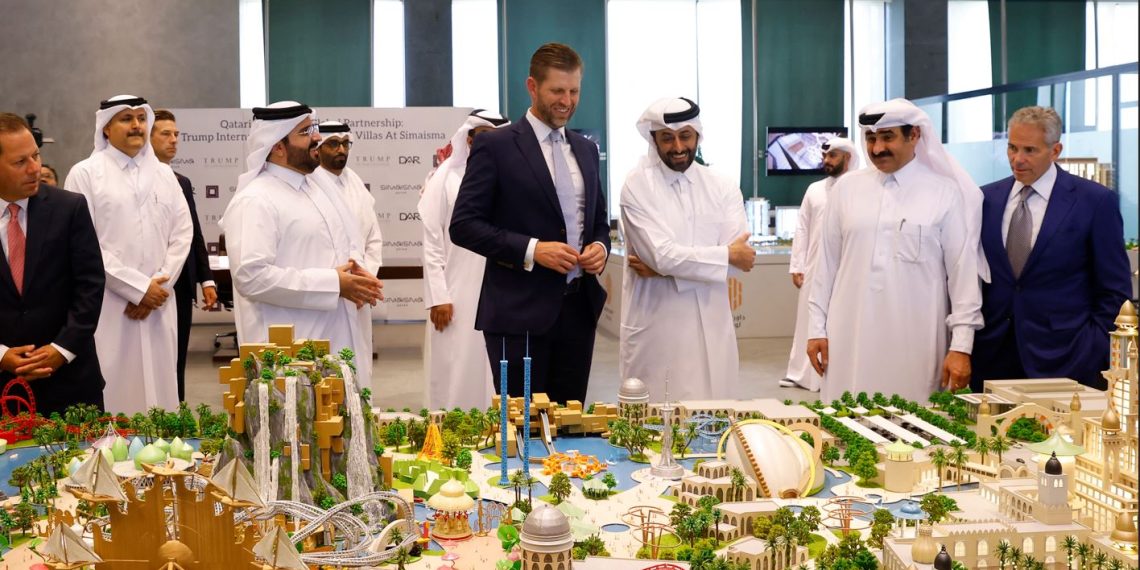
The Qatar project appeared in press reports on May 12, 2025, indicating that the Trump family is negotiating with Qatari investors to establish a hotel-residential complex with an estimated cost of $5.5 billion in the new Lusail economic zone.
The Digital Currency “World Liberty Financial”
A Reuters investigation (October 2025) clarified that the company raised over $800 million during the first half of 2025 from the sale of its digital currencies, and that an Emirati fund injected $100 million into the company, whose board is chaired by Eric Trump and Zack Witkoff, the son of Steve Witkoff, who manages his family’s finances in partnership with the Trump family.
Other newspapers also published reports stating that “companies linked to the Trump family are seeking to expand in the Middle East in real estate and cryptocurrencies, supported by Gulf investors.”
- Steve Witkoff and the Real Estate and Credit Network in the Gulf
Steve Witkoff is a prominent New York real estate developer and an old intimate of Trump. During Trump’s second term, his role expanded from an informal economic advisor to a “Special Envoy for International Investments.” Witkoff visited Gulf countries seeking funding for a real estate trust fund exceeding $3 billion for hotel and residential development in the United States.
The New York Times reported that while the US Special Envoy to the Middle East, Steve Witkoff, was busy negotiating a ceasefire between Israel and Hamas before the Israeli strike on Qatar, his son, Alex Witkoff, was secretly soliciting billions of dollars from the countries participating in those negotiations. A source, according to a Times of Israel report, stated that Qatar refused to approve the investment before a ceasefire was reached.
The Witkoff Group aims to raise $4 billion, with the potential to generate hundreds of millions of dollars from fees and profit shares. One potential contributor to the fund is the Qatar Investment Authority (QIA), which is considering participation in real estate development in Miami and Los Angeles estimated at $750 million.
Steve Witkoff, who led President Donald Trump’s diplomatic efforts around the world since his inauguration in January, previously headed the Witkoff Group, a New York-based real estate development firm. His son, Alex, has since taken over as the Group’s CEO.
Additionally, his son Zack Witkoff plays a role in the “World Liberty” crypto company, directly linking the family to the financial flows in which it invested. Thus, the Witkoff family represents an intersection point between American real estate investment and foreign capital, with a close personal and political connection to the Trump family.
Conclusion: Gulf investments constitute the strongest financial pillar for the projects of Kushner, Eric Trump, and Witkoff. The funds are distributed across three paths: investment funds (Affinity), real estate projects (Trump Organization / Witkoff Group), and digital projects (World Liberty Financial).
These investments grant states soft power to create a more friendly political and diplomatic climate in Washington, even without direct interference in the decision. This is reflected in the repeated praise from Trump and his circle for Gulf states and even for those sponsored by these states, such as the interim Syrian President Ahmed Al-Sharaa.
In the background of the scene is a growing network of financial relationships between Trump’s inner circle (Kushner/Eric Trump/Witkoff) and Gulf investors, including Qatari investments in funds/projects linked to them. This factor, for example, raises the cost of an Israeli conflict with Doha and increases the communicative political incentive to protect the relationship on the part of Trump’s financial team. However, it—based on what is publicly available—is not sufficient proof that the US decision was formulated “exclusively” in response to financial interests, with a stronger probability of overlap between family interests and US interests from the perspective of Trump and his team.
The Financial Influence on US Political Decision-Making
This hypothesis is one of the most exciting discussion points in research and media circles since mid-2025, which is that US foreign policy, under Donald Trump, is no longer formulated solely within the decision-making institutions, but is also influenced by a “system of private financial interests” of his family and close circle. Proponents of this argument rely on a set of interconnected evidence, which can be summarized and analyzed in the following areas:
A number of experts, such as Stephen Cook at the Council on Foreign Relations and Christopher Davidson at the American University of Sharjah, indicate that Gulf states have learned from the 2017-2020 experience that influence in Washington is not only bought with military deals or defense contracts, but also with direct investment in projects linked to decision-makers.
The New Arab report described this phenomenon as “private investment diplomacy,” considering that financing Kushner’s Affinity fund or the Trump family’s World Liberty project is “more influential on White House decisions than buying F-15 aircraft.” This reflects a shift from “institutional alliance” to “personal alliance,” where US interests are linked to contracts owned by the same economic elite that sets the strategy. Thus, the political decision has become less subject to institutions (Congress, State Department, Pentagon) and more linked to private interest networks.
Proponents argue that the chronological sequence between major Gulf investments in Kushner and Trump family projects and the shifts in US policy toward the region is not a coincidence. During the period (May–August 2025), Gulf funds injected about $1.5 billion into Affinity Partners and World Liberty Financial. Only weeks later, Trump’s statements about the “necessity of protecting our friends in the Gulf” were issued, and Envoy Tom Barrack appeared at the Manama Forum, announcing Washington’s support for the new Syrian government and for “Gulf consensus in the region.”
This temporal coincidence is read as evidence that the financial flows from the Gulf towards the Trump system created a more flexible environment in Washington’s policies.
Proponents cite Trump’s first experience (2017–2021) as a basis for reading his current approach; he explicitly stated in the book The Art of the Deal that “International relations are nothing but big deals.” Based on this, they believe the President does not separate commercial gain from political gain.
A Washington Post investigation (May 13, 2025) mentioned that the President “sometimes confuses the language of the market with the language of alliances,” and that some of his decisions about the Middle East are first discussed within the circle of businessmen and not the National Security Council. Consequently, President Trump’s psychological and political structure is easier to penetrate through financial tools, not through traditional diplomatic pressure.
Summary
Solid security and institutional considerations intersect with financial considerations of President Trump’s inner circle. The result is a policy of “mixed interests” that blends security, alliances, and mediation on the one hand, with private financial ties on the other, without the former being canceled or the latter reducing the entire decision. However, if the influencers on the US strategic decision in the Middle East are measured, any file, from Gaza to Syria through Iraq, Yemen, and the Gulf, is not dissectible and analyzable without reviewing the extent of the overlap of the Trump team’s financial interests with the crises.