


There may be no phrase more eloquent to describe the Kurdish political currents on the eve of the post–World War I peace conferences than this: every effort, every initiative, every stance carried more error than correctness. As such, studying any Kurdish figure during this period inevitably intersects with these mistakes.
However, a critical and often missing distinction needs to be made between two blurred, conflated labels—the “traitor” and the “mistake-maker.” Branding a mere mistake as betrayal erects a shield protecting the betrayals that persisted—and still continue today in Afrin and Serekaniye—by hostile forces determined by personal, familial, or party interests. The root of the problem isn’t only the figure of Hasan Khairi; despite his central placement in tales of “treason,” he is not the sole focus. One might say the only person who truly acknowledged that every action carries the risk of error—and acted accordingly—was Sheikh Said al-Kurdi (al-Nursi). He charted a singular, controversial, and strange path during the tumultuous period between the Treaties of Sèvres (10 August 1920) and Lausanne (24 July 1923).
Misguided readings of Kurdish figures from that era stem primarily from incomplete and distorted interpretations of key political events. In that context, let’s consider one such contentious moment—the Treaty of Sèvres—because starting from it opens the door to understanding the political environment in which Hasan Khairi Bey and his peers operated: a deathtrap looming from every angle of political struggle and revolutionary resistance.
On the analytical and intellectual front, four Kurdish figures applied critical or skeptical readings to Sèvres—specifically the three clauses concerning the Kurds within this massive treaty of 433 articles. These figures are Muhammad Amin Zakki, Kamal Müzher Ahmad, Abdulrahman Qasemlo, and Abdullah Öcalan (to my knowledge). While the full breadth of their perspectives lies beyond our immediate discussion, what requires emphasis is the very nature of the treaty: based on one’s understanding of this already-doomed international forum, their subsequent historical trajectory—and even present‑day choices—are shaped.
Was Sèvres truly a lost opportunity? Who lost it? And if subsequent events reveal that Kurdish leaders who opposed Sèvres actually faced worse alternatives—does this absolve researchers and readers from exposing the treaty’s glaring flaws?
Most importantly, a neglected question remains: did Kurdish leaders who failed to embrace Sèvres do so out of pro‑Turkish submission? Historical records show that many Kurds indeed betrayed their own people—joining the Committee of Union and Progress and later Mustafa Kemal—even after their masks fell in Lausanne. But neither Hasan Khairi nor his comrades—who sent the telegram “One state for Kurds and Turks”—belonged to that group.
Kurds, in general, focused on the three articles relevant to them in Sèvres—important, as they represented the first international recognition of the Kurdish issue—if only as a statement of presence at the most significant post‑WWI diplomatic forum. Yet they fixated on the wording and neglected the larger picture—the Sèvres maps.
The shocking map
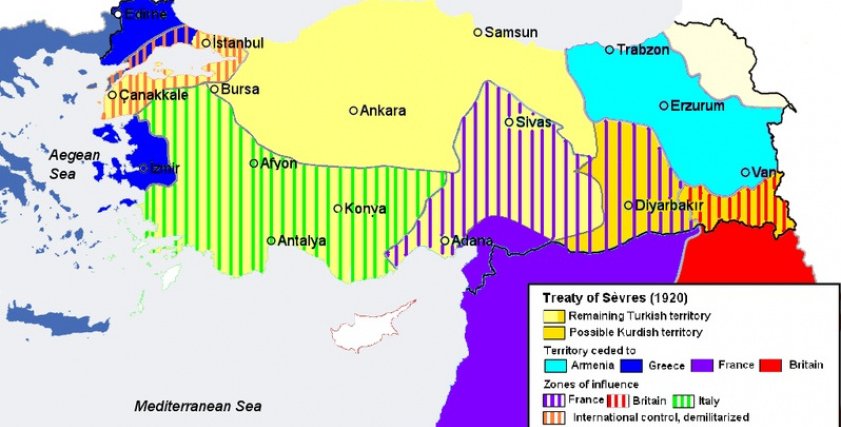
A review of the Sèvres maps helps explain why many Kurds opposed the treaty: it excluded entire Kurdish regions from the proposed state. From this map, one understands why leaders from Bitlis, Van, Mush, Serhad, Mardin, Nisibin, Urfa, Suruç, Malatya, Adiyaman, Maraş, and Antep opposed it, while only a small number—from Botan, Amed, and Dersim—supported it. These divisions mirror the proposed administrative boundaries of the Kurdish state, as the excluded areas lay outside them. Moreover, the treaty’s same-day revision—delivering Kurdish oversight to the League of Nations—was quickly followed by Britain, France, and Italy carving out spheres of influence. France and Britain divided the projected Kurdish state: Botan under British oversight, western Kurdistan (with Diyarbakır as center) under French, while southern Kurdistan (centered on Sulaymaniyah) was outside of the treaty and remained administratively part of the British‑mandated Iraq.
The Article 64 left the door open for the potential inclusion of Southern Kurdistan into the “Sèvres state” through a vague and ambiguous formulation, which stated:
“The Principal Allied Powers will not oppose the voluntary inclusion of the Kurds living in that part of Kurdistan which is still under the Mosul Vilayet into the independent Kurdish state.”
Meanwhile, Kurdish areas stretching from the Mardin line to Urfa, Antep, and Afrin came under direct French control, in preparation for their annexation to the newly created state of Syria.
The treaty was geographically fragmented and, in effect, a systematic partition within Kurdistan. It delineated borders that vast Kurdish areas were excluded from, leaving them existentially insecure—not included in the proposed Kurdish state or the Armenian alternative, forcing them toward migration or elimination. There was broad Kurdish consensus that accepting Arab rule—whether in Syria or Iraq—was unacceptable. Facing looming massacres, they vehemently opposed Sèvres.
The treaty then returned to involve Kurds in Articles 88–93, those related to the Armenian question. It empowered President Woodrow Wilson to draw the borders between an independent Armenian state and the proposed Kurdish state. As Öcalan succinctly framed it, both the Armenian and Kurdish projects were nationalisms competing for the same territory. This bred widespread Kurdish suspicion toward Sèvres—one that neither the optimistic propaganda of the Bedirkhan and Cemil Pasha families nor others could dispel the panic that had spread throughout most parts of Kurdistan..
When considering why Sayyid Abdulqadir al-Nahri was confused, why Said al-Kurdi withdrew from politics, why most Kurds joined Mustafa Kemal in the War of Independence, why most accepted a binational state with the Turks, and why figures like Yusuf Ziya Bey, Husayn Awni Bey, Hasan Khairi Bey, Şahin, Bozan Bey, alongside all Kurdish deputies in the Grand National Assembly, sent a telegram to Lausanne favoring autonomy under the national pact- Misak-i Milli over the entire territory of Kurdistan as envisioned by the Kurds at that time… All these questions find their answer in what was previously discussed — the problematic Treaty of Sèvres.
The Treaty of Sèvres also has its unofficial story. It emerged within the context of the rivalry between the governments of Ankara and Istanbul. The offer presented by Ankara, led by Mustafa Kemal, was a gradual one. First came the Erzurum Congress on July 23, 1919, followed by the Sivas Congress in September 1919. Kurdish participation in the Erzurum Congress was stronger, and according to researcher Robert Olson in his book The Emergence of Kurdish Nationalism(translated into Arabic by Dr. Ahmad Khalil as The History of the Kurdish National Struggle), the Kurds held the upper hand at Erzurum, where the representative council consisted of nine members, at least three of whom were Kurds: Haji Musa Bey from Mutki, Salah Effendi from Bitlis, and Fawzi Effendi from Erzurum.
Although Olson does not mention an official declaration of autonomy in these two congresses, this matter is beyond doubt and is documented in the congress records circulated by the Kurdish participants as part of a campaign to persuade their peers of the value of Kurdish-Turkish cooperation. Olson does not exaggerate in his concise conclusion that “without Kurdish support, the Turkish nationalist movement would not have achieved the success it did.”
In general, the outcomes of these two congresses were crowned in the Misak-i Milli (National Pact) on February 28, 1920 — six months before the Treaty of Sèvres was signed on August 10, 1920.
This Pact envisaged a shared Kurdish-Turkish nation and pledged to reclaim all Kurdish lands under British and French mandates (plus Aleppo and Mosul). The joint Kurdish‑Kemalist momentum was not naïve—it ultimately failed by betrayal from both the Kemalists and the British. And in parallel, the event should not be taken out of its context. When the Kurds were torn between multiple options, any evaluation today must not overlook the fact that the future was uncertain for everyone — even for Mustafa Kemal. As evident in his speeches during the early days of the War of Independence, he was not confident about anything — neither victory nor the country’s survival against occupation.
The Armenian Borders
By February 28, 1920 — the date the Misak-i Milli (National Pact) was adopted — Mustafa Kemal and his Kurdish partners were in a position of advantage in building an alliance based on shared interests and a common destiny. From a Kurdish perspective, these efforts aimed to unify all of Kurdistan and link it with Anatolia in a joint state. Of course, one must not overlook a highly significant religious and economic factor: all of Mustafa Kemal’s allies, without exception, formed a strong front against any project that involved establishing a political entity for Armenians in the eastern provinces. In this sense, the majority of Kurds viewed U.S. President Woodrow Wilson’s proposal to demarcate the borders of an Armenian state as an act of aggression by the United States — a sentiment expressed by Sheikh Said al-Nursi during a meeting with European officials, in which he challenged Western forces to set foot on the mountains of Kurdistan.
It’s also important to point out that the parallel discussions in the Ankara Parliament were much clearer than the six articles of the Pact itself — a significant shortcoming that may have later convinced Mustafa Kemal and his associates to manipulate the agreement without finding themselves cornered.
The Misak-i Milli was a manifestation of Kurdish-Turkish unity, and the follow-up discussions included provisions for Kurdish self-administration. On this basis, the two sides fought the War of Independence against Western occupation, aiming to liberate Anatolia and the Aegean, and to reunify Kurdistan after freeing its parts occupied by Britain and France.
In contrast, the projects being prepared by the British and their Kurdish allies were extremely weak and fragmented between British spheres of influence — in London, India, and Istanbul — later joined by the Middle East Office in Cairo in March 1921. Each British office proposed its own ideas to the political bureaucracy. The only apparent consensus among these offices was the exclusion of Eastern Kurdistan (in Iran) from the Kurdish question and leaving it under Persian sovereignty. Overall, the British proposals are barely worth studying due to their extreme fragmentation and the sharp contradictions between the visions of the leaderships in India, London, Baghdad, Cairo, and Istanbul. The Russian scholar Mikhail Lazarev’s book The Kurdish Question 1917–1923 highlights in several chapters the absence of a unified British policy toward the Kurds. This confusion persisted until the London Conference in February 1921 and the Cairo Conference in March 1921, when Britain opened the door to reconciliation with the Kemalist movement and opted to settle for Southern Kurdistan without granting it independence.
There was another point of British consensus — besides ceding Eastern Kurdistan to the Iranian government — and that was the return of the Bedir Khan family to power in the Botan region, although the means to do so were never clearly defined. Nevertheless, this was mentioned in multiple memos from Major William Noel and Under-Secretary of State for India Arnold Wilson to the British Foreign Office.
The Misak-i Milli was strong enough to leave no room for Britain’s weak policies toward Kurdistan. Thanks to an intersection of international interests, Britain and France persuaded the Sultan’s government in Istanbul — which opposed the Kurdish-Turkish cooperation embodied in the Misak-i Milli — to sign the Treaty of Sèvres on August 10, 1920. The treaty effectively served as a response from Istanbul and Britain to Mustafa Kemal’s push to win over the main Kurdish powers — and to sabotage the Misak-i Milli.
Sèvres—with no protection
However, this treaty was “hollow,” as scholar Muhammad Amin Zaki described it, and “divisional”, according to Öcalan, and the destruction of the “Muzahariyah” (flowering) according to Kamal Mazer Ahmed ”born dead from the start” according to Abdulrahaman Qasimlo. It also clearly shows its rapid death only a few months after its ratification. More dangerously, what happened in the spring of 1920—just a few months before the treaty—was that Britain changed its strategy in Mesopotamia and Kurdistan by nearly abolishing infantry forces and relying on air power. This shift rendered the Treaty of Sèvres meaningless, as Britain, after that date, was no longer prepared to send any soldiers, and Italy quickly retracted from signing and confirmed that it would not send a single soldier to implement the Treaty of Sèvres.
Additionally, the Minister of Indian Affairs, Edwin Montagu, strongly opposed the Treaty of Sèvres. When he published his resignation letter on March 10, 1922, one of the reasons he justified his resignation was the serious difficulties faced by the Indian Ministry from Muslims because of this treaty (published in the Leeds Mercury newspaper – Friday, March 10, 1922).
If we present the above data to any Kurdish leader of that time, it would be a reckless gamble to follow the British, who had no plan other than dividing Southern Kurdistan and annexing it to Iraq. This does not mean that collaborating with Mustafa Kemal was comfortable. Every step was fraught with mistakes, and the overall situation was a complete trap.
Now, while the entire British archive is accessible to researchers, an esteemed academic like Robert Olsen hints at his inability to fully grasp what Britain wanted in its policy toward the Kurds. Therefore, in a context where communication and information transfer depended on personal meetings or reading some newspapers—most of which were biased—what did the Kurds know at that time about British intentions? There were only two sources that obtained information, often inaccurate directly: first, Sayyid Abdul Qadir Al-Nahri in Istanbul, and second, the scattered BadrKhan family between exile in Istanbul, Damascus, Cairo, and Europe. If even today there is a near inability to fully understand British policy despite its extensive archives, then what knowledge did the Kurds have at that time about these policies? Nothing. Perhaps what confirms “nothing” is that Amin Ali Badr Khan and his son Jeladet, both staunch supporters of “Sèvres,” approached the British embassy in Istanbul on May 25, 1921, as documented in the British colonial archive. Badr Khan had begun opening channels with the Greeks, who were occupying the Aegean region and advancing into the depths of Anatolia. Since Badr Khan did not know whether the British approved of this relationship or not, he went to the embassy to inform them of his plans, stating he would retreat if Britain disapproved. This document also leads us later to discuss a revolution that did not receive much attention in modern Kurdish history—the Qojkri Revolution in the Dersim area between late 1920 and spring 1921.
Towards the decisive battle
On August 10, 1920, the Treaty of Sèvres was announced. When reading the treaty, instead of being surprised by the widespread Kurdish rejection of it, one should consider the event within a sequential context. It was preceded by the “National Pact” (Misaq i-Milli), which, for the majority of Kurds at that time, was much better in theory than a completely unserious proposal like Sèvres—aimed at establishing a Kurdish state that would encompass only about 20% of the supposed Kurdish territory. Given this situation, how could subsequent Kurdish nationalist followers in later generations be surprised by those who rejected Sèvres? How could they imagine that the leaders of “Van,” “Badran,” “Mardin,” the southern plains, “Nusaybin,” “Urfa,” and the Soruj Plain would defend a treaty that marginalized them and cast them into the unknown?
This introduction is necessary to understand how the Kurdish transition from “Sèvres” to Lausanne occurred. In light of this, it is also possible to understand the motives of Shahin, Bozan Beg, Hussein Aouni, and Hassan Khairi in supporting the project of full autonomy for Kurdistan within the “Shared Homeland” . Before it became clear to everyone that what was established in Lausanne was not merely a negation of “Sèvres,” but something much more dangerous—a dismantling of the joint struggle and a “historic betrayal,” as Öcalan described it, of the National Pact, and a cementing of the division of Kurdistan between Turkey and the international powers. This led to a final Kurdish polarization. The “traitors” were exposed after Lausanne; they were those who remained loyal to the Republic.
Conversely, Kurdish supporters of “Sèvres” and supporters of the “National Pact” united in a joint front, ending a division that had begun in 1918. They gathered all remaining Kurdish forces and all the spirit of resistance since the last destruction of Kurdistan, starting from 1914. They fought the decisive final battle on February 15, 1925, which ended in a crushing Kurdish defeat, resulting in a long revolutionary vacuum that persisted until the declaration of armed struggle in 1984.
What is striking about the decisive battle of 1925 is that no one demanded that the Republic implement “Sèvres,” even though the slogan was Kurdish independence, because “Sèvres” was also dead among Kurds. A comparable situation can be seen if we review the advanced ranks of the revolution. Although they expressed unity between the two Kurdish currents—the “National Pact” and “Sèvres”—most of the leaders were opponents of “Sèvres” and supporters of the “National Pact,” including Sheikh Said Piran, Khaled Bek Jebri, Yusuf Dia Pasha, Hassan Khairi Bey, and others.
For reasons still unexplained and not subjected to serious studies, the supporters of “Sèvres” in this decisive battle were either in the second row, at best, or neutral—ranging from the BadrKhan family to the Jamil Pasha family.