

Following the turmoil and wars of the so-called “Arab Spring,” new calls emerged, many of which were previously unfamiliar. These can be summarized as follows: any state, regardless of its political system, is better than a stateless situation and total social and political chaos. This idea has reached the point where established states, such as Egypt and Morocco, base a significant part of their legitimacy on this principle, especially in a context filled with failed states and civil wars.
This represents a sad outcome for the revolutionary and reformist aspirations that have historically accompanied Arab political culture’s perceptions of the state. Traditionally, the state has been viewed as having a function or an “eternal mission,” to some extent. It is either the ultimate embodiment of the nation and its aspirations; or a tool for a greater purpose, such as fighting colonialism and imperialism; achieving the hegemony of a particular class; fostering urbanization, modernization, secularization, or Islamization; or at least serving as the arena for a democratic social contract that aims to improve human conditions and end conflicts.
Today, many people are no longer primarily interested in democracy, liberation, or other causes. Instead, they seek to continue their lives with minimal losses, maintaining a basic level of social organization and the ability to perform fundamental life functions—even under conditions of severe repression, poverty, and exploitation.
All this has led to two interconnected intellectual tendencies:
The first: Justifying tyranny, but not always in a simplistic way. Some intellectuals have begun to marshal all their arguments and employ various historical and critical concepts from political science to prove that democracy is not a perfect, final system, nor suitable for all countries and circumstances. They argue that the social contract is merely a myth, that liberalism is full of contradictions, and they have exaggerated the concept of “sovereignty,” presenting it as the “true” politics and the only legitimate foundation for any political system.
The second: The phenomenon can be called “state worship.” However, not as an idolization of a transcendent principle—such as reason, the cosmic order, or the spirit of the nation—but rather as it exists in its current form, devoid of any political or moral meaning, purpose, or principle. Its only function is to protect against something worse. Phrases like “the worst state is better than the best militia” powerfully encapsulate this view, and more importantly, they make criticizing or denying it extremely difficult. Being imprisoned within a state bureaucracy, with some judicial procedures—even if they are not independent or fair—is seen as preferable to being forcibly disappeared by a militia. This reflects the political ambition prevalent in our region, in many cases.
This perspective might be understandable—or even comprehensible—in countries that already possess functioning states, amidst chaos and civil war. But what about “state worship” in quasi-states, failed states, or areas of ongoing civil conflict—the majority of countries in the Levant? Often, the issue isn’t about maintaining social order or confronting chaos. Instead, the concept of “the state” becomes a tool in civil conflicts—used as a means for one group to impose dominance over another under the guise of “the state,” its prestige, and sovereignty. This may be an old, deeply ingrained habit in the Levant, which has historically turned many other categories into tools for overcoming civil conflicts, such as “the Palestinian cause,” “the fight against colonialism, imperialism, and Zionism,” or “Arab nationalism.”
“State,” therefore, is not truly the state as understood in conventional political terms. Paradoxically, this obsession can lead to the formation of new militias and death squads, further exacerbating social chaos and the collapse of institutions of civilization. It might be more productive to dismiss this concept entirely and not take it seriously. Instead, understanding what the obsession with repeating the word “state” signifies—beyond a desire to dominate in civil conflicts—can shed light on the political, moral, and cultural ideas in societies that are caught in perpetual civil wars. Analyzing political and cultural discourse may help us grasp the underlying practices and behaviors that threaten social continuity today.
The most pressing question in this context is: what is the “truth” that proponents of “state worship” in the Levant are advocating for or implying? It may seem cynical, but it is not. Such a question may reveal much about the meaning, purpose, and even the schizophrenia of our contemporary culture.
The End of the Eternal Message
Many contemporary Arab ideologies have displayed a tendency toward the doctrine of superiority embodied by the nation. Whether we speak of an “eternal message” or “world mastery,” we rely on the legacy of an empire and a universal religion, which the theorists of the nation viewed as deserving of restoration and support. They mobilized all energies toward this goal. In this context, the state is seen as the executor of the nation’s message, its importance deriving from being the best possible mechanism to achieve it. Even if it collapses, declines, or is colonized, the nation possesses the potential to rise again and establish states that reaffirm its message. The state is a means, not an end in itself. Its legitimacy comes from its capacity to fulfill this goal, including re-educating people, refining their language, behavior, customs, and traditions, and purifying them from impurities, eradicating tumors that have grown on the body of the nation.
Here, the nation is perceived as an organic community capable of existing and surviving throughout history—even without the state—but ultimately needing the state to realize itself and reach the highest stages of spiritual development. This recalls the famous debate between the Nazis and fascists regarding which should come first: the organic nation or the organic state?. The Arab response was often closer to the former, favoring the Nazis’ prioritization of the nation. This is understandable, given the influence of German nationalist and romantic thought on Arab nationalist and Islamist theorists, even if it reached them through intermediary languages such as Turkish or French.
This concept became intertwined, especially in later phases, with calls for national liberation from colonialism. Good relations with the Soviet Union played a significant role in softening this idea, particularly among Arab nationalists, among whom influential currents took root. They spoke more of brotherhood among oppressed peoples and of the global struggle against imperialism. Meanwhile, Islamists maintained unwavering loyalty to their organic nation and its mastery over the world. Consequently, the fight against colonialism and imperialism became a battle between “Islam” and “the West,” or any other designation for the enemy. Beginning in the 1970s, prominent thinkers within the “New Left” theorized about the liberating potential of Islam as representing a major segment of the peoples of the “Global South,” or its indigenous inhabitants, in opposition to colonialism and Western centralism. This paved the way for a rapprochement between the “Left” (i.e., national liberation movements) and political Islam.
Within this framework, the idea of the organic nation re-emerged in a new guise. It became a concept of oppressed societies collectively capable of producing various forms of resistance—regardless of their form, practices, or rhetoric—even if such resistance destroyed societies themselves, brutally repressed them, or engaged in civil wars involving practices that amount to crimes against humanity. This was a prelude to replacing the state with resistance militias as the embodiment of the organic nation and its spirit. As for the “eternal message,” each group interprets it according to its own ideology—whether it be the honor of Islam, the guardianship of the Master of the Age, or anti-colonial struggle.
Today, after the total devastation of most Levantine societies, many are returning to talk about the state and denying the militias, whose destructive impact has become greater than any ideological ability to ignore or conceal. Yet, defining the “eternal message” has become exceedingly difficult. We have failed in resistance, decolonization, and restoring the honor of Islam. What remains? Is it permissible to think of a state without an eternal message?
Their origins are gold!
Perhaps the societies of Syria and Iraq are the closest to awakening from the dream—or nightmare—of the “eternal message,” given the severe destruction and horrific civil wars they have endured in recent years. There is no longer any serious meaning to be produced, nor any spiritual or intellectual transcendence embodied by the state or the political force that replaces it. Even institutions and structures capable of producing any form of coherent political thought—however weak—have disintegrated, leaving only militias and “non-governmental organizations,” both of which can be described as “anti-intellectual.”
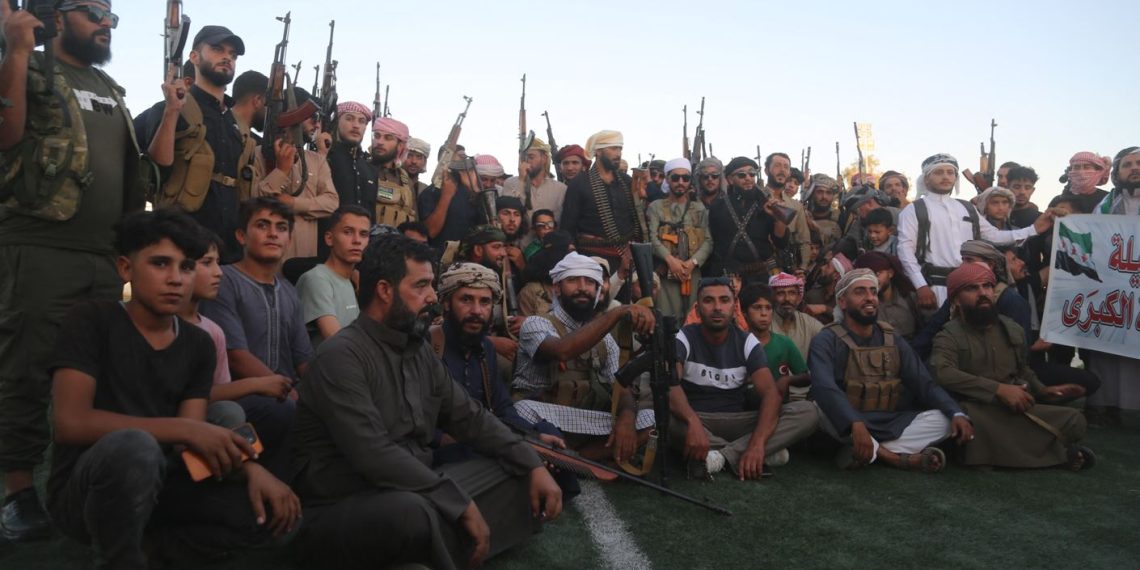
However, awakening from a dream or nightmare does not necessarily mean awakening in the literal sense. It seems we are living a compounded nightmare, moving from one horror to another, with no “reality” to wake up into. The new horror is the “state,” which combines two rights: the “right of sovereignty” over all territories—justifying forms of repression and terrorism amounting to genocide—and the declared “right of sectarian dominance,” where the state is defined as the right of a majority based on identity to impose sovereignty. How can the logic of a “state,” supposedly transcending its components, be reconciled with the logic of dominance by the largest group? There is no answer within political thought. We are discussing supporters of militias.
This is reflected even in the famous principle of the “monopoly of violence,” which here is understood as the monopoly of the majority over violence, not the monopoly of the state as a transcendent apparatus. According to this view, which is closer to hallucination, the state itself becomes the majority, opening the door to unprecedented forms of militia-ism that justify themselves as supporting the state and its sovereignty. “Worshiping the state” here is not an eternal message but a natural right for those “whose origin is gold,” as the Syrian song goes—adapted (or, in militia language, corrupted) from an Iraqi lament.
The nation remains organic but can no longer dispense with the dream of the state, as it might entail a return to “victimhood.” Consequently, the connection to the state becomes existential. It is difficult to find an ideological equivalent for this; the closest might be a broad, somewhat vague term like “primal fascism” (referring to ideologies and political movements predating fascism, which exhibit incomplete or inconsistent fascist elements).
All of this can be linked to significant developments within certain currents of political Islam, especially Salafi jihadism, which has become increasingly conciliatory in the fight against the West. In fact, some are even fully prepared to engage and form alliances with it, based on a jurisprudence of priorities that considers fighting internal enemies as the foundation for building a sound Islamic society. This has established longstanding precedents in political Islam, such as the experience of the Palestinian Muslim Brotherhood within occupied territories; the “Fighting Vanguard” organization in Syria; and the Afghan jihad, which prioritized fighting Soviet atheists over Western “People of the Book.”
We are facing a “nation” of “golden origin,” preoccupied with internal jihad, proud of its “pragmatism” in dealing with external actors, and whose “state” combines the right of the majority to dominate, confronting an existential threat linked to “oppression,” with the lingering shadow of an eternal message—postponed until it triumphs in its internal battles, establishes its legitimate society, and God’s decree brings about what is destined to happen. All of this is carried by militia forces that are incapable of constructing a coherent system at any level. Instead, they prefer flexible structures, unwritten understandings, informal balances, and the principle of “mobilization.” This is the “state” whose sovereignty must be accepted; without it, the nation cannot survive.
Is it possible to wake up from this nightmare? Could it lead us into another? The answers are difficult. Therefore, the stance of some parties—who reject this vision, or simply do not want to see it, and continue to live within their own “realism” in dealing with the situation—can be understood. In any case, everyone seems to want this vision to become reality, whether it is correct or mistaken.