


Turkish Studies Unit
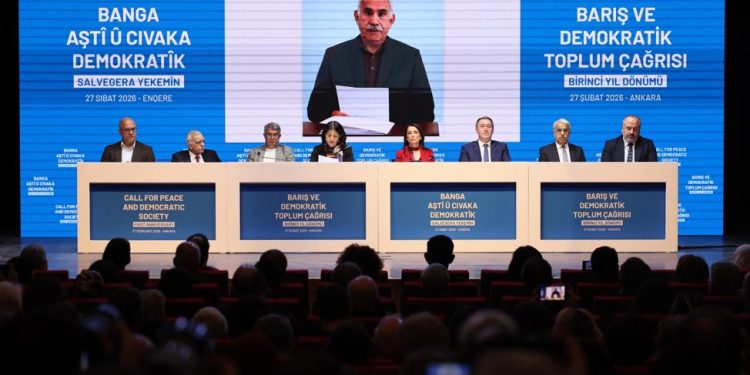
The leader of the Kurdistan Workers’ Party (PKK), Abdullah Öcalan, has issued a message on the first anniversary of the historic appeal he launched on February 27, 2025, titled “Peace and Democratic Society.” In the message, he examined several points, demanding that the Turkish state take concrete positive steps toward a political solution and greater democracy. This would ensure the recognition of the identity and rights of the Kurdish people and achieve tangible participation for Kurds in the country’s administration and policymaking. The message was read in Kurdish by politician Veysi Aktaş—who was alongside Öcalan in İmralı Island Prison during the reading of the “Peace and Democratic Society” appeal a year ago—at a meeting attended by leaders of the Peoples’ Equality and Democracy Party (DEM Party) on Friday, February 27, 2026, at the “Yılmaz Güney” hall in the Turkish capital, Ankara.
Öcalan’s message, which contained several points, served as an audit of a full year of dialogue and negotiation between the Kurdish movement and the Turkish state, as well as a review of the measures and reforms undertaken by the government regarding the recognition of Kurdish identity and rights. The message recalled the initial unilateral initiative launched by Öcalan a year ago in the “Peace and Democratic Society” appeal, in which he announced the end of the armed struggle phase and the dissolution of the PKK. The full response of the Kurdish side to this call proved the cohesion of the Kurdish movement’s political and military fronts and its commitment to the option of peace and a democratic solution, thereby transitioning from a stage of violence and confrontation to one of dialogue, political practice, and democratic integration.
Öcalan referred to the shared history between Kurds and Turks, stating that the early stages of the Republic’s founding respected this history and recognized the existence and role of the Kurds. He noted that the “Peace and Democratic Society” appeal is a return to that sincere founding moment and a revival of the spirit of unity and brotherhood. He emphasized that all initiatives and steps taken by the Kurdish side are solely to pave the way for a democratic solution and remove obstacles to building a democratic society that achieves justice and equality between the two founding components: Turks and Kurds. Öcalan also called on the Turkish state to respect the particularities of ethnic and religious groups, open the doors of politics and participation to them, and ensure a genuine democratic transformation through tangible, lived reforms and the absorption of all identity manifestations within the framework of peace laws, thus granting everyone the opportunity for integration and political participation.
Öcalan called for establishing citizenship based on the individual’s relationship with the state—viewed here as a system of institutions defining a set of duties and rights—rather than on the individual’s belonging to a “nation” defined by ethnicity or nationalism. Öcalan explained that the rights of the free citizen are secured through a citizenship that guarantees freedom of belief and the expression of identity and intellectual views, with all these fundamental rights protected by the state through its democratic laws. He asserted that the state should not impose a specific nationality on the citizen, just as it cannot impose a religion or language. A citizen who adheres to the law, the constitution, and the state’s unity has rights that must be protected in the free expression of identity, religious belief, ideas, and ideologies without fear of prosecution or accountability. Öcalan continued by stating that achieving a democratic society in Turkey and changing laws to protect citizens and guarantee their various freedoms creates the ground for coexistence for all oppressed groups throughout the Middle East. He noted that women are at the forefront of groups subjected to oppression due to the absence of protection laws, and therefore, he considers women the force most inclined toward liberation and bringing about democratic transformation and integration. He stressed that achieving a democratic society requires the state to grant everyone the right to free expression of opinion and thought and the manifestation of identity and particularity, and that the state must approach everyone with a high spirit of understanding, respect, and inclusion (1).
The “National Solidarity, Brotherhood, and Democracy” commission—which was established on August 5, 2025, and included 51 parliamentarians from blocs represented in the Turkish Parliament—had held a total of 137 meetings and consultations with figures, activists, and institutions to delve into the required reforms and legal and constitutional changes planned to recognize Kurdish identity and rights. The committee, which met with Öcalan on November 24, 2024, issued its extensive 60-page report on the Kurdish issue and the possibility of a democratic solution—or what it termed “The Historical Roots of Turkish-Kurdish Brotherhood”—on February 18, 2026. The report was passed by a majority of 47 deputies, with two objections and one abstention. In its main outlines, the report included a set of reforms the state would undertake to resolve the Kurdish issue and open the way for “peace and a democratic solution.” These steps are:
- Disarmament and Legal Guarantees: The report calls for the issuance of a special, temporary law for the post-disarmament phase of the PKK, ensuring the return of militants to society and providing legal immunity for individuals participating in the dialogue process.
- Judicial Reforms: Emphasis was placed on implementing the decisions of the European Court of Human Rights and the Constitutional Court. It also proposed a review of the penal code, particularly regarding the release of sick and elderly prisoners and distinguishing between political criticism and the crime of terrorism.
- Local Administrations: The report suggests changes to the municipality system so that if a mayor is dismissed, the municipal council has the right to elect a replacement instead of appointing a trustee (Kayyum).
- The Brotherhood Law: The report depicts the history of Turks and Kurds as a “shared destiny” and calls for moving beyond the language of violence and building a new civil constitution (2).
Öcalan commented on the report’s content in a private letter written on February 19, 2026—one day after the report was published—which was released by Fırat News Agency on March 2, 2026. He noted that the Parliament’s formation of the “National Solidarity, Brotherhood, and Democracy” committee to address the Kurdish issue is a historic step and precedent. He explained that moving the Kurdish issue from the “execution platform” to the “parliamentary hall” is in itself a historic achievement that should not be undervalued, despite having several observations on the report. Öcalan stated that the committee’s report, which addressed the Kurdish issue and spoke openly for the first time about “the brotherhood of Turks and Kurds,” is a good start to a long and arduous stage of democratic struggle. He added that it gives everyone certainty that dialogue, not weapons, is the most successful method for achieving rapprochement and passing a solution and settlement, and that the report closed the door on the posturing that some forces have long engaged in to abort any political solution to the Kurdish issue (3).
For its part, the DEM Party bloc stated that although the report did not meet all Kurdish demands regarding explicit constitutional changes, what it contained could open the way for further democracy and constitute important steps to build upon. The party believed there are urgent measures the government must take, such as ensuring Öcalan’s freedom, announcing laws that guarantee the integration of fighters into political life, and releasing Kurdish political prisoners (foremost among them Selahattin Demirtaş and Figen Yüksekdağ, the co-chairs of the HDP detained since 2016). It also called for regarding the decisions of the European Court of Human Rights as the reference in dealing with them, stopping the seizure of municipalities in Kurdish provinces, ceasing the appointment of “trustees” in place of elected mayors, and working to enact a new civil constitution that guarantees Kurdish rights, consolidates the “shared destiny between Kurds and Turks,” and moves beyond the “language of violence.”
An observer of the report will notice Öcalan’s fingerprints; the terminology and phrases he repeated in his messages, especially in the “Peace and Democratic Society” appeal, are present in the report. The report can be considered a qualitative and historic step taken by the Turkish Parliament for the first time to deal with the Kurdish issue by name. In this report, prepared by parliamentarians who met with Öcalan and with political, social, and human rights figures from across the country—both Kurds and Turks and other components—there is a direct reference to the Kurds. They are placed alongside the Turks in a context that identifies two primary and fundamental components that formed and founded the Republic together, and asserts that the relationship between them must be corrected and placed in a new framework after removing all previous approaches of denial, neglect, and the use of force and violence. From the beginning, the DEM Party bloc rejected the efforts of some Turkish parties and figures to name the committee “Turkey Without Terrorism” and insisted that the committee embody the true spirit of the process called for by Devlet Bahçeli, leader of the Nationalist Movement Party (MHP), which came amid regional developments and circumstances that clearly narrowed Turkey’s options (Bahçeli’s call in the Turkish Parliament on October 22, 2024). That was the call to which Öcalan responded, laying out the “roadmap” for it after arranging and engineering it into an initiative titled “Peace and Democratic Society” launched on February 27, 2025. Consequently, the name of the parliamentary committee, “National Solidarity, Brotherhood, and Democracy,” was in total harmony with the name of the initiative/phase launched by Öcalan (4).
Öcalan sees the final report issued by the “National Solidarity, Brotherhood, and Democracy” committee as a real opportunity for peace and a democratic solution and for silencing the voices calling for war and military resolution. He believes it opens a new page through the Parliament and state institutions, provided that the Kurds redouble their democratic political struggle in cooperation with all national forces and activities in the country. Öcalan had previously pointed to the potential of the DEM Party to mobilize broad sectors of citizens behind it and transform into a national democratic front—pro-labor and a defender of the rights of women, components, and cultural diversity—thereby easily obtaining a percentage that could reach 20% of the total votes across Turkey. As a first practical step after the publication of the committee’s report, parliamentarians Pervin Buldan and Mithat Sancar (the İmralı delegation) met on March 3, 2026, with Justice Minister Akın Gürlek and Interior Minister Mustafa Çiftçi. They discussed the measures intended to be taken in light of the recent report and conveyed the views of Öcalan, whom the delegation had met on February 16, 2026, to the two ministers. The two ministries are expected to implement a package of decisions within the reforms agreed upon between Öcalan and the DEM Party on one side and the parliamentary committee on the other, including the release of political detainees and the reinstatement of elected mayors in Kurdistan to their duties. There are also other reforms related to the “Right to Hope,” which would ensure Öcalan’s freedom to meet with politicians, journalists, and social figures, and guarantee his communication with the outside world and contact with various Kurdish structures and institutions inside and outside Turkey (5).
The PKK believed in the “Peace and Democratic Society” phase launched by Öcalan and understood the spirit of this phase and the shifts in the region and the world, which impose new approaches on the Kurds. The party realized that politics, following the “Peace and Democratic Society” variable, would grant the Kurds gains manifold greater than what armed action achieves. Consequently, the party held its twelfth congress between May 5 and 7, 2025, deciding to dissolve itself and end the armed struggle phase. In its final statement, the PKK explained how “the previous stage pushed the Kurds in Turkey to adopt the option of taking up arms to face the state’s policy of denial and national assimilation, and to confront the authority’s constant bet on repression and the security-military approach.” The statement also noted the “international circumstances at that time” and spoke of “socialism and national liberation movements that took up arms in response to the tyranny and oppression of totalitarian military regimes.” On July 11, 2025, a group of 30 female and male fighters from the party’s military wing held a symbolic ceremony in which they burned individual weapons, implementing instructions from Öcalan and demonstrating their commitment to the peace process and democratic solution. On October 26, 2025, at a press conference in the mountains of Kurdistan, leader Sabri Ok announced the withdrawal of the party’s first military units from within Turkey as a new gesture of goodwill. Meanwhile, the “İmralı delegation,” comprising DEM Party deputies, met a few days later, specifically on October 30, 2025, with Turkish President Recep Tayyip Erdoğan (marking the third meeting with Erdoğan after two previous ones on April 10 and July 7, 2025), and a fourth meeting recently took place on February 11, 2026, to discuss developments in the peace process and democratic solution.
Through the “Peace and Democratic Society” process that began a year ago, Öcalan seeks to end the chronic official Turkish approach to the Kurdish issue as a “security issue” and the view of Ankara that the movement demanding rights and recognition of identity and language is a “rebellion against the state.” Öcalan wants to establish a new phase based on a narrative he presented more than thirty years ago: the narrative of the “thousand-year historic brotherhood of Kurds and Turks,” and the necessity of re-forming/re-founding the Republic on the basis of the existence of two main components, Kurds and Turks. This would mean getting rid of the mentality of “one people, one flag, one language state” and transitioning to a “Democratic Nation” state that recognizes all identities within a national framework, rather than granting sovereignty and representation to a dominant nationality that acts with clear racism, deals with the demands of other components with iron and fire, and implements “war/colonial” policies of national assimilation, erasure, and replacement. Öcalan wants a new state—the state of “Peace and Democratic Society”—based on diversity, pluralism, and recognition of all particularities, identities, and societal manifestations. He wants a healthy political life with elections, parties, and programs, where representatives are chosen based on the economic prosperity, rights, and decent life they offer the masses. He wants to build solid alliances between political forces and parties to form a democratic front (including independent politicians, jurists, intellectuals, trade unions, women’s unions, civil society organizations, and social and religious activities of all components) capable of translating the demands and aspirations of the masses. This would allow for discarding the remnants of worn-out nationalist thought, the corrupt oligarchy profiting from racist nationalist incitement, and the entire “war economy” that has come to yield massive sums for “power centers” still influential in deep state apparatuses—army, intelligence, media, and judiciary. The society and economy of war, which positioned and rooted itself to fight the Kurdish movement since 1986, fed military resolution campaigns that cost the state more than 2 trillion dollars, by the admission of Turkish Parliament Speaker Numan Kurtulmuş.
Democratic transformation, according to Öcalan, means the state lifting restrictions on Kurdish organizational work and political activism in the Kurdistan provinces and throughout Turkey. It means the state and its apparatuses stop pursuing Kurdish politicians and stop terrorizing and intimidating Kurdish communities to prevent them from electing the “Kurdish party/representative of Kurdish identity,” and resorting to labeling them with the charge of “loyalty to terrorism.” Öcalan wants to implement the Kurdish democratic will in the Kurdistan provinces within a local societal and political alliance with Arab, Turkmen, and Syriac components, so that the DEM Party succeeds in winning hearts and representing everyone, while creating a national democratic front across Turkey in which various forces and parties participate, becoming a figure that cannot be bypassed in planning the state’s future and ensuring the interest and safety of all its citizens. In other words: Öcalan does not want the salvation and democratization of only the Kurds and Kurdistan, but the salvation and democratization of all of Turkey. In short, he does not want just Kurdistan; he wants all of Turkey! Lifting the “terrorism” designation from the Kurdish political movement in Turkey, stopping the pursuit of Kurdish politicians and activists, and ceasing the intimidation, threatening, and “bullying” of Kurdish citizens in the name of “law,” “state,” and “homeland,” will give the Kurds their true weight and natural size in the political equation of the country. It will make them the decisive factor in change and in pushing toward a state of citizenship, democracy, and law. It is worth noting here the negotiation phase between the Turkish state and the Kurdish movement between 2013 and 2015, during which campaigns of repression, pursuit, and restriction against the Kurds and their political movement receded. This resulted in a state of relief and an atmosphere of calm and safety, contributing to people expressing their political will without fear and standing behind the Peoples’ Democratic Party (HDP—the representative of the Kurds, engaged in dialogue with the state) in the elections held in June 2015. The party won 50 seats in 14 Kurdish provinces, while the ruling Justice and Development Party (AKP) won only 9 seats. At that time, media outlets reported the “shock” of local official authorities at what was done by the residents of a town in Siirt province (whose men were involved in “village guard” groups formed by the state to fight PKK forces in exchange for salaries and generous privileges), who gave all their votes to the HDP candidate, who won a landslide victory over the “state party” in the town.
Öcalan’s project for “Peace and Democratic Society” faces rejection from war oligarchies—those who trade in Turkish nationalism and imagined imperial slogans (Neo-Ottomanism, the National Pact, the Blue Homeland, the state of the Turks extending from the Adriatic Sea to the Great Wall of China, etc.)—and from advocates of a mono-totalitarian state based only on the Turkish element. These groups consider the peace project a danger. Öcalan knows them well, and they know him too. Currently, while these forces are retreating within Turkey before the peace narrative that aligns with reality and is proven correct by the variables and threats facing Turkey, they are attempting to sabotage the phase through hostility toward Kurds in Syria, Iraq, and Iran. The war oligarchies and “power centers” benefiting from emergency laws want to involve the country in wars outside its borders (Iraq and Syria, and later Iran) to dismantle the “Peace and Democratic Society” project internally. Their goal is to take the Kurdish issue out of the political sphere (“parliamentary hall”) and return it to the fields of war and armed confrontation (“execution platform”)—something Öcalan and other rational actors in Turkey are working with all their might to prevent.
Sources
- Abdullah Öcalan: Peace and Freedom Laws are Necessary for a Solution. Welat News Agency, February 27, 2026.
- The Turkish Parliament’s Roadmap for Peace: PKK Disarmament and the “Turkish Model” for Resolution. Rudaw Media Network, February 24, 2026.
- Öcalan: The Report is Not the Conclusion, But the Opening of a Door. Firat News Agency (ANF), March 2, 2026.
- Tariq Hemo: Öcalan, Democratic Society, and the End of “Monist Turkey.” Kurdish Center for Studies, November 12, 2025.
- Turkey: İmralı Delegation Meets with the Turkish Minister of Justice within the Framework of the Peace Process. RojNews, March 4, 2026.