


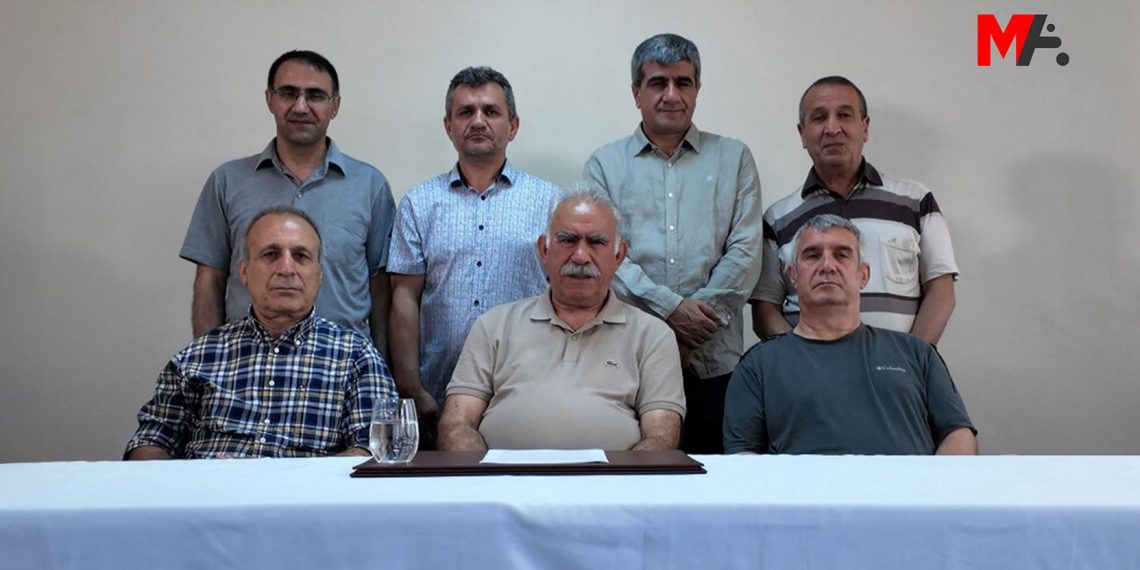
The televised message delivered by Kurdish leader Abdullah Öcalan on July 9th, which contained several points directed at both the Turkish state and the Kurdish movement, complemented Öcalan’s call for “peace and a democratic society,” issued on February 27th. This call marked the most significant shift in the Kurdish issue, which has been ongoing in Turkey for a century. It included a call to end the armed struggle and to launch a new phase of struggle based on repositioning and reshaping the Kurdish movement. It also urged the state to open political channels and recognize Kurdish identity, making Parliament the sole venue for resolving the long-standing issues and problems that have accumulated over decades.
Öcalan’s interpretation presented in this televised message (his first public appearance, both in voice and image, since his abduction in 1999) represents the culmination of his reflections on the Kurdish movement, the reality of the Kurdish people in Turkey and abroad, and the changes occurring within Turkey and across the region. Öcalan offered a comprehensive vision of the entire situation, partly providing a critical review of the Kurdish movement’s progress, partly examining the mechanism for integrating the Kurdish issue into the legislative agenda of the Turkish Republic, and finally, discussing how to rectify and “correct” the historical relationship between Turks and Kurds—the two foundational elements of the current state called Turkey.
In general, the main points included in Öcalan’s televised message can be summarized as follows:
First: The “Peace and Democratic Solution” initiative is part of the Kurdish liberation revolution, which Öcalan has been leading himself for fifty years. He sees it as a revolutionary and moral duty to shift its course toward a new path—one that aligns with the latest developments in the region and the world—while preserving social peace among Kurds, Turks, and the other peoples and components of the region. This approach aims to ensure coexistence among them and to build a solid bridge of love and brotherhood.
Second: The negotiations conducted by the Turkish state with Öcalan and the Kurdish movement within the framework of the peace process—originally initiated at the request of the Turkish state (Devlet Bahçeli’s invitation on October 22, 2024)—are an acknowledgment of the Kurdish issue and recognition that Öcalan—and by extension, the PKK and the DEM party—represents the Kurds. This historic democratic solution process must be based on mutual trust and good faith.
Third: The PKK, which emerged to oppose the policies of denial and erasure pursued by all Turkish governments against the Kurdish people, has achieved its historical and objective purpose. It has dispelled the official Turkish narrative of “burying Kurdistan” and the erasure and suppression of Kurdish identity and language. The PKK confronted war and repression through armed struggle until Turkey finally acknowledged the reality of the Kurdish presence and realized the futility of war and military solutions. It then turned to dialogue and politics, with Öcalan and the PKK being the primary actors concerned with the Kurdish issue in Turkey.
Fourth: All steps following the historic event of the PKK’s dissolution and its declaration of abandoning armed struggle—including mechanisms for disarmament and steps toward integration into society and political life—must be translated into legal and constitutional reforms, undertaken by a committee formed by Parliament from all political blocs. Every practical step by the PKK must be matched by a corresponding action by the state, passed and legalized through the relevant parliamentary committee. There is a need for maximum restraint, avoiding provocations, and demonstrating a sense of historic responsibility.
Fifth: Laying down arms and initiating the “Peace and Democratic Society” phase does not mean the defeat of the Kurds and their liberation movement. Rather, it marks the achievement of the first stage of the long struggle: the armed resistance that lasted for 41 years. During this phase, the PKK—as a national liberation movement born in its specific time and place—responded with arms to policies of erasure and liquidation. It succeeded in protecting the Kurds from extermination and displacement and established them as a foundational component whose existence the state has accepted and whose political will it recognizes. This transition signifies moving into the second phase of the struggle: a democratic resistance aimed at transforming Turkey into a pluralistic state that embraces all its citizens, thereby shedding the legacy of exclusion and dominance based on Turkish ethnicity.
Sixth: The Equality and Democracy Party, the third-largest bloc in the Turkish parliament, is the engine of change and plays a prominent role within the parliamentary committee to be formed for implementing the legal reforms accompanying the PKK’s practical steps. Öcalan has high hopes for the democratization of Turkey through this party. He envisions it surpassing 20 percent of the vote by expanding its organizational work to reach all segments and classes of society across Turkey. Öcalan spoke of the millions of working citizens that the party must reach and include in its platform, so that it becomes an inclusive party capable of representing and defending their aspirations. He emphasizes that it should not remain in opposition but should become a governing party that manages the country.
Seventh: Öcalan does not prioritize his personal freedom in this context. He considers his freedom part of society’s freedom, and through the liberation and democratic development of society, he will also be liberated. Therefore, he does not make his release from prison a prerequisite for advancing the peace process. He believes that societal liberation will open the doors of Imrali Prison.
Eighth: Öcalan closely follows the resonance of the current peace process and the call for “peace and a democratic society” in Turkey, the region, and the world. He considers the praise, encouragement, and support from local and international actors as a victory for the forces of democratic modernity that he represents and leads. Öcalan advocates a comprehensive program for change across Turkey and the region. When he states in his message, “We possess a theoretical program that includes strategic and tactical aspects,” he means that he personally supervises the application of this theoretical program of the forces of democratic modernity with all his strength and resolve.
Öcalan’s project for “peace and a democratic society” represents an authentic movement that originates from within peoples and communities. Its aim is to democratize national societies and develop democratic mechanisms through legislative institutions, public opinion forces, and community actors to address issues of identity and their manifestations. It is a project that is as much local as it is international, seeking solutions from within and rejecting prevailing approaches and the traditional reliance on external forces and the outcomes of “change” driven by their interventions within the frameworks of “redrawing maps” here and there.
It is also a project that re-evaluates and reorganizes the historical relationship between the Kurdish and Turkish components within the consciousness, body, and legacy of the Ottoman Empire’s heir: the state called Turkey. Öcalan is correcting history and working toward democratizing geography. He is laying the foundations for a new mentality that accepts that the institution emerging from the democratic process should be the one regulating the relationship between citizens and the state and guaranteeing their rights—rather than the oligarchic alliances that manage power, set priorities, manipulate minds, and create fears of imaginary enemies.
These enemies are fought at the expense of millions of people, under the pretext of protecting the “unity of the nation and homeland.” In reality, however, they are protecting their own interests and entourage, while covering up the coffers of wealth accumulated at the expense of people’s blood and tears.