


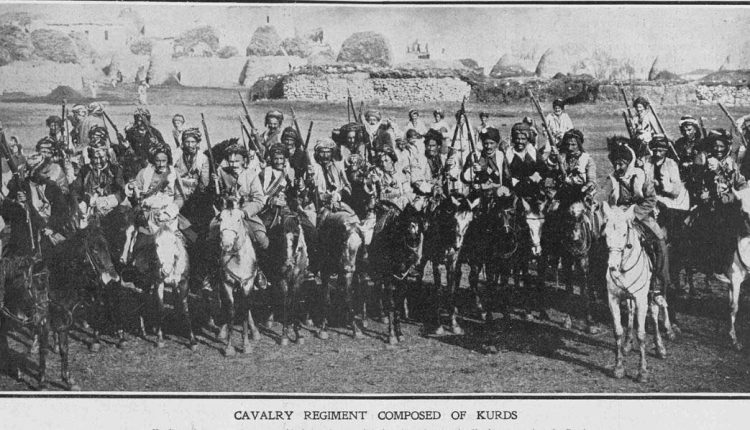
If we were to attempt to write the first chapter of Kurdish-Turkish relations, it would begin with the Battle of Manzikert (known as Malazgirt in Arabic history) in 1071 AD. The final chapter concludes with the 1925 revolution led by Sheikh Said Piran, an event stemming from the outcomes of the 1923 Treaty of Lausanne.
Between these two events, relations experienced ups and downs, periods of prosperity and devastation, but they remained rooted in the solid foundations of shared struggle. When transgressions and clashes occurred, the defeat of one side did not imply the extermination of its population or the destruction of its social fabric.
This principle remained valid even during circumstances that, theoretically, appeared as if relations were in a deadly crisis, such as during Sheikh Ubaidullah al-Nahri’s revolt in 1880, or earlier, during Badrkhan Bey’s rebellion in Botan in 1848. Settlements often followed defeats, leading to a new phase of equal relations.
Starting from July 24, 1923, the effects of Malazgirt and the subsequent moments of crucial alliance between the two sides came to an end, especially during the first half of the Ottoman era. The Treaty of Lausanne represented a complete erasure of Kurdish identity and society, and the end of the shared historical legacy of the region’s peoples since the demographic and political upheaval caused by the rise of the Turks in the Middle East.
The arrival of the Turks in the capital of Kurdistan in 1042 AD was an ordeal unseen by the peoples of Kurdistan and Armenia since the early Islamic wars during the caliphate of Omar ibn al-Khattab. The Seljuk Turkish expansion was socially driven, with thousands of families accompanying soldiers to their new settlements, forming the nucleus of a new people.
The Kurdish-led Marwanid Emirate (982–1086 AD) was the most powerful governing entity in the regions of Kurdistan, as well as parts of Armenia and Azerbaijan. No Turk had ever reached that land before. Within a few years, the capital of the emirate, Mayyafariqin, faced its first Seljuk invasion attempt in 1042 AD, with ten thousand horsemen. Ibn al-Azraq, the historian of the Marwanid state and a contemporary of several of its emirs, commented on this attempt by saying, “This was the first appearance of the Turks in these lands, and people had not seen their images before that” (History of Mayyafariqin, p. 161).
As the moment of the Battle of Manzikert approached in 1071 AD, the Seljuk Sultan Alp Arslan had visited Amed (Diyarbakır) before heading to the battle and had met with the emir of the Marwanid state to reach an agreement. Ibn al-Azraq did not mention the terms of this agreement in his “History of Mayyafariqin,” as he wrote after the fall of the Marwanid state and with the Seljuks having become the masters of Kurdistan.
Settlement with the Seljuks: “Survival in Exchange for Sovereignty”
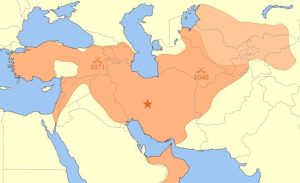
The Seljuk State at the Height of its Expansion in 1092 AD
Kurdish cooperation with the Seljuks can be viewed as a forced collaboration between both parties, especially the Kurdish side, rather than as subordination to a new leadership. The nature of the two ruling factions—the Kurds and the Turks—shaped their identities early on during the Marwanid-Seljuk encounter. The ruling Kurdish faction did not attempt to expand beyond the geographic boundaries of Kurdistan and Armenia. This is one of the paradoxes that most historians studying this period have not addressed or have deliberately overlooked, due to reasons related to the monolithic nationalist narrative of history that spread in the early twentieth century. Unlike all the Islamic frontier emirates, the Marwanid state was not a jihadist entity. It functioned primarily as a buffer role, easing conflict between Islam and Christianity by fostering positive relations with the Byzantine Empire in favor of the Abbasid Caliphate in Baghdad.
It is noteworthy that around the year 1000 AD, Armenian historian Asogik, relying on Armenian and Islamic sources, summarized a paradox that may be shocking to the common narrative: “The Muslim population was the enemy of the Marwanid prince. Accordingly, the Kurdish prince succeeded in crushing the opposition Muslim groups, exiling them, and primarily maintaining Armenians and Syriacs within it.” (Arshak Poladian – The Kurds in the Era of the Abbasid Caliphate).
This conclusion stems from the hostility that intensified between the Arab Hamdanid rulers of Mosul and Aleppo and the Marwanids, at intermittent but bloody intervals, including what Nasr al-Dawla ibn Marwan did when he massacred the populations loyal to the Hamdanids in Mayyafariqin (see: History of Mayyafariqin). Arshak Poladian collected testimonies from Armenian historians and Muslim scholars such as Ibn al-Athir to support his conclusion that the Kurdish Marwanid emirate was linked to the Byzantine Empire, especially during the reign of the most prominent emir, Nasr al-Dawla ibn Marwan, who ruled for 50 years. Prior to that, Byzantine Emperor Basil II had signed an agreement with the founder of the Marwanid state, granting him a rare title never before given to an Islamic ruler by a Christian emperor: “Maxitros” and “Duke of the East” in 1000 AD. (Arshak Poladian – The Kurds in the Era of the Abbasid Caliphate, p. 201).
Thus, the Kurds who appeared as Muslims on the historical stage in the early 11th century AD were not driven by the ideology of “conquest” and expansion, unlike the Seljuks, who sought new lands to rule and settle. The Seljuk state was expansionist in nature, making the idea of jihad against Christian entities fitting for their aims.
Following their role in tipping the balance in favor of the Seljuks against Byzantium, the Kurds lost their most vital function for the continuity of their kingdom: their responsibility to protect one of the most dangerous border zones between Muslims and Byzantines.
Few have viewed this from another perspective. According to an analytical interpretation by Abdullah Öcalan, leader of the Kurdistan Workers’ Party (PKK), the Kurdish-Turkish meeting at Manzikert was a compromise to open a corridor for Turkish tribes to move into Anatolia via Erzurum and northern Diyarbakır, in exchange for the tribes not settling in Kurdish lands and their Armenian surroundings. (See: Öcalan – The Kurdish Issue and the Solution of the Democratic Nation, p. 107).
The Kurds tried to adapt to Turkish expansion into their lands, and together they fought the epic Battle of Manzikert. In reality, this was a strategic move. The Marwanids believed it would save them from the Turkish social upheaval that shook the entire Abbasid East—from Khwarazm to Gaza. The Byzantine defeat at Manzikert opened a pathway for Turkish tribes into Anatolia rather than their settling in Kurdistan. Despite the Marwanids’ sacrifice—”sacrificing sovereignty for survival”—the elimination of Turkish settlement in Kurdistan and Armenia was only achieved a century later, when Salah Aldin Al-ayubi waged relentless campaigns against the Seljuks throughout Kurdish territories. Although Turkish dynasties such as the Artuqids remained in power in Kurdish cities like Mardin, they ultimately submitted to Ayyubid leadership and lacked social depth, in other words: lineages without a social base.
However, the Malazgirt alliance did not establish a long-term coexistence between the two ruling classes—the Kurds and the Turks. Until 1086 AD, the fall of the Marwanid state, the Kurds relied on paying tribute to protect their unique autonomy from the turbulent surroundings. This lasted until the final blow dealt by the Seljuks, as two expanding and jihadist forces clashed with an inward-looking and isolated one.
Ibn al-Azraq, in his History of Mayyafariqin, relays significant remarks not found elsewhere. The famous Persian vizier of the Seljuk Sultan, Nizam al-Mulk, addressed his master Malik Shah, referring to the lands of the Marwanids: “That land is deserted, and it contains wealth beyond measure.” In 1086, Malik Shah seized all the Kurdish kingdoms. He also sent a message to the Kurdish emir, Nasser al-Dawla, asking what he would demand in exchange for relinquishing sovereignty over his land. Nasser al-Dawla famously replied: “A spear falls into my chest, then emerges from my back.” (History of Mayyafariqin, p. 213).
Scholar Muhammad Amin Zaki summarizes in his A Summary of the History of the Kurds and Kurdistan that after the Battle of Manzikert, “all of Armenia and Kurdistan gradually came under the rule of Alp Arslan the Seljuk. Thus, all existing Kurdish emirates and states ceased to exist and became subject to the authority of the Seljuks.” (p. 213)
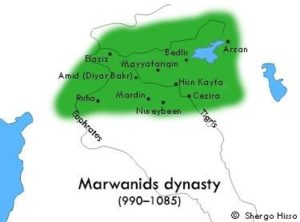
The Marwanid State at the Height of Its Expansion
The connection between Kurdish participation in the battle and the opening of a corridor for the Seljuks to expand westward is indirectly supported by Turkish writings, including Yilmaz Öztuna, author of the Encyclopedia of the Ottoman Empire. He states that after the battle, Sultan Suleiman Shah captured Antioch from the Byzantines in 1084, and “hundreds of thousands of Turks came from the east and settled in Anatolia, beginning with the cities” (The Ottoman Empire – Part One – p. 68).
With this pattern of Seljuk domination over the Marwanids, the Kurdish population remained largely in place, as it is approximately today, while Turkish tribes migrated hundreds of kilometers westward—though not without a cost. Despite this strategic compromise, the Marwanid state was unable to escape the hordes of Turkish tribes and the transfer of wealth from Kurdish princes to the Seljuk sultan. A Kurdish-Arab uprising against Seljuk rule failed following the assassination of Nizam al-Mulk and the death of Malik Shah. Widespread rape and enslavement of women are documented by Ibn al-Qalanisi in his History of Damascus, concerning events in 485 and 486 AH (1092 and 1093 AD).
Since population flows from the east to the west continued unabated, a demographic shift occurred in the region under the influence of Turkish invasions. A portion of the Kurds migrated to the Levant from Kurdistan and Azerbaijan. The Seljuk invasion crushed Arab presence in the northern Jazira region and Mosul, and the Arab Uqaylid state ended simultaneously with the collapse of the Kurdish Marwanids. The joint Kurdish-Arab resistance failed to repel the Turkish military advance due to the ongoing influx of people resulting from a population explosion and the collapse of livelihoods in East and Central Asia—though this hypothesis has not been thoroughly studied historically.
Despite heavy losses suffered by both Kurds and Arabs, this pivotal era passed with this settlement—namely, the opening of the way for Turks to advance westward, rather than settling Kurdish and Arab lands. This did not happen immediately and was not without casualties. Thanks to the policies of the Marwanids and their Kurdish followers, a decisive battle with the incoming Turks (the Seljuks) was avoided. The Kurds had territory to lose if defeated, while the Turks could simply change the reins on their horses and end the matter. Therefore, any decisive battle would have meant the annihilation of one of the sides—similar to what happened with the last Arab-led state in the Abbasid era, the Banu Uqayl emirate in Mosul and al-Jazira, which was shattered militarily and socially in a decisive war with the Seljuks.
The Ayyubid Era: Kurdish-Turkish Wars
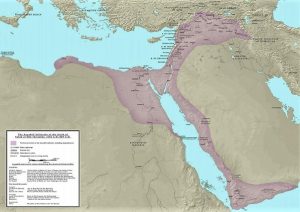
The Ayyubid State in 1193 AD / Source
Turkish-Kurdish relations during the Ayyubid period took on a dangerously confrontational character, characterized by widespread social clashes in which armies intervened to settle disputes.
When Salah Aldin Al-Ayubi assumed power in Egypt in 1174 AD, the Kurdish lands were under the control of Turkmen tribes. As the Ayyubids expanded into the Levant and the Jazira, a fierce war broke out with the remnants of the Turkish ruling dynasties. This war lasted two years, inflicting heavy losses on both sides, and was temporarily halted in order to unite against the Crusaders. However, the Turkish-Kurdish conflicts resumed again, “until they resulted in the expulsion of the Kurds from some parts of Syria, Cilicia, and Adana” (Muhammad Amin Zaki – History of the Kurds and Kurdistan, p. 222).
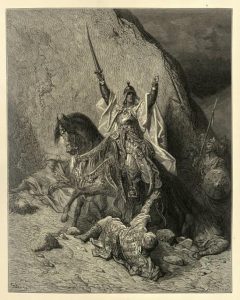
A painting depicting Salah Al-din Al-Ayyubi victorious, by Gustave Doré.
The first recorded mention of the Turkish-Kurdish wars during the Ayyubid era appears in the tenth volume of Ibn al-Athir’s (Al-Kamil fi al-Tarikh), in the events of the year 581 AH (1185 AD), under the title “Mention of the strife between the Turkmen and Kurds in the lands of al-Jazira and Mosul” (p. 11). It details the origins of the social conflict when a group of Kurds attacked a Turkmen wedding, leading to widespread fighting across Kurdish territories:
“In that period, the conflict began between the Turkmen and Kurds in Mosul, al-Jazira, Shahrizor, Azerbaijan, and the Levant. Many people were killed, and the fighting lasted for several years. Roads were blocked, blood was shed, and wealth was looted.”
A year later, Shams al-Din al-Dhahabi, in his encyclopedia History of Islam, reports:
“During this time, discord was widespread in Diyarbakır and the Jazira between the Kurds and Turkmen” (Part 41, p. 14).
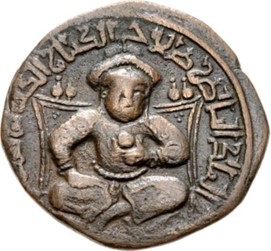
Inscription on an Islamic Ayyubid, coin bearing the image of Salah al-din/ Source
These bloody events within the heart of the historical Kurdish homeland indicate that Turkish tribes had settled in every corner of Kurdish lands. Ibn al-Athir, who was undoubtedly biased in favor of the Zengid dynasty against the Ayyubids, offers only this justification for the Kurdish-Turkmen war of 1185 AD. However, in the same year, Saladin had agreed to a peace treaty with Izz al-Din, who was a vassal of the Zengid dynasty. Notably, the treaty stipulated that Mosul would remain under the control of Izz al-Din, but Salah al-din would take over the entire region beyond Mosul, which was entirely Kurdish—namely Shahrazur, the province of Qarabulli (the Kirkuk region), and beyond the Zab River. He would also deliver sermons for him from his pulpits and have his name inscribed on the coins.
The Mamluks: The Elimination of the Kurdish Aristocracy
In Volume 47 of History of Islam by Al-Dhahabi, there are successive accounts of the Mamluks seizing power from the Ayyubids and the massacres they carried out against Kurdish princes in Egypt and the Levant. This was a comprehensive purge of the ruling Kurdish aristocracy. However, the tribal leadership remained intact and continued to contribute to the Mamluk military efforts in exchange for a new balance of local sovereignty. This was particularly notable because Kurdish society had been exhausted by prolonged depletion resulting from the Ayyubid wars far from Kurdish lands. By the end of the Ayyubid era, Kurdish cities had come to a settlement whose influence persists to this day. This region escaped Turkish settlement, but it was never entirely free from Turkish influence or control.
Unlike all other Kurdish states and emirates, the Ayyubid dynasty was an exception in leaving Kurdish borders. This was the first such event recorded in Kurdish history since the Mitanni-Hurrian state around 1500 BC. However, it was a problematic expansion—an expansion that was reversed, beginning in Egypt and Damascus and then extending toward Kurdish lands.
The Mamluk state was preoccupied with ongoing raids on Turkmen emirates in Anatolia and north of Aleppo. During this period, relative stability prevailed for the Kurds, who maintained a significant share of the Mamluk military forces (see Muhammad Abdullah Salem Al-Amayreh’s book, The Kurds in the Mamluk Military System).
Kurdish sovereignty was established over large areas settled by Turkmen in Aleppo and its northern outskirts. Kurdish tribal and military independence remained resilient until the rise of the Ottomans, who became a key part of the Ottoman eastward and southward expansion and played a decisive role in establishing Ottoman dominance over the rival Turkmen emirates.
The Ottoman Era: The Empire and Tribal Alliance
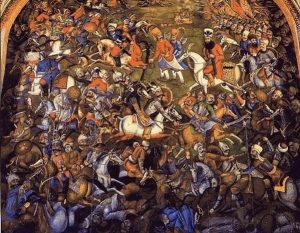 A painting depicting the Battle of Chaldiran is displayed at the Golestan Museum in Isfahan.
From the Seljuk Invasion of the Middle East to the Rise of the Ottoman Empire, the lands stretching from Khorasan to Anatolia were embroiled in a prolonged and exhausting civil war, primarily fought between Turkish tribes that transferred their Asian conflicts to the newly settled regions of the Levant, Iraq, Kurdistan, and Anatolia. The cycle of internal Turkish conflicts persisted throughout the region, resulting in a division of the dominant powers at the time. During this imperial period, these powers consisted of three kingdoms: two of Turkish origin—the Safavids and the Ottomans—and a third, a mixed Turkic and Caucasian entity represented by the Mamluks in Egypt, the Levant, and the Hejaz.
The Safavid identity was distinctive: it had a Kurdish-originated leader, an army mainly composed of the Qizilbash Turkmen, and a predominantly Persian population.
During the Safavid era, the Turkification of Azerbaijan, an ancient capital of the Caucasian and Iranian peoples, was completed. It became a major settlement for the Kara Koyunlu (Black Sheep) tribe, which formed the backbone of the Safavid military forces. On the other hand, Sultan Selim I of the Ottoman Empire mobilized forces from the Turkish tribes in the name of Sunni Islam to the east. However, his forces were not sufficient to achieve a decisive victory or a turning point in the region’s history. Such a victory would not have been complete without securing Kurdish support.
The Kurds saw in Selim I a Turkish supporter against the ruling Turkish tribes of Kurdistan—the Ak Koyunlu (White Sheep, Sunnis) and the Kara Koyunlu (Shiites)—who were seizing control over all of Kurdistan. The emir of the Ak Koyunlu, Hasan al-Tawil, harbored imperial ambitions. At certain points in history, access to Central Asia via the Black Sea route was considered safer for European traders. This was unfortunate for some trading stations in the eastern Mediterranean. The region extending across Armenia, Kurdistan, and northern Levant became deserted and impoverished. Similarly, Anatolia was transformed, during brief but extremely harsh periods, into “armies without communities.” This significantly delayed the settlement of newly arriving peoples, such as Turkish tribes, in urban areas. For a long time, these peoples remained entirely militarized. This nomadic tendency or lack of urban settlement persisted among Turkish tribes until a late period.
The Turkmen Akkoyunlu tribe ruled from 1469 to 1502, granting privileges to Italian Venetian merchants in Diyarbakır, but without establishing cities for their Turkmen population. Venice viewed Diyarbakır, with its historic and fortified capital, Amed, as the eastern flank of the encirclement to contain early Ottoman expansion. Relations between the two sides strained, leading to several wars following Mehmed the Conqueror’s conquest of Constantinople in 1453. Venice then formed an alliance with Uzun Hasan, whose power was waning, and whose dynasty quickly collapsed.
According to Akmaladdin Ihsanoglu in his book The Ottoman State, Uzun Hasan (Hasan al-Tawil) envisioned himself as “Tamerlane II,” dreaming of uniting the Turkmen emirates with their capital in Diyarbakır. In other words, he aspired to a future where Amed would be the capital of the Turkmen.
The Battle of Chaldiran in 1514 between the Ottomans and Safavids provided an opportunity to establish a new Turkish-Kurdish relationship that would transcend the long-standing tensions dating back to the Seljuks and their successors. Conversely, this event allowed the Ottomans to alleviate the problem posed by nomadic Turkmen tribes, who rejected the very concept of an imperial state. In this context, Selim I leveraged the Kurds against the Safavids, strengthening them against the Turkmen, who had been undesirable subjects under Ottoman rule until the establishment of the Turkish Republic—due to their rejection of imperial allegiance.
Before the Battle of Chaldiran, which shattered Safavid ambitions to make the Euphrates the western border with the Byzantine Empire (Ottoman), the renowned Kurdish Sheikh and scholar Idris Bidlisi was granted a mandate by Sultan Selim to organize the fragmented and disputing regions of Kurdistan. He united their voices and convinced them to accept a special administrative system based on hereditary rule. Bidlisi then regulated the relationship between the Kurdish emirates and the Ottoman Empire through a written pact of self-governance, covering more than 46 Kurdish emirs, 12 of whom held the title of Khan (Sharafkhan Bidlisi – Sharafnama). Regarding this, the Ottoman traveler Evliya Çelebi wrote in the mid-17th century:
“Since Sultan Selim’s law, these twelve governments are neither appointed nor dismissed. They and their descendants are governed by ministers and by the sultan’s orders, and a royal decree is sent to them. The inhabitants of these districts call their rulers khans. Praise be to God, I traveled through the stony land of Kurdistan for seven years and wrote about it in a separate book. Had Kurdistan not served as a buffer between the Ottomans and Persia, the Ottomans would not have achieved stability, because Persia is a formidable and brave adversary.”
In appreciation of the Kurdish stance, Sultan Selim sent the Kurdish princes “15 flags and 500 luxurious royal robes” (Summary of the History of the Kurds, p. 249).
Kurdistan once again soon became a battleground for regional armies. By 1550, Kurdish cities had been completely destroyed by these two powers, each seizing parts of territories inhabited by Kurds.
From 1514 until the end of Suleiman the Magnificent’s reign in 1566, the Kurds faced partial sanctions, including against some of their emirs. The comprehensive Kurdish-Turkish agreement at Chaldiran resonated during Suleiman’s rule, despite his violation of the agreement when he deposed a Kurdish emir and appointed someone else in his place in Bitlis. However, once Murad III took power in 1574, this fragile “era of peace” was severely destabilized. Kurdish lands became a constant target of Safavid raids, year after year. This ongoing conflict hindered development due to successive military campaigns, and large numbers of Kurds were killed in each campaign. The state abdicated its responsibility to defend Kurdistan against the Safavids, considering the duty of defense to be a personal matter—except when the Sultanate deemed intervention necessary—leaving Kurdish princes to bear the costs of the autonomy granted to them, faced with a resourceful army.
Moreover, the aforementioned Kurdish-Ottoman peace agreement strictly limited the growth of any centralized Kurdish emirate capable of leading defense and administrative affairs. The borders of these semi-autonomous emirates remained fixed—”neither expanding nor uniting”—under the Ottoman banner.
There is a hypothesis, requiring further research, suggesting that there has been an exaggeration in portraying the influence of religious trends on Kurdish leaders during the Ottoman-Safavid conflict, and that the Kurds preferred to align with the Sunni (Ottoman) state under sectarian influence. In fact, the documented facts in the Sharafnama, the most important source in Kurdish history, do not indicate that the Kurds made decisions primarily based on Sunni or Shiite sectarianism. However, modern academic studies tend to contradict this hypothesis, linking the “failure” of Kurdish political agency to their alleged subjugation under religious thinking. This conclusion is less supported by concrete evidence and more by a Western interpretation of modern Middle Eastern history that often magnifies the role of religion in shaping events.
A glance at population estimates at the beginning of the sixteenth century among three peoples reveals an aspect of the relationship between psychology and the development of statehood. Although these estimates lack reliable figures, the size and density of their geographical and tribal distribution suggest that the populations of Kurds, Persians, and Turks were comparable. Ruling dynasties succeeded in establishing Iranian and Turkish empires that transcended sectarian and ethnic boundaries. In contrast, the Kurds, throughout the Middle Ages and modern times, governed areas smaller than their actual territorial influence. Various explanations have been proposed—some contradictory—but it is important to note that “commercial innovation” lies at the core of this paradox. Leaders who neglected the “economic dimension” in building political entities failed to establish imperial states. This has been true—and remains true—of the Kurds in the Middle East. Like Uzbeks, Baluchis, and Pashtuns, they have often been portrayed as an obstacle to the expansion of commercial capital. In other words, they have not positioned themselves as trading partners to imperial—and later capitalist—powers seeking wealth and influence. Even in the agreements between Sultan Selim I and Kurdish princes between 1514 and 1516, the partnership was essentially based on granting the Kurds the freedom to remain isolated.
The interpretation of this agreement—the partnership—between the Ottoman state and the Kurds also fell victim to religious assumptions, and thus this pivotal event in Ottoman history has not received an analysis that reflects the magnitude of the change it brought. It was the first strategic move that defined the imperial character of the Ottoman Empire, which prior to this was a state half-Balkan and half-Anatolian. Following this partnership, which granted Kurdish princes the right to govern their emirates and pass them on through inheritance, as well as the right to establish a confederate government called Kurdistan, the Safavid state was defeated—not only did it quickly recover the city of Tabriz and most of Kurdistan, but it also lost its alliance with the Kurdish emirates from Urmia to Amed. This compelled the Safavids to completely revise their strategy. Instead of Shah Ismail’s imperial ambition to establish the Euphrates as the natural border between him and the Ottoman Empire, he became convinced of the Aras River as the border.
The Safavids sought to exploit Ottoman mistakes in Kurdistan, winning the allegiance of several Kurdish emirates sporadically, but this did not alter the overall course of the ongoing conflict over the three contiguous plateaus—Persian, Armenian, and Anatolian.
The equation on the eve of Chaldiran could be formulated as follows:
“The party that would ally with the Kurds would become the dominant power in the Middle East. The position of the Ottoman Sultan Yavuz Selim, in forging the strategic alliance between these two nearly equal powers (the Kurds and the Turks), quickly bore its historical fruits. The alliance recognized the Kurdish emirates with extensive semi-autonomy and the authority to transform into ruling governments. More than a mere alliance, it paved the way toward a Turkish-Kurdish empire, similar to the Austro-Hungarian Empire. Any vigilant observer of history would see the strategic nature of the partnership between Anatolia and Mesopotamia.”
(Abdullah Öcalan – Roadmap – p. 108)
Gradually, nothing remained of the strategic covenant between Selim I and the Kurdish princes except a memory. The Kurdish emirates began to fall one after the other, suffering decisive blows starting with the reforms in the Ottoman Empire from 1839 onward. While the empire’s borders receded in the Balkans, internal violence intensified, especially as the political elite sought to understand why they lagged behind and how Europe was advancing.
This new vision required the abolition of autonomous emirates within the empire, including the provinces of Kurdistan. As a direct consequence, religious tensions escalated among various components and sects. After the reforms (Khat-e Gulhane 1839 – Khat-e Humayun 1856), the state was perceived—by the Kurdish princes and sheikhs—as increasingly biased in favor of Christians.
There are many complexities in analyzing this period, but the results are clear. The Ottoman Empire ended the Emirate of Soran (present-day Iraqi Kurdistan) in 1834, and the Emirate of Botan in 1847. The Baban Emirate also collapsed by Ottoman decree in the mid-19th century. When Sultan Abdul Hamid II assumed power in 1876, the historic Kurdish emirates—some dating back to the early days of Islam—had completely disappeared, leaving chaos, massacres, and forced deportations in their wake.
In a critical period, Sultan Abdul Hamid II (1876–1909) attempted to reverse the reforms. He suspended the constitution he had approved in 1876 and revoked the privileges previously granted to Armenians. This move was immediately noticed by the Kurds, who saw how the legacy of Ottoman reforms had turned their lands into a chaos of banditry and violence. Once again, they found an ally in the Sultan himself—something that had only happened once before, with Sultan Selim I. Abdul Hamid II developed a new approach that allowed the Kurds to distinguish between the state and the Caliph-Sultan.
In this context, the era of Sultan Abdul Hamid was characterized by the Kurds’ opposition to the administrative state (officials, army, governors, etc.) and their loyalty to the Sultanate—namely, Sultan Abdul Hamid himself. This influence is evident in the fact that Abdul Hamid maintained direct contact with some Kurdish sheikhs, bypassing official channels of communication.
Both sides—Kurds and the Sultan—had their own calculations, and they converged in opposition to pro-Russian nationalisms and sectarian groups within the empire. As a result of mutual interest and the multiple centers of influence in Istanbul, the most prominent Kurdish figure of the era, Sheikh Ubaidullah al-Nahri, led a widespread Kurdish nationalist revolution in 1880 that encompassed Kurdish territories within both Iran and the Ottoman Empire. Following a large-scale attack on Qajar garrisons in Iranian Kurdistan, Sheikh Ubaidullah’s followers managed to liberate most of the Kurdish tribal regions around Lake Urmia. However, he was later defeated after the political intervention of the Ottoman government, which sought to halt his advance—an action that alarmed both states, despite suspicions of collusion between Sheikh al-Nahri and Sultan Abdul Hamid.
In subsequent years, relations between the Kurds and Ottoman authorities entered into an undeclared truce, primarily due to the weakening of independent Kurdish social forces and the rise of the Hamidiye brigades. Nonetheless, this truce did not include the Yazidi and Alawite Kurds, who remained a constant target of Ottoman repression since the first Kurdish-Turkish agreements. With Abdul Hamid II’s success in consolidating control over the instruments of violence and governance, three conflicting visions of the state emerged—each differing in the degree of strength.
1- The Islamic Nation
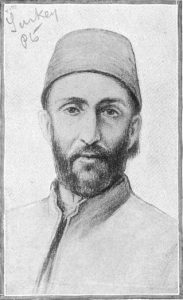
Portrait of Sultan Abdul Hamid II / British Archives
The reformist framework of the state was pushing the regime toward a “nation-state,” while the central authority was experiencing chaos in implementation and the erosion of loyalty to the state among the broader population.
In Kurdistan, the appointment of governors over the Kurds—rather than relying on the traditional Kurdish dynasties—and the failure of these central officials to achieve better progress than the previous emirs, undermined the internal legitimacy of the state. Moreover, the state granted the Armenians a privileged position in the benefits of reform, despite their strength, but they could not withstand the looming Kurdish populist resentment. Tensions escalated and threatened to erupt socially, had Sultan Abdul Hamid II not halted the Ottoman modernization process, which he managed through a confusing method of managing imperial pluralism. He resorted to supporting Kurdish, Circassian, and Arnautian social leaders internally against the Christian subjects, whom France, Britain, and Russia had pledged to protect.
Although he temporarily suspended the constitution he had issued, Abdul Hamid II endured a crushing defeat in the 1878 war with Russia, followed by the signing of the humiliating Treaty of San Stefano and the Treaty of Berlin. These developments resulted in the state becoming more hostage than ever to Britain and France. It was too late to reverse the course charted by his grandfather Mahmud II and his father Abdulmejid I. No reform movement rooted in Ottoman traditions emerged, leaving Abdul Hamid with the options of either aligning with French-educated reformers or strengthening internal reactionary forces to obstruct the transition of the state from an imperial phase to a “nation-state.” He chose to bolster conservatism, without granting it any formal representative legitimacy—except through the Hamidian Brigades in Kurdistan. This approach fostered an “Islamic nationalism” within the state, which was sometimes offensive and sometimes defensive toward Christian nationalities. Especially since the interventionist policies of the European states had disturbed centuries of coexistence and created illusions among a large segment of the elites of Christian peoples that their salvation depended on a self-determined uprising, with the outside world ready to turn their revolution into gains of independence.
2- Ottoman Nationalism
The idea of nationalism evolved through parallel phases of reform proposals, including those advanced by the organization of the “New Ottomans” led by Namik Kemal, a pioneer of Ottoman nationalism.
What Namik Kemal presented was more of a vision than a fully developed theory. Ottoman nationalism was a local, unrepeatable attempt to address the challenge of managing internal diversity while pursuing irreversible modernization along the model of the nation-state. No alternative successful model had emerged at that time to serve as a template.
The concept assumed equality among Muslim, Christian, and Jewish subjects within a national synthesis crafted from above by the state under Ottoman rule. Namik had a Turkish inclination in his poetry and literature, inspiring many later nationalists, such as Mustafa Kemal and Halide Edip. However, he did not win the admiration of Sultan Abdul Hamid II, who described him in his memoirs as someone living two double lives without realizing it. Despite this, he praised Namik’s disagreement with the more Westernized Midhat Pasha group.
In Abdul Hamid II’s efforts to thwart privileges granted to Western powers, two dilemmas emerged with disastrous consequences. Armenian self-confidence grew as a nation with armed internal strength and Western and Russian support. Conversely, Abdul Hamid sought to suppress what he saw as Armenian independence tendencies within the empire. He recognized early on the failure of the idea of “Ottoman nationalism” and worked to bolster the position of neighboring Muslim groups fearing Armenian attacks from the Russian front. Similar events occurred between 1894 and 1896, culminating in massacres carried out by the “Islamic Nation” alliance against “Ottoman nationalism.”
3- Turanist Nationalism
The founding of the Committee of Union and Progress (CUP) was initially a revival of Ottomanism within an extreme positivist philosophical framework. However, this idea did not align with Ottoman historical identity. The society aimed to break with the Ottoman past and start anew, under the same name. After 1906, internal turmoil arose, with pro-Turanist elements gaining control and pushing for Turkification of the entire empire. Non-Turanist factions, including two of the six founders—Kurdish academics Abdullah Cevdet and Ishak Skoti—emerged as opposition groups.
Nevertheless, the nationalist idea required a comprehensive academic apparatus—whether through invention, effort, or factual basis. The Turanist group lacked this apparatus when the CUP was founded around 1894 in Paris. However, in Paris, this group was influenced by three thinkers whose works are traced by researcher Niyazi Berkeş in his book The Development of Secularism in Turkey.
The first of these, David Lyon, offered a provocative historical interpretation that even shocked Ottoman nationalists like Namık Kemal, asserting that the Mongols (whom he described as Turks) built the most significant empire in history, and Genghis Khan (a Turk) was the greatest leader of all time.
The second, Arthur Lumley-Davids, argued in his book Turkish Grammar for the deep historical and social connection between the Turkish language and Turkic peoples from ancient times through the reign of Mahmud II. He criticized European and Turkish scholars for distinguishing Tatars from Turks, considering them both to be Turks with Turkish language, and his mother translated his book after his death as a gift to Sultan Mahmud II.
The third thinker, Armeniz Vambery (1832-1913), conducted linguistic and social research into the ethnic links between Central Asian peoples and the Turks of Asia Minor. All three were European Jews.
Despite the critical tensions in the nineteenth century between the Kurds and the Ottoman state, the historic Kurdish-Turkish alliance persisted, although it experienced severe setbacks and faltered at various points, especially in the mid-19th century. It had endured for over 400 years since the Battle of Chaldiran and nearly 900 years since the Battle of Malazgirt, each time being revived—most recently during Sultan Abdul Hamid II’s reign. As Hamit Bozarlan explains in A History of Contemporary Turkey (pp. 19-20):
The long reign of Sultan Abdul Hamid II, characterized by the absence of major wars between 1877 and 1909, allowed him to reconsider the empire within a new identity framework. Abdul Hamid II seemed aware that the empire would eventually shrink within Anatolia. His doctrine aimed to create homogeneity within this “core” and protect it with a circle that included Muslim but non-Turkish groups such as Kurds and Arabs. The massacres of 1894–1896, which resulted in at least 100,000 Armenian victims, represented in fact the first tangible step toward rediscovering Anatolia as a Turkish and Muslim entity.
On July 24, 1923, the ruling class of Anatolia decided to end 400 years of joint Kurdish-Turkish protection of the empire, at least on the Caucasus and Iranian fronts. After Lausanne, they took all measures to revive Uzun Hasan’s project of Turkifying Kurdistan.