

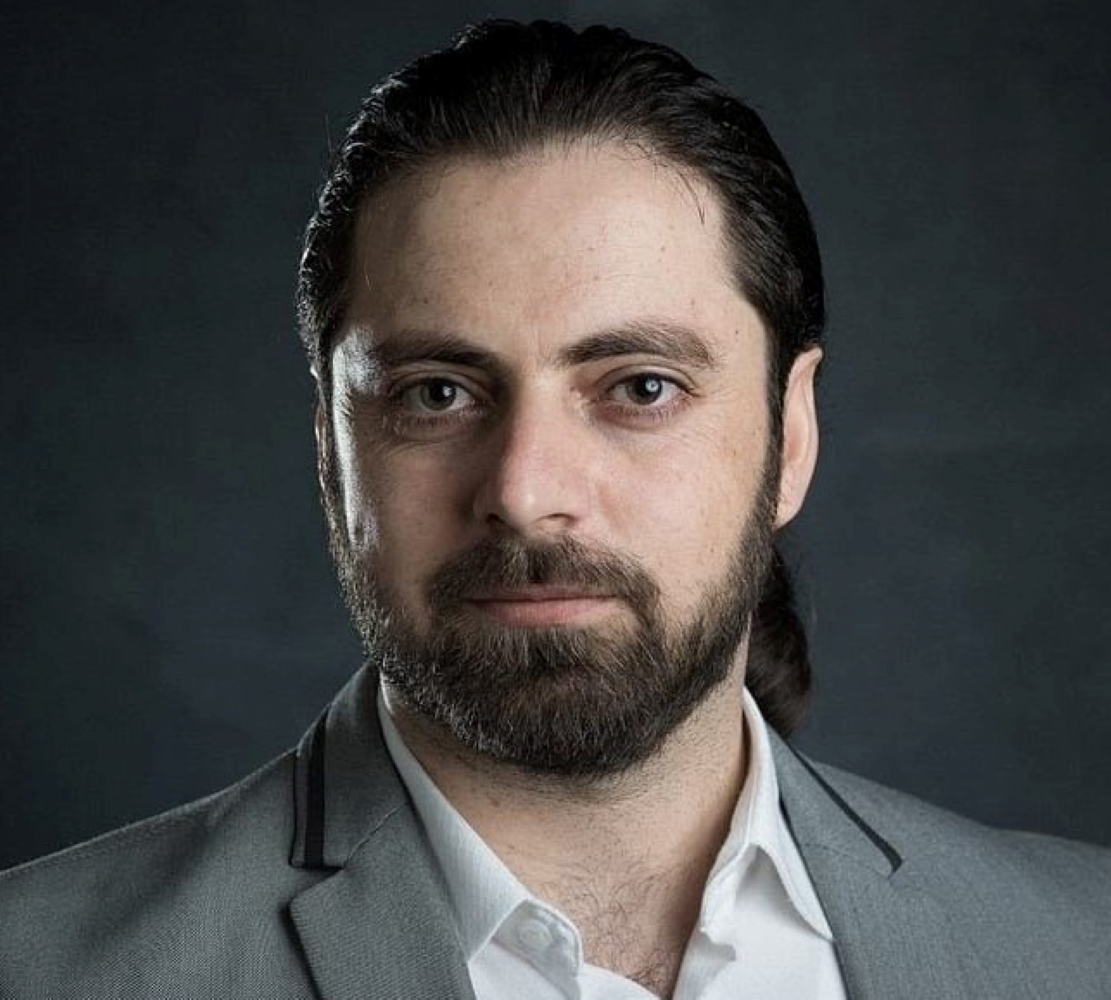
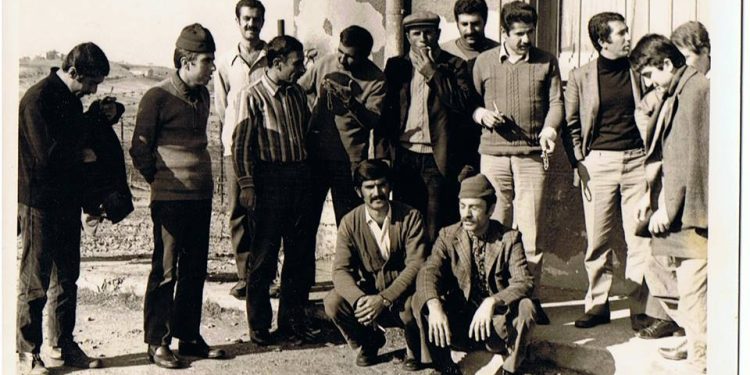
On February 9, 2026, the Kurdish writer and intellectual Muhammad Amin Bozarslan passed away in his exile in Sweden. He left behind a life that filled a vast void in literature, politics, and the “presence” of Kurdish culture. Bozarslan was one of those influential and rare figures among the producers of knowledge who lived a long and productive life; he was born at the end of the Mustafa Kemal Atatürk era (born in 1934) and lived until what appears to be the end of the Recep Tayyip Erdoğan era. In his biography, we find all the wonders of the Kurdish experience in the twentieth century: he began in the schools of the Republic, then became a Mufti, then a Kurdish nationalist pursued and imprisoned by the authorities, and finally an exile, still pursued!
Personally, I owe the late Kurdish writer and intellectual, Muhammad Amin Bozarslan, an apology coupled with my shame for an error I committed due to complex technical reasons. The result was that my memory stored his name as “Zaki Bozarslan” instead of his real name, Muhammad Amin Bozarslan. I wrote the wrong name in an article and spoke in two video programs about the achievements of “Zaki Bozarslan,” noting that the latter is a writer who shares the Bozarslan surname. I had read an important book of his in Kurdish titled Nêrînek Li Dîroka Kurdistanê (An Approach to the History of Kurdistan), published in 2004 by SOZ Publishing, but I could not find a biography for Zaki Bozarslan or whether he was related to Muhammad Amin Bozarslan’s family and his son, Hamit Bozarslan.
The late Muhammad Amin Bozarslan has a personal favor over me, and I consider myself one of his students. Some of his works that I reviewed formed the most important window for me to understand Kurdish politics at the beginning of the twentieth century. I have written a number of articles and studies based on the knowledge and new insights I gained from reviewing the complete available issues of the magazine Jîn, and what Kurdish intellectuals wrote using material from this magazine, which was published between 1918 and 1919. The credit for the availability of this magazine in Latin-alphabet Kurdish goes to the late Bozarslan and his colleagues. The transition of Kurds in Northern Kurdistan from the traditional alphabet—based on the Perso-Ottoman version of the Arabic script (shared by the peoples of Afghanistan, Kurdistan, Balochistan, Persia, and Azerbaijan)—without the presence of educational institutions and structures, almost became a cultural catastrophe. This was avoided only because of the intellectual support provided by figures like Bozarslan. He dedicated his life to transliterating Kurdish knowledge written in the Arabic script into the Latin Kurdish alphabet, the foundations of which were laid by Prince Celadet Bedirxan (who died in 1951) and completed by a number of Kurmanji experts, including Bozarslan.
The value of Bozarslan and his favor to Kurdish generations lies in his provision of a collection of rare knowledge sources, even more than the direct benefit from his own intellectual output—which is no less valuable in any case. Perhaps if he had not devoted the time he spent facilitating and providing Kurdish literary and political knowledge before and after the founding of the Turkish Republic, Bozarslan would have had more personal works and perhaps a bigger name among Kurdish luminaries. Therefore, he deserves greater appreciation because he dedicated his life so that we might know what he knew—to remain connected to what was severed as a result of the alphabet change, even though the Kurdish intellectual crisis is deeper and more dangerous than a mere alphabetic transition, manifesting partly in the aversion to lengthy foundational readings in literature, politics, and history in all languages!
In the spring of 1977, the Dutch anthropologist and social history researcher Martin van Bruinessen met the late Muhammad Amin Bozarslan for the first time. It is, as usual, striking that one of the best pieces written about the deceased is what Bruinessen published about him in an article in 2013, which he republished a few days ago in tribute to the great man.
Bozarslan was working at the newspaper Günaydın when Bruinessen met him; a friend of mine who worked at the same newspaper and knew the extent of my admiration for him arranged that meeting. I had known Bozarslan and his books for 4 or 5 years, and among the Kurdish intellectuals Bruinessen knew, Bozarslan was an exceptional individual.
His uniqueness emerged from his different background and his disciplined, serious work, which made him the most productive of Kurdish intellectuals. The famous books he authored in the sixties—that is, before Bruinessen met him—include The Sheikhdom and the Aghadom from the Perspective of Islam and Problems of the East, in addition to his Turkish translations of Mem û Zîn (1968) and The Sharafnameh (1971). He was known by the title “The Communist Mufti,” as Bozarslan entered official religious service early and became a Mufti in 1956, moving between the regions of Khani, Kulp, and Malatya during 1956–1969. However, this position expanded his potential for conflict with the Republic; the books he began writing in Turkish about “the East” (symbolically meaning Kurdistan during the era of the total ban on the name), its social structures, and the relationship of religion to traditional power structures, were touching upon “state security.”
Van Bruinessen relied on Bozarslan’s outputs when he entered the Kurdish world, and even the title of his most famous thesis, Agha, Shaikh, and State, seems to echo the title of Bozarslan’s earlier book, as Bruinessen himself noted.
The coup of March 12, 1971, and the abundance of political trials marked a new stage of the “Eastern Reform” project in the systematic destruction of all tools of Kurdish culture. Among those prosecuted was Bozarslan for a group of his books, which were banned and withdrawn from libraries and academies, including the book Sharafnameh. It was reprinted again after the 1974 general amnesty during the era of the coalition government between the Republican People’s Party and the National Salvation Party (Islamist), headed by Bülent Ecevit and his deputy Necmettin Erbakan. However, the ban remained on his other books, including The Kurdish Alphabet—a book of the Kurdish alphabet developed from previous attempts since its publication by Celadet Bedirxan—as well as the continued ban on the Turkish translation of Ahmad Khani’s diwan Mem û Zîn. The Public Prosecution’s comment in Diyarbakir was that Bozarslan, with these two books, was planting two mines under the feet of the Turkish Republic!
The 1971 coup did not tolerate revolutionary leftist organizations, despite Ecevit’s attempts to expand the scope of the amnesty. Consequently, the amnesty had a later effect in reproducing new political dynamics, where for a moment it seemed that the transition of Kurds from the Turkish internationalist leftist cloak toward nationalist political structures was even less risky. However, the opposite was soon proven, and it became clear later—after many years and the emergence of the Ergenekon scandal—that the state was using the far-left in the process of Turkifying the Kurds and implementing the “Eastern Reform” plan!
Bozarslan published another important historical source, The History of the Kurdish Marwanids, in 1975, based on a translation of the book The History of Mayyafariqin by Ibn al-Azraq, the first Arabic edition of which was published in 1954 in Egypt from two manuscripts in the British Museum. This source, the history of Ibn al-Azraq, is the broadest basis for the Kurdish presence in the eleventh century, and it is impossible to construct a Kurdish historical narrative without Ibn al-Azraq.
Van Bruinessen recounts that Bozarslan had a presence among Syrian Kurds, and it seemed many knew “The Mufti”—the title by which Bozarslan was known—and admired him greatly. Turkish student activists from the 1968 generation recounted how they carefully read Bozarslan’s translation of Sharafnameh when it was first released, trying to discover if their ancestors might have belonged to one of the Kurdish tribes mentioned in that book. In 1975, when Van Bruinessen was in a village in the Mardin plain, friends gave him a very precious gift: it was a copy of Bozarslan’s translation of Mem û Zîn, which they had kept buried underground for several years for fear of the authorities. The paper had become brittle due to moisture, covered with black fungus here and there, and insects had eaten its edges; nevertheless, it was treated with great respect because it was considered a symbol of Kurdish identity.
Muhammad Amin Bozarslan played an extremely important role for the emerging Kurdish movement in the sixties and seventies, even though he was not a politician. In a time when the movement needed national symbols and an awareness of a national history, Bozarslan made two great classics by Kurdish intellectuals from the sixteenth and eighteenth centuries accessible to a new generation: Sharafkhan Bidlisi and Ahmad Khani. Translating these works was a counter-attack from within against the “Eastern Reform.” From my tracking of the details of this project, some of which I published in the Kurdish Center for Studies, I have no doubt that Bozarslan performed these translations into Turkish consciously; he transferred some of the most important traditional sources of Kurdish nationalism into the Turkish language. He was distinguished by his vast and professional linguistic knowledge of the Kurdish, Arabic, Persian, and Turkish languages—the four languages that no Kurd could master without becoming a figure of significance in the history of his nation. He learned Turkish late, much like Mulla Said al-Kurdi al-Nursi. Most importantly, he was the only intellectual of his time whose educational attainment was from religious schools in Kurdistan, and he became a teacher to Kurdish nationalists among university students.
With the discipline of the religious school and his knowledge of Arabic, Kurdish, Ottoman Turkish, and some Persian, Bozarslan continued to connect the current generation of Kurdish intellectuals to their history by making important historical sources available to them in modern Turkish translations.
He resigned from his position as Mufti in 1969, then spent several years in prison, after which he found journalistic work. His work did not leave him enough time for the projects he was planning, as the living conditions for someone like him began to deteriorate continuously. In 1978, his son “Gani,” who was politically involved and had begun to make a name for himself as a poet and translator, was found murdered. The loss of his son shattered his spirit and was the main reason he left Turkey in 1979 to seek asylum in Sweden.
Kurdish Magazines
In exile, Muhammad Amin Bozarslan became more productive than he had been in Turkey. Sweden’s multicultural policies made publishing in Kurdish possible and even provided a degree of financial support for it. Sweden was also the first European country where it was possible to teach Kurdish children their Kurdish language as a mother tongue.
During that time, Bozarslan worked hard on an ambitious, long-term project: he was preparing annotated editions of the first Kurdish magazines that appeared in Istanbul at the beginning of the twentieth century. This meant he had to find complete sets of those magazines (as most library collections are incomplete, requiring the collection of copies from different libraries to form a complete set).
He had begun work on the most important early Kurdish magazine, Jîn, the magazine of the Kürd Te’ali Cemiyeti. Jîn published articles in Kurdish and Turkish, all written in the Arabic script, making them inaccessible to most contemporary readers. Bozarslan’s new edition consisted of a photographic reproduction of the original magazine, followed by a word-for-word transcription of each issue into the Latin alphabet, and then a translation of the Kurdish articles into modern Turkish. The first volume of this meticulous work was published in 1985, and in 1988 the entire set was completed in five volumes. This work is considered a cultural masterpiece that no historian can ignore. It gives us an insight into the debates within educated Kurdish circles at an important historical moment: the years between the end of the First World War and the founding of the Turkish Republic.
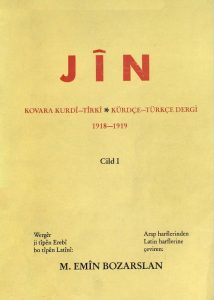
Bozarslan later completed this great work with similar annotated editions of two older magazines: the newspaper Kurd Ta’awun ve Terakki (1908–1909) and Kurdistan (1898–1902).
In his introduction to the magazine Jîn, Bozarslan wrote details about the personal and political relationships between the writers and members of the magazine’s management. He excavated and researched the names of several writers who used symbols instead of their real names or pseudonyms. Bozarslan conducted comparisons that can only be described as exhausting, and based on his knowledge and acquaintances, he succeeded in revealing the names of several “hidden” writers in the magazine. As for Bozarslan’s method of analyzing the circumstances and political environment in which Jînwas published, it is an analytical masterpiece unmatched by any historian whose writings I have reviewed on that period.
At the end of his lengthy and enjoyable reading of the magazine in Kurdish (nearly 85 pages), the great teacher and intellectual Muhammad Amin Bozarslan expresses his hope that this work will contribute to the benefit of Kurdish nationalism and fill a void for those loyal to the Kurdish people. The deceased was immensely generous toward his nation and its revolutionary movements. As I conclude this elegy for the departed, I am struck by a sense of anxiety regarding his will to his family that his funeral be private, restricted to family members. The anxiety stems from the feeling that, in his final years, he felt a sense of disappointment and ingratitude from those he spent his life serving.