


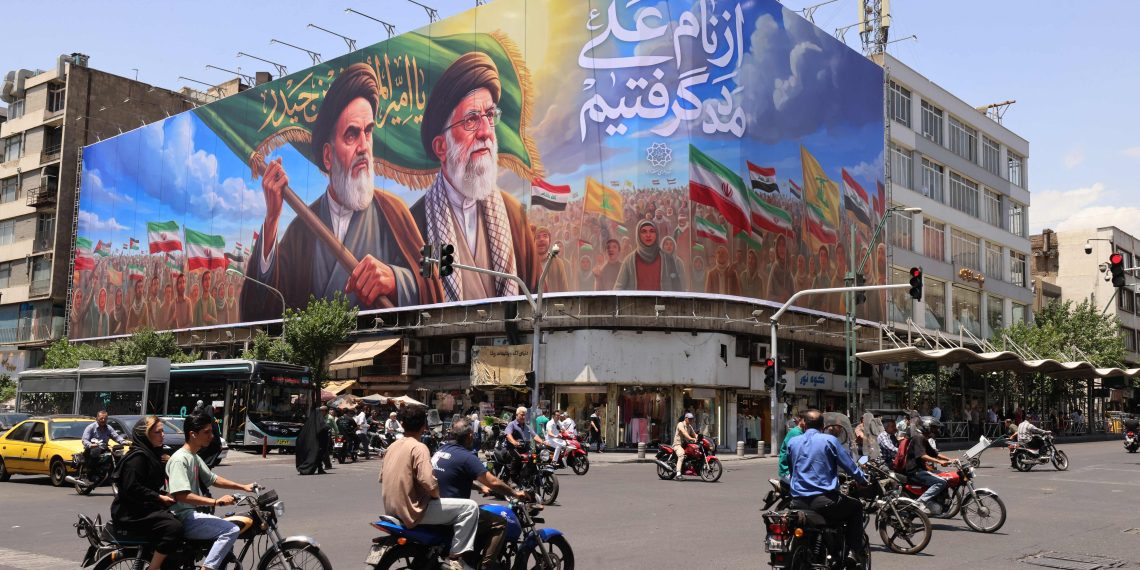
Whether an agreement takes place or not, the ongoing war in the Middle East, with Iran at its center, does not seem to have eradicated the causes that led to its outbreak. The rise of new powers in the region necessitates a redistribution of spheres and zones of influence. Iran stands out as the Middle East state possessing the most extensive ideological and militia extensions within its regional sphere—extensions meticulously constructed over decades of Islamic Republic policies since 1979.
The current war is suspended. What chiefly prevents its total extinguishment is the manner in which each party conceptualizes the outcomes of this conflict. In Iran, if the war concludes under the current equation and present rate of attrition, the new Iranian leaders will push toward a phase of the “Third Islamic Republic,” according to researcher Suzanne Maloney in a Foreign Affairs article published on April 1.
How did Suzanne Maloney arrive at the concept of the “Third Republic”? She explains:
The First Republic, led by Khomeini, was an experiment that sought to impose clerical rule at home and export the revolution abroad. The rule of Ali Khamenei launched the Second Republic, which consolidated the hegemony of the Supreme Leader’s office and empowered the military establishment through its role in reconstruction following the Iran-Iraq War in the 1980s. By engineering the rise of Mojtaba, the regime seeks to establish the Third Republic: an explicit military-security state in which the Islamic Revolutionary Guard Corps (IRGC) and the broader security apparatus firmly control decision-making across all facets of governance, society, and foreign policy.
In conclusion, Maloney believes that the leaders of the Third Republic will rely heavily on war to re-consolidate authority, just as their predecessors did in the 1980s, utilizing conflict as a pretext to impose de facto military rule while attempting to mobilize a highly radicalized nationalist sentiment.
Two Contradictory Options
Viewed through the prism of the “Third Republic” and its antitheses, Iran stands today between two contradictory historical options: either a “Third Republic” that re-militarizes the expansionist project using security and “Mahdist” tools, or a “Little Iran” that retreats to the Iranian Plateau as its historical sphere of survival when empires fail to protect their peripheries.
Prevailing and popular readings regarding the future of the Iranian regime generally rule out that an agreement, under current realities, would alter the Iranian thesis in politics, society, and religion. This thesis centers on geographic expansion via modern instruments that circumvent the criteria of the “nation-state”—namely, through groups, parties, and militias—to achieve something akin to the utopia of “Greater Iran,” which merges with a parallel utopia: that of the “Awaited Mahdi.” In its contemporary political utility, this second thesis conjures narratives of Khaybar and an existential enmity toward Israel.
We detailed this previously in an article on two expansionist ideologies that have alternated over Iran throughout history during separate historical epochs. The first was reconciled with Israel and the Jews, with its final application occurring during the reign of Shah Mohammad Reza Pahlavi, drawing upon the imagined legacy of the Achaemenid Emperor Cyrus, the “Conqueror of Babylon” and “Liberator of the Jews from Babylonian Captivity” in 539 BC. Conversely, the second necessitated a rupture with the first, beginning in the sixteenth century when Shah Ismail the Safavid declared Twelver Shiism as the state religion in 1501 AD.
It fell upon the jurists of Jabal Amel, who arrived to construct the “confessional state” in the land of Shah Ismail, to provide Shiite Hadiths and traditionalist accounts (Ikhbarayat) centered around the Awaited Mahdi, who—according to these narratives—is destined to have a rendezvous in Jerusalem, where Jesus the son of Mary will pray behind him. When the Shiite school of thought was reconstructed through scholars like Sheikh Ali al-Karaki and Mohammad Baqir al-Majlisi, it incorporated numerous Hadiths regarding the “impurity of Jews,” and the reviling of Jews began to be proclaimed from pulpits, making them a proverb for negative traits. The ascendancy of Twelver Shiism marked the beginning of the collapse of Iranian-Jewish relations until the end of the Qajar era in 1925, after which “Jewish-Iranian” relations rebounded throughout the Shah’s era until its overthrow under the leadership of Khomeini in 1979.
Generally speaking, the Safavid era represented a harsh epoch in the Iranian-Jewish collective memory, wherein brief periods of limited economic prosperity were intermingled with policies of discrimination, religious persecution, and forced conversion, particularly during phases of the 17th century. Their living conditions deteriorated during numerous intervals, forcing most to live in isolated cantons within major cities. This situation did not conclude until the fall of the Safavids during the Afghan-Pashtun occupation of Isfahan, before this occupation dissolved with the emergence of a leader capable of unifying Iran in 1736: Nader Shah Afshar, who expanded his campaigns eastward as far as India.
During this period of turmoil, the Jews devised mechanisms for survival; they imagined encouraging tales and patiently awaited deliverance amidst the upheavals. The traces of that era remain present in the Iranian-Jewish memory through proverbs and folklore passed down through generations, which depict the Safavid Shah as another Pharaoh who tested their faith.
However, the wave of radical enmity toward Israel on the part of the Islamic Republic has become a long-term entrapment, preventing even the regime’s survival in the current war. Thus, it cannot present an internal thesis of self-transformation by which to survive the protracted war it is waging (and in which it has likely endured thus far due to American electoral considerations). The Mahdist doctrine no longer merely dictates that the Mahdi will pray in Jerusalem with Jesus behind him; rather, the entire place is now named Israel—a novel reality confronting Shiite jurisprudence compared to what prevailed during the Safavid and Qajar eras. Furthermore, a foundational component of the imagery of heroism in Shiite heritage attributed to Imam Ali bin Abi Talib is linked to the storming of the Jewish fortress of Khaybar. There appeared to be no willingness to focus on the Imam’s heroism outside of the “Khaybar narratives,” despite their abundance in the accounts of the traditionalists (Ikhbariyin), who hold the greatest influence over Shiite popular culture compared to Shiite rationalists (Usuliyin).
While Iran—both state and society—lives today under an existential threat of war, it appears too late for internal transformation. This transformation yields but a single exit: conviction and contentment with a “Lesser Iran” bounded by its direct Iranian sphere, devoid of proxies in Lebanon, Yemen, and Gaza.
In periods of civilizational defeats, Iran’s survival lay in returning to “Lesser Iran”—a conceptual, terminological description rather than a rigid geographical map. The Qajar state period (1789 to 1925) was a model of inward retreat in the face of monumental defeats. Within less than a century, Iran shifted from the position of a historical empire with a vast sphere spanning the Caucasus, Khorasan, Herat, and Central Asia, into a state besieged within borders far narrower than the domain it once considered part of its political and civilizational space. This occurred through a series of wars and settlements imposed upon the Qajar state by the Great Powers, at a time when the global balance of power was tilting rapidly in favor of the Russian and British Empires.
The first blow came from Russia. At the turn of the 19th century, Qajar Iran entered into a direct clash with Imperial Russia over the Caucasus regions—territories that had for centuries remained within the Iranian sphere of influence, or linked to it politically and culturally. The First Russo-Persian War concluded with the Treaty of Gulistan in 1813, which inaugurated the era of major retreat. By virtue of this treaty, Iran lost vast portions of the Caucasus, including territories in Dagestan, eastern Georgia, and present-day Azerbaijan. This was the beginning of Iran’s exit from the Caucasus and the start of the shift in the northern balance of power in Russia’s favor.
Yet the loss did not halt at Gulistan. More than a decade later, Iran attempted to reclaim what it had lost, entering into a second war with Russia between 1826 and 1828. The outcome was even harsher. The Treaty of Turkmenchay in 1828 forced Iran to surrender the remainder of its major positions in the Caucasus, specifically the khanates of Erivan and Nakhchivan, and established the Aras River as the definitive boundary between Iran and Russia.
Following the two Russian blows in the north, the British blow fell in the east. Herat, as the gateway to Khorasan and one of the most critical cities in the historical Persian sphere, was a theater of conflict between Iran and Great Britain. Qajar Tehran viewed Herat as a natural extension of its influence, whereas Britain, ruling in India, perceived any Iranian return to Herat as a threat to Indian security and a gateway for indirect Russian influence. Consequently, Herat transformed into a flashpoint in what would later be termed the “Great Game” between Russia and Britain.
This confrontation ended with the Treaty of Paris in 1857, which compelled Iran to relinquish its claims to Herat and Afghanistan. Thus, Iran lost its great eastern gateway, along with the capacity to reclaim a vital portion of its ancient Khorasani sphere.
Following these three treaties, Iran ceased to operate as an empire capable of protecting its peripheries. Then came the Treaty of Akhal in 1881 to complete the ring of contraction in the northeast. Following Russian expansion into Central Asia, Iran was forced to recognize the new de facto reality and the loss of its remaining political ties to the Turkmen and Khorasani spheres beyond its borders. By virtue of this treaty, the exit of regions such as Merv, Abiward, and Nisa from the Iranian sphere was cemented, and decisive influence in Central Asia shifted to Imperial Russia. Akhal was, in this sense, the denouement of a long trajectory of erosion at the Iranian extremities: the Caucasus in the north, Herat in the east, and Central Asia in the northeast.
Thus, during the period stretching from 1813 to 1881—in less than 70 years—Qajar Iran contracted from a state with a vast imperial memory that had reached India during the era of Nader Shah, into a far narrower political entity, confined within borders dictated by defeats and treaties. It transitioned from “Greater Iran,” which extended in historical consciousness toward the Caucasus, Herat, Greater Khorasan, and Central Asia, into “Lesser Iran,” which began to take shape within defensive borders under the pressure of Russia from the north and Britain from the east and south.
Despite the severity of the outcomes, the Iranian Plateau remained the “seat of the throne.” When the Ottoman Sultan Selim I defeated his Safavid rival Shah Ismail at Tabriz, the state did not collapse despite the fall of the Safavid capital and the center of its military might. “Lesser Iran” performed an automatic function: protecting society and the state from existential peril, contrasting sharply with the current posture toward an expansionist “Third Republic” under contradictory banners—Mahdist-Khaybarite in the face of Israel, and Cyrusian-Imperial in looking toward its Gulf neighborhood.
This Mahdist-Achaemenid momentum risks the fate of the broader Iranian society. Geopolitical trajectories offer no guarantee that Iran will remain a principal regional actor, or within the three primary lines of power (according to Ahmet Davutoğlu’s classification: Iran, Turkey, and Egypt). There is a new subject looming on the horizon of Middle East politics, named the “Iranian Question.” It is highly probable—as the experiences of modern nations demonstrate—that every “cause” and “question” is subjected to cycles of experimental solutions and counter-solutions, much like the “Eastern Question” in the nineteenth century.
In Iran’s case, it may culminate in geographic partition or an internal collapse within a collapse, wherein two Sunni visions are anticipated to compete over the reconstruction of Iran. In either scenario, Iran does not escape its status as a “cause” or a “question.” Therefore, without liberating the Iranian state from the political exploitation of the Shiite Mahdist vision and the ascending Achaemenid-Shahnameh synthesis, the current trajectory and impending wars may render Iran itself the “Grand Prize” in the conflicts of regional axes in its vicinity, so long as it persists in its arrogance and refuses to content itself with “Lesser Iran.”