


The Arabs lost their political power at the end of the first century following the start of the Abbasid state in 750 AD. New forces emerged in the Islamic world, most notably the Amazigh (Berbers) in the Maghreb with the Almoravid (1055–1147) and Almohad (1121–1269) states. In the East, the Seljuk Turks arrived from the steppes of Central Asia as invaders of Persia, subsequently seizing control of the Abbasid capital, Baghdad, in 1055, and ruling from behind the Caliph’s back. The Kurds were the second major power in the Islamic East.
The Kurdish Marwanid state (990–1085), which extended between Ameda (Diyarbakır) and Mardin, served as a geographical buffer between the Abbasid state and the Byzantine Empire. The new Turkish arrivals viewed the Anatolian region as a vital space for expansion. The Battle of Manzikert (Malazgirt) in 1071 between the Seljuks and the Byzantine Empire was practically a battle between the Kurds and Turks on one side, and the Byzantines on the other, as the army of the Seljuk commander Alp Arslan was equally divided between them. The Kurdish role was decisive, given their status as indigenous people familiar with the geography of the region and the adjacent Byzantine area—a knowledge that the newly arrived Turks lacked.
It is true that Manzikert marked the beginning of the Turkish ascendancy in the region. The Ottomans translated the Turkish control over Anatolia, which opened its gates following the battle, into expansion towards the Black Sea and the Balkans, making the Fall of Constantinople in 1453 inevitable. The greater Ottoman translation was the control over the Fertile Crescent, Egypt, and the Hijaz after defeating the Safavid rulers of Iran in the Battle of Chaldiran in 1514, in which the Kurds played a crucial role alongside the Ottomans through Idris Bidlisi. However, the Ottoman State’s internal balances did not permit an exclusive Turkish control over affairs; rather, it was the result of a Turkish–Kurdish–Arab triangle since Sultan Selim I (1512–1520), who defeated the Mamluks in the Battles of Marj Dabiq (1516) and Al-Raydaniyya (1517). This occurred amidst an unprecedented Shia–Sunni schism declared by the Safavid state in Iran, a rivalry that began at Chaldiran and spanned a century and a third, with its theater extending from Mesopotamia to Azerbaijan.
In this triangle, the Sultan and his Janissary army occupied the first, and most powerful, third. The second was the Kurds, who enjoyed administrative autonomy in Eastern Anatolia with political, military, and sectarian loyalty to the Sultan. The Arabs were the last third. The Arab component was a strong participant in the Ottoman context, given its religious heritage, holy sites, demographic size, and geographical location, though it remained the weakest of the three in the Ottoman triangle. Historically, the Ottoman Empire’s diverse composition is unparalleled, except perhaps by Tsarist Russia and later the Soviet Union. Also, in some ways, the Ottoman Empire, like the Austro-Hungarian Empire, was closer to a dual-national state controlling highly diverse nationalities, ethnicities, religions, and sects, but with power confined to that duality (between Vienna and Budapest) to rule Czechs, Slovaks, and large parts of Poland and the Balkans.
This triangle was shaken with Sultan Mahmud II, who moved toward a centralized state to be administered directly from the capital after abolishing the Janissaries in 1826 and moving to build a regular army based on conscription, and to curb the power of the governors in the provinces. This was accompanied by, or entailed, the strengthening of the Turkish element and the beginning of a tendency in the Ottoman capital toward the centralization and Turkification of the state. Then came his son, Sultan Abdulmejid I (1839–1861). Notably, the decree (Hatt-ı Şerif of Gülhane – the Tanzimat) he issued in 1839, which introduced the concept of citizenship in a state where citizens are equal regardless of religion or nationality, broke with the ‘Nation-Millet’ state upon which Sultan Selim’s Turkish–Kurdish–Arab triangle was founded. However, while satisfying the Great Powers who exploited the issue of non-Muslim minorities amidst the weakness of the Ottoman state, it also involved an increasing Turkification and centralization of the Ottoman state. We saw its peak with the Committee of Union and Progress (CUP), who controlled the Ottoman state between 1908 and 1918 after their first coup in 1908 and the second in 1909 against Sultan Abdulhamid II.
Sultan Abdulhamid II (1876–1909) pursued an opposing approach to his father and grandfather. He saw the protective dam against external storms facing the Ottoman state as ‘Pan-Islamism’ (Jam’iat al-Islamiya), which was a re-creation of the Turkish–Kurdish–Arab triangle. It served as a tool for internal Ottoman cohesion through the religious adhesive, a tool against the nationalist tendencies that emerged among non-Muslim groups within the Ottoman Empire, such as the Armenians, whose uprisings (1894–1896) were primarily suppressed by the Hamidian Regiments, largely composed of Kurds. It was also a tool against Great Powers, allowing for the use of Muslims in their colonies (like British-controlled India and Egypt) to support the Ottomans and the “Caliph of the Muslims.”
Sultan Abdulhamid satisfied the Kurds and Arabs but faced opposition from educated Turks, graduates of Western universities or state administrators, whose intellectual elite gravitated towards the Committee of Union and Progress, founded in 1889 on the centenary of the French Revolution. The Unionists’ control was a clear path toward the collapse of the Ottoman Empire after it fell under the control of Turkish nationalists.
It seems that Mustafa Kemal, an officer of the CUP, in his war against the Allied forces occupying Ottoman territories between 1919 and 1923, was aware that the “national movement” could not succeed if it adopted anything other than the trans-national religious slogan. He played on this chord to attract the Kurds, concealing his surging, chauvinistic nationalist leanings, the characteristics of which became clear after he founded the Turkish Republic in 1923 following the Treaty of Lausanne. This tendency embraced secularism and hostility towards religious trends, manifestations, and rituals.
To this day, the debate continues over the nature of Sheikh Said’s revolt in 1925 against the new Turkish Republic: was it purely Kurdish nationalist, even if its social base was Kurdish, or was it Islamic, seeking to restore the Caliphate abolished by Mustafa Kemal and fight his secularism? Or was it a mixed movement containing both motives? In the two Kurdish revolts of 1930 and 1937–1938, there was a purely Kurdish nationalist content against a chauvinistic Turkish national state led by Mustafa Kemal (Atatürk) that did not recognize ethnic diversity.
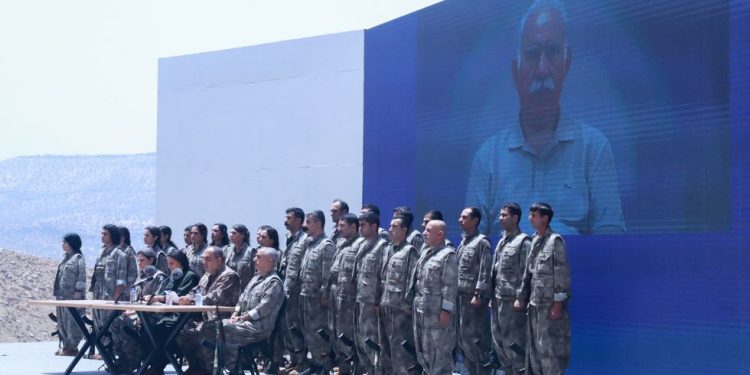
In the August 15, 1984, revolt announced and waged by the Kurdistan Workers’ Party (PKK), there is a Kurdish nationalist tendency mixed with Marxism, finding parallels in China and Vietnam under Mao Tse-tung and Ho Chi Minh, where the blend of Marxism and nationalism was intended for national liberation and unity. During his imprisonment on Imrali since 1999, PKK leader Abdullah Öcalan presented the theory of the “Democratic Nation,”which advocates for the equality of nationalities, ethnicities, religions, and sects in rights and duties within the existing society, along with their cultural, linguistic, and ritual freedoms, arguing that the national state whose identity is based on a specific nationality is an explosive fuse that will detonate sooner or later.
The peace process between the Turkish state and Öcalan/PKK in the 2013–2015 period was an attempt to overcome Kemalism (Atatürkism), which had been an explosive fuse for the Turkish state since Sheikh Said’s revolt, and whose explosions did not cease for a century. That path was unsuccessful. Since October 22, 2024, a second initiative has begun, initiated by Devlet Bahçeli, leader of the Nationalist Movement Party (MHP)—a Turanist party advocating for a Turkish world extending from Chinese Turkestan to the Aegean Sea—and supported by Turkish President Recep Tayyip Erdoğan. Öcalan and the PKK have responded positively. Its negotiation process, conducted among three non-Kemalists—Erdoğan, Bahçeli, and Öcalan—is based on the equation: (Peace in exchange for constitutional amendments leading to a non-Kemalist Turkey based on equality between nationalities and democracy for the citizens of the new state).
The question now is: Will Bahçeli’s initiative succeed, given the deep Turkish state’s realization of the fragility of the 1923 state’s internal structure, and how Turkey’s 1923 strength stemmed from its external functions rather than its internal structure? Especially since the new US-Turkish honeymoon, beginning in 2025, requires a Turkish–Kurdish reconciliation that makes a Turkey, recovered from its internal fragility, capable of roles demanded by Washington from Ankara in Eurasia against China, Russia, and Iran—via a Turkish world extending from Chinese Turkestan to the Aegean Sea that is loyal to Washington (like Western Europe post-1945 and Central/Eastern Europe post-1989)—and roles for Ankara in the Middle East and the Caucasus–Caspian Sea region, where Turkey is intended to be a corridor for energy pipelines from those two regions as an alternative to Russian energy for the European continent.