


Book Review by Muhammad Shamdin
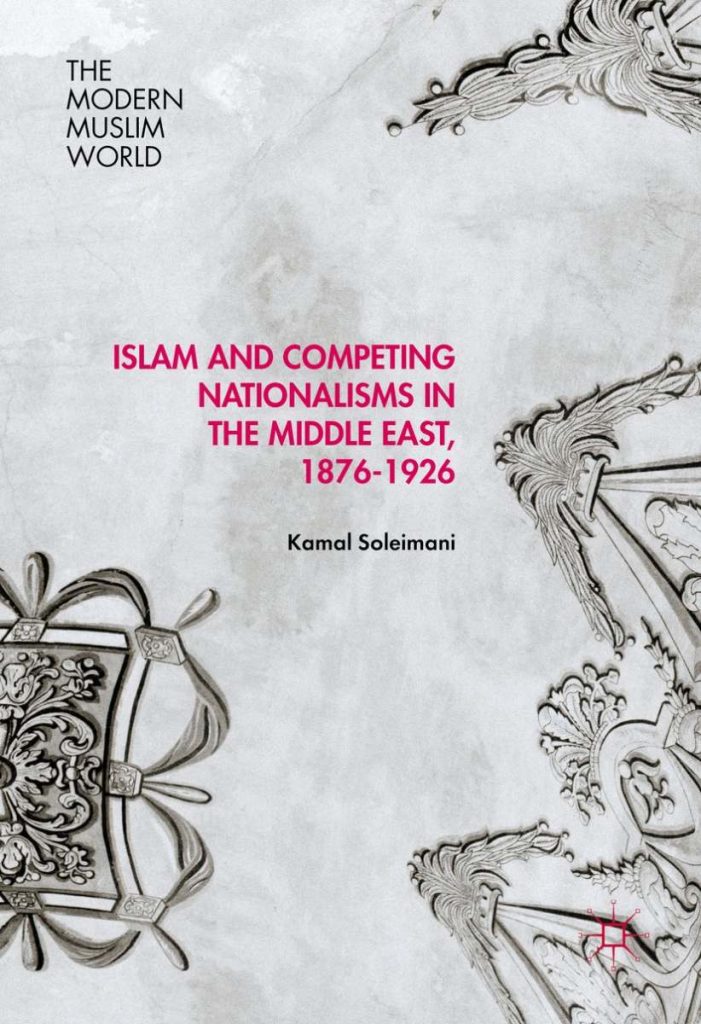
Islam and the Competing Nationalisms in the Middle East (1876 – 1926)
Author: Kamal Soleimani – 2016
The book was originally a doctoral dissertation in which the author earned a doctorate from Columbia University – United States of America.
Published by Palgrave Macmillan
Number of pages: 317
Content
- Introduction
- Religious (Islamic) Thought, Nationalism, and the Politics of the Caliphate
- The Politics of the Old and New Caliphate
- Official Nationalism and Islamic Identity
- Abdulhamid II’s Islamic University / Nationalism
- Kurdish Nationalism and Exceptional Islam: The Case of the Naqshbandi Sheikh Ubaidullah al-Nahri
- Kurdish Nationalism and the Caliphate in Nursi’s Pre-Exile Writings
- Nationalism in Religious Garb”: The Caliphate as a Site of National Competition
Kamal Sulaymani’s work primarily addresses the relationship between modern Islamic thought and nationalism, with a particular focus on certain trends (the religious-nationalist Kurdish trend) in Islamic religious thought during the late Ottoman period. He traces the clear historical relations between Kurds and Turks in the late 19th and early 20th centuries through case studies of the Sheikh Ubaydullah al-Nahri revolt, the Sheikh Said Piran revolt, and the writings of Sheikh Said Nursi.
The 1880 revolt, led by the Kurdish Naqshbandi Sheikh Ubaydullah from the Nahri region, embodied this approach to Islam among the Kurds. Ottoman administrative documents reveal that this revolt—in which religion and Kurdish nationalism merged—had a far-reaching impact on Kurdish politics overall. On some levels, it made Kurdish politics more ambiguous, as it convinced some actors that Kurdish independence would not be possible without external support. It also introduced a new meaning to Kurdishness (Kurdish identity), becoming both a source of inspiration for Kurds and a lasting grievance against the state. Conversely, Nursi reflected a stance common among Kurdish mullahs and religious leaders. He often boasted of his religious devotion, linking his integrity and courage to his Kurdish upbringing.
A close reading of Nursi’s writings before his exile reveals his doubts about Kurdish unity and his uncertainty about the spread of Kurdish national consciousness. Despite his deep concern for the Kurds’ fate, Nursi seemed to believe—unlike the Armenians—that Kurdish national consciousness had not yet reached the level needed to form a “nation.” He claimed that “Kurdish national consciousness is like a handful of beads on a torn string.” He saw Kurdish illiteracy and widespread internal discord as major obstacles to the growth of national consciousness. He believed that true national consciousness forms when the individual within the nation becomes the embodiment of the whole.
In the case of Sheikh Said Piran, leader of the 1925 revolt and an icon of Kurdish anti-Kemalist sentiment, Sheikh Said represented Kurdish religious nationalism. On one hand, he made the 1924 constitution of Mustafa Kemal a point of resistance. The new constitution gave him an excuse to call on all religious and community leaders among the Kurds to unite. He thus declared that “since the Turks have [already] abandoned their religion and turned their gaze towards the West [i.e., Europe], we must establish our own state based on Islam,” because Islamic symbols and morals are an integral part of Kurdish identity. However, he considered this identity endangered due to what he saw as a long-standing Turkish historical conspiracy and deception.
Introduction
Studies of the late Ottoman period, including those concerning the Kurds, tend to present Islamic history as homogeneous. These studies also assume that, after World War I and with the rise of Kemalism, the intellectual history of Islamic nationalism was treated as a relevant historical fact. They present the historical disparity between the “Muslims of Asia Minor” and their “lack of ethnic self-awareness” as an indisputable truth and categorically reject the idea of nationalist tendencies among Muslims prior to World War I. The emergence of Turkish nationalism is treated as the birth of the “modern Turkish state” and simultaneously as the genesis of Islamic nationalisms in the Middle East.
Different societies often linked their interpretations of “authentic” Islam to claims of “ethnic superiority.” During this pivotal period, Islam became closely intertwined with nationalism. The connection between the two—the notion of “true Islam” and ethnic superiority—manifested in various forms and patterns. In the late nineteenth century, the Ottoman state sought to impose a “correct” and desirable form of Islam and grew increasingly skeptical of the various other Islams around it. Conversely, Muslim communities on the empire’s periphery viewed the state and its centralizing tendencies as regressive and morally decadent.
The propagation of state-sanctioned Islam became increasingly tied to official nationalist practices and policies, which were challenged and resisted by the ethnic groups under Ottoman rule.
It was clear that the Ottoman elite’s efforts to distinguish themselves from other Muslims were based on their nationalism and their ethnic self-perception as the only group capable of modernizing “the rest.” Literature from that era glorifies them as the vanguard of change in the Islamic world. The Ottoman elite’s view of the ethnic Other was marked by clear disdain, as they saw themselves bearing the heavy burden of civilizing the rest. The Shi’a-Sunni divide lost significance in the elite’s mindset, and they adopted ethnic identity and belonging to a “civilization” as markers of their uniqueness. Arguments advanced by some Ottoman intellectuals against Iranian participation in a potential pan-Islamic unity exemplify this trend.
Such attitudes toward the Other are evident in the works of prominent figures such as Ahmed Midhat and Essam Eddin Sami. Midhat insisted that Turks possessed greater Islamic zeal than Arabs. In the periodical Tercüman-ı Hakikat(Translator of Truth), Midhat went so far as to claim that the Qur’an itself was not an Arabic text but “the language of God.” This reflected a shift in Turkish nationalist discourse, where Turkish Islam would be separated from Arabic, which was deemed a “backward Semitic language.”
However, this Ottoman-derived nationalism did not necessarily lead to Muslim unity—just as European nationalisms did not produce Christian unity. The call for indigenous, or more precisely, national culture appears not to have extended to non-Turkish cultures. Instead, Islamic interpretations increasingly became excluded. This explains why Ottoman Muslim modernists like Hamdi Bey saw their mission as “saving the Ottoman heritage not only from the West but also from the Eastern peoples of the Ottoman Empire.”
Over time, these nationalist approaches also influenced non-Turkish communities’ interpretations of Islam. Some scattered texts produced by Kurdish elites and intellectuals, found in Ottoman magazines from the late nineteenth century, reveal similar nationalist tendencies. The “narration” of a nation with a “past” became a central concern for many Islamic figures. Kurdish intellectuals sought to present a “civilized Kurdish Muslim nation” with a distinct history, almost entirely separate from that of other Muslims.
For many Islamic religious figures, whose primary role was to lead communal religious affairs, it became common to use nationalist language and to redraw Islamic boundaries along ethnic and national lines—always under the growing influence of nationalism. Nevertheless, these figures’ interpretations of Islam were hardly comprehensive or totalizing.
Religious (Islamic) Thought, Nationalism, and the Politics of the Caliphate
In this chapter, Sulaymani explores the relationship between religious thought and nationalism by engaging with nationalist theorists such as Ernest Gellner and sociologist Leah Greenfield, who argue that the rise of nationalism diminishes the role of religion, reducing it to a mere cultural symbol or a private relationship between “man and his Creator.” Sulaymani dedicates much of the chapter to demonstrating that “Islamism” struggles to conceptualize a political system that transcends the nation-state framework.
The modern concept of the state in the Islamic world emerges alongside religious reform movements and profound sociopolitical transformations. The spread of religious reform and the rise of modern Islamic renaissance movements during the nineteenth and twentieth centuries is far from coincidental. In the third decade of the 19th century, the Ottoman Empire launched a groundbreaking project, marking a cognitive shift in the approach of statesmen toward Islam, the state, and society. Sultan Mahmud II dismantled the old army, which was deeply intertwined with the traditional religious establishment, and created a new army integrated into the state apparatus rather than acting as a parallel force. Simultaneously, he sought to centralize the religious establishment by making it a state institution. For the first time, the highest religious office in Sunni Islam, the “Sheikh al-Islam,” was appointed by the Sultan to the cabinet. Furthermore, the state adopted new policies aimed at the peripheries, attempting to eradicate local authorities and ethnic distinctions. During this period, the state also prioritized educating its subjects in the “Semitic language of the state,” even in distant regions such as North Africa. These shifts in policy and administrative culture coincided with diverse religious reforms across the empire.
In the nineteenth and early twentieth centuries, Arabs more than other Muslim groups “ethnicized” (racialized) the discourse of the caliphate. However, it is important to note that the idea of the caliphate throughout the Islamic world became increasingly saturated with nationalist sentiments. The abolition of the Ottoman caliphate in 1924 exposed this shared trend among Muslim communities. While various Islamist groups sought to preserve a nostalgic caliphate discourse, they simultaneously prioritized their national borders above the broader question of an Islamic caliphate. This nationalist priority led to the First Congress for the Revival of the Caliphate in 1926, where “each participating delegation aimed to establish a ruling caliph of its own… Abdul Hamid II, the last effective Ottoman caliph, had exercised his authority freely but politicized the office beyond permissible limits.” Thus, the caliphate’s establishment is not inherently universal. Even when envisioned as the embodiment of a true Islamic state, Islamist groups conceive of a potential caliphate confined within their existing national and local spaces. Crucially, whether labeled fundamentalist or Islamist, these groups have internalized the boundaries of the nation-state.
Islamists operating within nation-states, in their pursuit of state control, have had to negotiate nationalism on multiple levels. Islamist efforts to work through the nation-state contribute to the fusion of religion and politics, driven ultimately by “national interest.” When Islamists attain power, they tend to reproduce conservative nationalist policies. The foreign policies of Islamic states are largely determined by what is known as the “national interest.” For example, the Iranian regime and Arab Islamist groups have maintained opposing stances on many critical issues, influenced more by their regional policies than broader Islamic solidarities. The massacre of Muslim Brotherhood members and unarmed civilians in Hama did not weaken Iran’s cordial relations with Syria; on the contrary, it reinforced them. Likewise, the genocidal wars in the Balkans and Russia’s open support for Slobodan Milosevic in the 1990s did not provoke any Iranian criticism of Russian foreign policy. China’s brutal repression of its Muslim populations also received scant attention or coverage in Iranian state media. Regarding Muslims beyond their national borders, these states either remain indifferent or restrict their involvement to safeguarding national interests.
The Politics of the Old and New Caliphate
In this chapter, the author examines the historical debate surrounding the concept of the caliphate, exploring key aspects of the discourse and approaches to the caliphate during the Ottoman era and earlier periods. The chapter seeks to clarify the heterogeneous nature of the conceptualization of the caliphate among Sunni Muslim thinkers, who claim to base their arguments on the Qur’an. Sunnis generally hold that every Muslim must pledge allegiance to the leaders of the Muslim community, whether the caliph or the imam. However, this broad generalization is problematic because it creates the misleading impression of universal Muslim compliance. Consequently, many scholars have overlooked the debates between the caliphate and the rising nationalist sentiments among Muslim communities in the late nineteenth and early twentieth centuries.
The emergence of the caliphate as a form of leadership can be understood as an ad hoc development in Muslim history. The events following the death of the Prophet Muhammad reveal that he did not provide explicit instructions on how the Muslim community should be led. Therefore, the available literature is highly contradictory, challenging the dominant Sunni Muslim narrative on this issue. Montgomery Watt was correct in asserting that the caliphate as a system of government is not rooted in the Qur’an. The term “caliphate” in the Qur’an derives from the Arabic root khulāf (successors or agents), which signifies succession or vicegerency—not a specific political system. It refers more broadly to humanity’s succession over generations and calls for reflection on God’s appointment of humankind as vicegerent on earth. Such theological reflections have inspired some Muslim scholars to view the term as partly indicative of a harmonious relationship between the Qur’anic creation narrative and the theory of evolution.
Both Shi’a and Sunni traditions present a variety of sometimes contradictory hadiths attributed to the Prophet Muhammad concerning the leadership of the community after him.
It appears that neither Muslims nor Muslim scholars have reached a consensus on these matters. Their views often reflect their personal relationships with rulers or the broader political-legal ideas with which they are aligned.
Mischaracterizing the debate by portraying the caliphate as a fundamental pillar of faith obliging all Muslims to obey any self-declared caliph complicates the discussion itself, especially regarding the early stages of Kurdish nationalism. Heber’s statement exemplifies such mischaracterization when he claims, “The Kurds, in particular, as overwhelmingly Sunni Muslims, unconditionally sympathize with and support their caliph, the sultan, viewing him as a religious and political leader.” Regarding the relationship between the Kurdish caliph and the Ottoman Empire, it is easy to detect the influence of Orientalist historiography and Kemalism, with the latter projecting its denigrated “Oriental image” onto the Kurdish Other. By depicting Kurdish movements merely as aspirations for reactionary Hamidian (irticai) rule, the Kemalist state both concealed its ambivalent stance toward religiosity and perpetuated the Ottoman-era Orientalist view of the periphery.
The aim was to demonstrate that the caliphate did not always signify the same thing and that rulers’ claims to the caliphate did not automatically secure the submission of their subjects. The Kurds, as subsequent chapters will show, were no exception. Concerning later Ottoman caliphs such as Abdul Hamid II, many contemporary Muslims recognized that he actively promoted pan-Islamic unity in hopes of integrating non-Turkish subjects into a campaign against the European challenges facing the empire.
Official Nationalism and Islamic Identity
This chapter discusses the notion of “Turkish nationalism” cloaked in religious guise and the Ottoman state’s policy of Turkifying the bureaucracy while imposing its official nationalism. The policies of Abdul Hamid II represented, in many ways, the culmination of a trend toward Ottomanization that had begun long before his ascent to power. At that time, state policy aimed to end the traditional relationship between the state and Ottoman subjects based on their religious affiliations. The Ottoman elite declared their intention to rectify inequalities among subjects. By the mid-nineteenth century, Ottoman leaders were expected to grant their subjects equal legal protection regardless of their religious backgrounds. It was proclaimed that “all subjects of a single state are members of the same nation.” However, the relationship between state and religion was replaced by a relationship between state and nationality. These policies sought to redefine the individual Ottoman’s bond to the nation-state, shifting loyalties and obligations away from sectarian and religious identities.
Turkishness ceased to be merely an incidental ethnic lineage associated with sovereignty and instead became a source of political and cultural restructuring of society. By the 1870s—the First Constitutional Era—the emphasis on Turkish identity markers had become more pronounced. During the second half of the nineteenth century, the idea of ethnic and linguistic unity beyond the state’s borders was gaining ground. This process began with the Tanzimat reforms and was later followed by an era characterized by the Turkification of history and the state.
Against the backdrop of growing focus on the ethnic identity of the ruling group, the Ottoman Constitution of 1876 declared Turkish as the official language of the empire.
Although the 1876 Constitution was soon eclipsed by the Sultan’s authoritarian policies, it nonetheless embodied the objectives and spirit of the Tanzimat and Ottomanism. It was the legacy of Ottoman bureaucrats who sought to Turkify the state. While it did not reflect the aspirations of Ottoman society at large, the Constitution was “an instrument designed to reshape society and legitimize government authority.”
This strategy signaled the state’s increasing political will to reshape its society and resist mounting external pressures. Beyond reorganizing the state bureaucracy, the elite sought to legitimize the state both domestically and internationally. These transformations had a lasting impact on Ottoman Turkish politics. Abdul Hamid II emerged as the most influential figure in this milieu, and his policies should be understood within the context of sustained control over official Turkish nationalism.
Abdulhamid II’s Islamic University / Nationalism
Chapter Five undertakes a textual analysis of Ottoman archival records and contemporary literature from the late nineteenth and early twentieth centuries. Alongside theories of nationalism, the chapter employs critical discourse analysis to reconstruct in detail the historical context surrounding the constitutional recognition of Turkish as the official language of the Ottoman Empire. Through this documented evidence, the author argues that Ottoman Islam was both exclusionary and cosmopolitan. While the Ottoman state harnessed Islam to foster loyalty to the central authority in its anti-colonial struggle and to suppress non-Turkish nationalist movements, its expression of Islam in the empire’s peripheries revealed cosmopolitan tendencies. Hence, the concept of pan-Islamism, or Islamic unity, must be understood within the broader context of the Ottoman state’s dual approach to Islam.
During Abdulhamid II’s reign, the process of institutionalizing Islam intensified as the Sultan sought to make the state the sole arbiter of “true religiosity.” From his era onward, the Ottoman/Turkish state claimed exclusive authority to define authentic Islam, in opposition to what it labeled as false or reactionary Islam (Irtica)—those religious interpretations deemed deviant from the state-sanctioned orthodoxy. The Hamidian policy of regulating religiosity persisted well beyond the founding of the “strictly secular state” in 1924. Under Abdulhamid II, Islam became a political battleground, compelling opposition forces to engage within the rhetorical framework set by the regime. Despite numerous opportunities, the opposition failed to exploit incidents effectively and maintained persistent hostility toward the palace.
Despite the widespread use of religious discourse and competing claims to religious legitimacy, religion was never—and could not become—the sole determinant in shaping relations between the state and various groups. Even the notion of Islamic unity functioned as a “condition of difference,” since the Ottomans did not consider every Muslim community or state sufficiently “civilized” to be included within this unity.
Kurdish Nationalism and Exceptional Islam: The Case of the Naqshbandi Sheikh Ubaidullah al-Nahri
Chapter Six explores the unpublished writings of Sheikh Ubaidullah al-Nahri, the leader of the 1880 Kurdish uprising, offering a crucial source for understanding the interplay between Islam and Kurdish nationalism. Al-Nahri passionately sought to establish an independent Kurdish state, though his vision of the state remained somewhat vague. Like many Islamic revivalists of his time, he saw the state as the primary engine of social and political change—a hallmark of modernity distinguishing it from earlier revival movements. This focus on the state reveals how deeply Muslims were influenced by modern nationalist sociopolitical contexts.
The state occupied a central place in Sheikh Ubaidullah’s religious-political project, particularly as an institution responsible for educating the populace and guaranteeing security, law, and order. He viewed the state as the vehicle to propagate his conception of “true Islam,” which was specifically centered on Kurdish identity. However, his religious revival efforts were confined within the narrow ethnic and geographical borders of Kurdistan, illustrating how emerging nationalist ideas shaped Islamic political thought by defining Islam within ethnic-nationalist frameworks.
The 1880 Kurdish uprising exemplifies the fusion of peripheral Islamic identity with Kurdish ethnonationalist aspirations. This is evident in al-Nahri’s Persian poetic work, the *Mesnevi*, as well as in his personal correspondence. His project reveals how Islamic revivalism and Kurdish nationalism were intertwined. The Russo-Ottoman War of 1877-1878, and the resulting Kurdish engagements with the Ottoman army, marked a turning point in the Sheikh’s ethnonational consciousness.Sheikh Ubaydullah’s writings indicate that he recognized the importance of self-reference in making political claims on behalf of the community. Notably, in Nahri’s arguments, the idea of self-governance is central, which differed from his political perspectives expressed earlier in Kurdish politics. In principle, Sheikh Ubaydullah placed the Kurds on equal footing with all other nations and affirmed: “We are ready to bear our responsibility, and no harm or injury will occur to any other nation/people.” He even attempted to persuade other parties that a Kurdish state, as a custodian of law and order, would be beneficial to them as well. In one of his letters to Iqbal al-Dawla, the ruler of Orumiyeh, Sheikh wrote that “the Kurds are no longer capable or willing to remain divided between Turkey and Persia/Iran and subjected to all the insults they have suffered until today. From now on, they are firmly determined to form a single nation.” After declaring the necessity of establishing a Kurdish state, Sheikh concluded his letter by stating that “all I have mentioned to you was inspired by my love for Persia.” Sheikh hinted that his efforts to create a Kurdish state should not be interpreted as hostility towards Persia, as he stated that an independent Kurdish state would bring peace and stability to the region.
For Sheikh, this self-referential and self-defined nation of the Kurds formed the moral foundation for their demand for their own state and rejection of Ottoman and Qajar rule. As mentioned earlier, this argument/idea for the necessity of a Kurdish state was essentially modern. It resembles the modern national approach to nation-building. Sheikh’s messages carry a certain prophetic power and contain specific vocabulary that belongs exclusively to a “particular construction,” namely, the nationalist model.
Kurdish Nationalism and the Caliphate in Nursi’s Pre-Exile Writings
Chapter Seven analyzes the writings of Said Nursi, the spiritual founder of the modern Nurist movements, highlighting the interplay between Islamic thought and nationalism. Nursi acknowledged nationalism as a real and influential force within the Islamic world. He praised what he called “positive nationalism,” viewing it as a valuable means to enhance personal character and communal ethics. According to Nursi, this positive nationalism revitalized genuine social bonds and replaced the “pre-national self-fracturing” of identity.
Badiuzzaman Said Kurdi, or Nursi (1876–1960), was a Kurdish religious scholar who produced a substantial body of work. Educated in institutions closely connected to Kurdish society, Nursi’s life before his exile in 1925 exemplifies how ethnic nationalism influenced religious interpretation.
A committed advocate of constitutionalism and a fierce critic of the Hamidian regime, Nursi was an active participant in Kurdish political life Before his exile in 1925, in many ways, his works reveal the concerns, anxieties, and contradictions of Kurdish religious leaders of his time.. His pre-exile writings (1907–1925) reveal three main influences: (a) the rise of Kurdish nationalism; (b) the constitutional reforms and anti-Hamidian politics within the Ottoman Empire; and (c) the growing fusion of religion and nationalism in Islamic intellectual discourse.
Contrary to the common assumption that Islam hindered the kurdish or Turkish ethnic self-awareness, The writings of prominent figures such as Said Nursi are considered a good example of the influence of nationalism.
Before his exile, Nurci’s works reflect the turbulent period of both Kurdish history and Islamic history in general. Nurci hoped to change the attitudes of the rulers towards the Kurds through the reforms he proposed. He also sought to change Kurdish thinking by introducing a new educational system. His tragic life story began with the hope of establishing a university in Kurdistan and ended with the same hope. He hoped that the new schools would change the fate of his people. However, the Ottoman authorities opposed this direction and imprisoned him in a mental hospital. He had great hopes that the 1908 Constitutional Revolution would lead to many good things, most notably Kurdish education. Thus, he announced that “schools will soon be built in places never before seen, and modern schools will be established instead of the old schools in each region of Kurdistan.” Disappointed with politics, Nurci returned to Van and resumed educating his people until he was exiled in 1925. In the 1950s, after decades of living in exile, Nurci hoped that his calls for changing Turkish policy would have meaning. He once again reiterated his request to establish a university in Kurdistan. However, in the autumn of his life, Nurci became disillusioned by the persistent hostility to his efforts to educate his people. He saw this as his personal mission, since the tyrant, Abdulhamid II, had kept them mired in layers of ignorance. Ozdalga summarizes Nurci’s ongoing efforts to establish a Kurdish university as follows: “In 1907, he went to Istanbul to convince Sultan Abdulhamid to support his project, but the Young Turk Revolution of 1908 halted his efforts. He continued his campaign even after Mustafa Kemal came to power, but his goal was impossible under the new secular and nationalist regime. In late 1951, after the Democrat Party came to power, Nurci again proposed the idea of establishing a university in eastern Turkey, which was again explicitly rejected.
Nationalism in Religious Garb: The Caliphate as a Site of National Competition
Chapter 8 offers a new interpretation of the abolition of the Ottoman Caliphate. This chapter partly focuses on the Sheikh Said uprising and addresses contemporary debates about the abolition of the Caliphate within Turkey. For some key Turkish political figures and groups (both religious and secular), the abolition of the Caliphate was a national necessity. Secular groups like the Kemalists, who supported the abolition, argued that it was consistent with Islamic teachings. However, other Turkish factions argued that the abolition was a misguided policy regardless of its consistency with Islam.
For a Kurd like Sheikh Said, the leader of the 1925 revolution, the abolition of the Caliphate was an event that revealed the true face of the Turks in their “misuse of historical Islam” for political gain. Despite some inaccuracies in these accounts, such views exemplify the redrawing of religious boundaries along rising ethnic nationalist lines. Figures like Sheikh Said assumed that these “religious differences in Turkish Islam” necessarily reflected the character of the Turkish ethnicity.
In this chapter, Kemal Suleymani focuses specifically on the fusion of religion and nationalism, continuing the book’s broader theme but with greater specificity and detail. This is done by discussing the Sheikh Said Piran revolt and placing it in the broader context of caliphate politics at their peak. Sheikh Said’s movement embodied the inseparability of Kurdish identity and Islamism. Meanwhile, Turkish nationalist tendencies, including the Kemalist movement of the early 1920s, represent a highly complex phenomenon where the proclamation of the Turkish Republic and the abolition of the Caliphate were merely outcomes of Kemalist secularist agendas.
The abolition of the Caliphate brought Turkish Islam further under state control. The establishment of the Directorate of Religious Affairs (Diyanet İşleri Başkanlığı) on March 24, 1924 — the day after the Caliphate was abolished — was another step towards the nationalization of Islam. The state designed the Directorate to promote an interpretation of Islam that separated religion from state governance. Any alternative interpretation of Islam was labeled “reactionary” and removed from the public sphere. Contrary to popular belief, the Kemalists did not declare Islam itself to be reactionary; rather, the term “reactionary” was and remains crucial for the state to distinguish between interpretations of Islam and to promote its own version of “true Islam.”
However, Sheikh Said’s Kurdish-Islamic nationalism, which the state considered an embodiment of reactionary, further complicated the already tense relationship between the state and religion in Turkey.
The Sheikh’s Kurdish-Muslim rebellion became a source of mobilization and a real challenge to the Kemalist state. In response, the Kemalists intensified their campaigns against all potential rivals, especially religious centers that had not been defeated.