

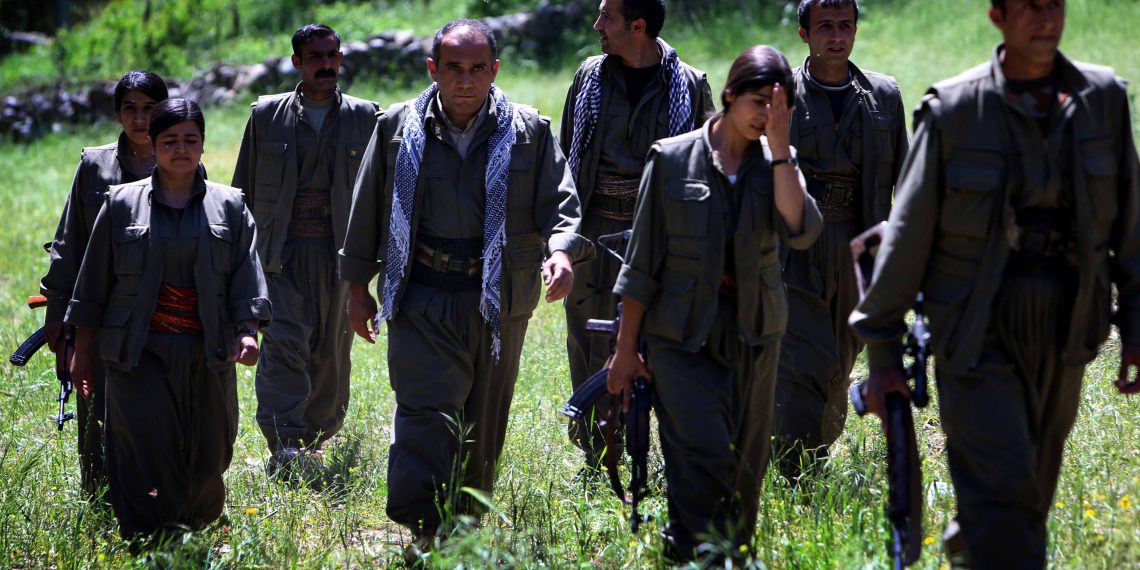
It appears that Washington lacks a clear plan for dealing with the Iranian Kurdish parties, nor does it possess a vision for the future of the Kurds in Iran. Instead, a sense of improvisation has dominated the recent scene, evidenced by the belated American contact with the leadership of these parties. Furthermore, Trump has appeared hesitant regarding the involvement of the Kurds in a battle whose duration and trajectory remain unknown. This is a matter that raises concern among Kurdish parties both inside and outside Iran, especially since the Kurds had a “semi-bitter” experience with Washington in Syria shortly before the declaration of war on Iran.
Moreover, there are several historical instances of abandonment at critical moments. The Kurds of Iran can hardly forget the reality of American support for Pahlavi Tehran against them; in September 1946, the President of the Republic of Kurdistan (Mahabad), Qazi Muhammad, asked the American Ambassador George Allen to support Kurdish demands—or at least for Washington not to seek hostility toward them. The Kurds aspired for Iran to adopt a “federal” system modeled after the American one, yet the exact opposite occurred when Washington supported Iranian military operations, labeling them as legitimate actions. The Kurds of Iran also read how Secretary of State Henry Kissinger withdrew support for the Kurdish revolution in Iraqi Kurdistan, narrowing the distance between the two opposites, Mohammad Reza Pahlavi and Ahmed Hassan al-Bakr. They recall how Washington turned its back on the Kurdish leader Abdul Rahman Ghassemlou and denied him military support; despite their offer to provide the Peshmerga with a few shoulder-fired Stinger missiles—which Ghassemlou naturally rejected as they would only lead to the destruction of Kurdish cities and villages—Washington kept its relations with the Kurdistan Democratic Party (Iran) below the required level, labeling Ghassemlou a “leftist troublemaker” until it finally granted him a visa to visit Washington (which he never made) just days before his assassination.
Trump appeared confused in his communications with Kurdish leaders during the first two days of the bombing of Tehran. On one hand, Trump views the Kurds as good fighters, but on the other, he does not want his country’s efforts to intensify toward supporting the Kurds in a way that establishes a Kurdish political entity that would be costly for Washington. Unlike Tel Aviv, Washington does not contemplate dismantling the Iranian entity, given the scale of internal challenges and the regional neighborhood’s rejection of such an endeavor. Furthermore, abandoning the Kurds after providing support and pledges could manifest as an image of Trump’s defeat in Iran, and perhaps the region.
It is impossible to comprehend the Kurdish affair in Iran without taking into account a regional environment that is unwelcoming to the creation of a new version of Kurdish autonomy in another part of Kurdistan. This means that Turkey stands to the right of the regional states that refuse to undermine Tehran’s central control over all Iranian territories. Although Ankara’s official pretext appears flimsy—given the Kurdish political pluralism in Iran and the parity of some parties in terms of military, political, and popular weight—it means that the “peg” of the Kurdistan Free Life Party (PJAK) will not be useful for intervention compared to the pretext of fighting the Democratic Union Party (PYD) and the People’s Protection Units (YPG), which Ankara feverishly employed to undermine Syrian Kurdish aspirations.
The positions of the Kurdish parties vary regarding the quest for American-Israeli support, but despite these variations, they read the scene with a mind full of doubt and caution. The regime is still capable of managing the conflict, and its chances of survival—even if it transforms into a ghost of a former regime—remain extant. This dictates that Kurdish forces adopt a “Third Way” formula, whether they declare it or not. This is further bolstered by the fact that the Iranian opposition does not provide the necessary reassurances regarding the future of Kurdistan. There is also the possibility that Tehran might alter its policies toward Washington and reach a last-gasp settlement if it feels an internal danger, choosing to reach an understanding with the outside to crush the inside and suppress Kurdish aspirations.
In the Iranian political and social imagination, there is a lack of trust mixed with suspicion and doubt regarding the idea of cooperating with the outside, whoever that “outside” may be. This can be interpreted as a reflection of Iranian national sentiment; while Iranians might rejoice at the assassination of their country’s leaders, they see an influential foreign role as nothing more than a mine-clearing operation that paves the way for them to rebuild a new and independent Iran. This issue is hardly limited to the Persian element; it extends to all national ethnicities and their near-total lack of trust in the idea of unconditional cooperation with the outside. In contrast, one can speak of a Kurdish lack of trust spanning nearly a century, ravaged by many instances of “betrayal” by successive regimes. Whether Tehran is under pressure or not, the matter can be explained in light of the Kurds’ historical mistrust of the Iranian regime. Since the Shah’s Prime Minister Reza Khan, “Qavam os-Saltaneh”—the man who contributed to the liquidation of the Kurdish experiment—promised Qazi Muhammad to respond to Kurdish national demands and expand the Republic of Kurdistan beyond Mahabad, the Kurdish side has been skeptical of the authorities’ promises and their seriousness in addressing the Kurdish cause. Tehran has assassinated tribal and political leaders of various orientations, and Iranian President Masoud Pezeshkian’s hint at expanding provincial powers during the war comes as a faint lure, if not an offer whose time has already passed for the Kurds.
Another notable aspect amidst Kurdish fears of proceeding with military escalation is the existence of a social/political division represented by the roles of the “Jash” Kurds (collaborators with the Iranian regime). Aside from the social and political status and financial benefits they have acquired, they have not decided to join the Kurdish national efforts calling for a break from the regime. Perhaps the process of defection is one of the vital indicators of the regime’s approaching end, as occurred in Iraq in 1991.
In all likelihood, Washington has abandoned its conceptions of ending the war via a ground crawl; according to its trajectory, the war will not be a ground war or in need of surgical military intervention on the ground, whether direct or through allies. Here, the importance of relying on the coalition of Kurdish parties formed last February diminishes, especially since those parties demanded a series of guarantees, including air cover, heavy weaponry, trainers, and opening a horizon of cooperation with Washington to become political rather than limited to military and logistical support. In this sense, Kurdistan is no longer the preferred land from which the process of toppling the Iranian regime can begin—an outcome that Kurdish forces no longer prefer either, for fear of a series of catastrophic results. Among these is that they would, in this form, become an “internal enemy” collaborating with the outside, acting on their national identity without a national opposition cover, all under regional hostility to the idea of reshaping the Iranian political system on federal foundations.