


On March 30, 1948, the United States submitted a draft resolution to the United Nations to revoke the Palestine partition plan and place the territory under UN trusteeship. Four months had passed since the partition plan, which Washington was among its early supporters, and a month and a half remained before the scheduled British military withdrawal from Palestine, announced by London. This withdrawal was the spark for fierce fighting over land between Jews and Arabs as that date approached.
The driving force behind the American proposal was Secretary of State George Marshall, who was thinking within the framework of the Cold War, which had begun a year earlier with the Soviets. Marshall was also the architect of the Marshall Plan (April 3, 1948), aimed at reconstructing Western Europe after Eastern and Central Europe had fallen under Stalin’s influence. Marshall was not only concerned about the negative repercussions for Washington of possible estrangement between America’s Arab allies and the West—particularly Saudi Arabia, which, along with Iraq, had become a major supplier of oil to the United States and Europe—but he also viewed with apprehension the Kremlin’s growing flirtation and connections with Zionist military organizations. These included Lehi (Stern Gang), led by Yitzhak Shamir—who later in the 1950s became a leader of the Israeli Communist Party—and the Irgun, led by Menachem Begin, which had bombed the King David Hotel in Jerusalem in 1946, the headquarters of the British military command. This culminated in Moscow’s race with Washington to approve the partition resolution.
In oral communist histories, the explanation for this sudden Soviet trend regarding Palestine—which led one of the Iraqi Communist Party’s documents, “Light on the Palestinian Question” (June 1948), to describe Stern and Irgun as “two progressive organizations”(Hanna Batatu: Iraq: The Second Book (The Communist Party), Arab Research Foundation, Beirut 1992, p. 259)—was due to Stalin’s calculation that the clash between the Zionist movement and London, which involved the Haganah—the most powerful military organization at the time, led by Moshe Sneh, who later in the 1950s became a leader of the Israeli Communist Party—would open an opportunity for Moscow to establish a foothold in the Middle East and deliver a significant blow to the Western camp, comparable to the losses it had suffered in Eastern and Central Europe.
Marshall’s proposal did not succeed, but his motives remained, and they are likely what prompted U.S. President Harry Truman to compete with Stalin in recognizing the State of Israel after its declaration was announced by David Ben-Gurion on the afternoon of Friday, May 14, 1948. Although Stalin’s gambles did not succeed—and this led him in 1949 to launch the “campaign against cosmopolitanism,” which continued until his death four years later—this campaign resulted in the purging of figures of Jewish origin from communist parties in Eastern Europe (Laszlo Rajik in Hungary, Rudolf Slansky in Czechoslovakia) and the suppression of the once-powerful and historically significant Jewish culture in Russia.
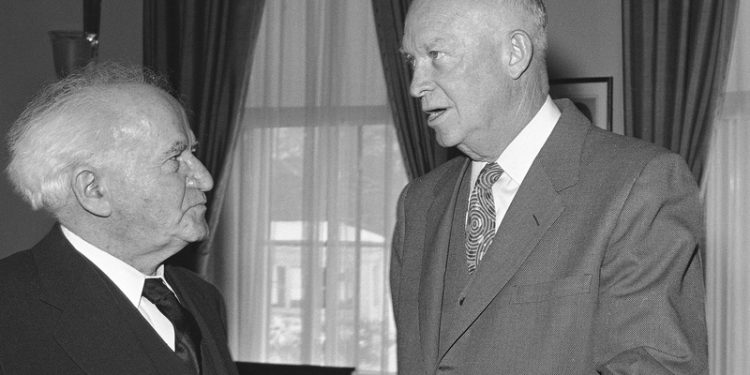
Ben-Gurion, however, was not one of those with pro-American tendencies. Since the 1950s—evident, for example, in the 1956 tripartite British-French-Israeli war against Egypt—he believed that Tel Aviv’s interests lay with the European continent. When the Paris-Bonn axis was formed between Charles de Gaulle and West German Chancellor Konrad Adenauer in the early 1960s, Ben-Gurion placed Israel’s bets on that axis. This angered President John F. Kennedy, who had previously clashed with President Dwight Eisenhower, who had forced him to withdraw from Sinai after the 1956 war.
The Levi Eshkol-Golda Meir alliance within the Mapai party in 1963 was based on a view opposing Ben-Gurion’s, aiming instead to establish a close alliance with Washington (Tahani Halsa: “David Ben-Gurion,” PLO Research Center, Beirut 1968, p. 158). Eshkol built this alliance after Ben-Gurion’s resignation, together with President Lyndon B. Johnson in 1964, at a time when the Vietnam War was just beginning.
Now, if we examine the clashes (or divergences) between the United States and Israel, we find the following:
- The confrontation between Eisenhower and Ben-Gurion during the 1956 Suez War and its aftermath.
- Kennedy’s dissatisfaction with Tel Aviv’s rapprochement with Paris and Bonn.
- President Ronald Reagan’s clash with Prime Minister Menachem Begin over the “Reagan Plan” for resolving the Arab-Israeli conflict in September 1982, based on UN Resolution 242, which rests on the principle of “land for peace.”
- President George H.W. Bush’s pressure on Prime Minister Yitzhak Shamir in October 1991 to attend the Madrid Peace Conference, following his threats to cut aid to Israel.
- President Barack Obama’s clash with Prime Minister Benjamin Netanyahu over the 2015 Iran nuclear deal.
- President Joe Biden’s conflict with Prime Minister Benjamin Netanyahu regarding Biden’s refusal to expand the Gaza war beyond October 7, 2023, into Lebanon and Iran. This confrontation continued until September 2024, when Washington gave the green light to extend the conflict from Gaza to Lebanon.
- The disagreement between Israel and the U.S. over the situation in Syria after Bashar al-Assad.
If we review the convergences and agreements, we find the following:
- Johnson and Eshkol agreed on the June 1967 war, which the Soviets saw as “Egypt’s defeat being their defeat as well” (Mohamed Hassanein Heikal: The Road to Ramadan, Dar al-Nahar, Beirut 1975, p. 50), as an American attempt to compensate for the quagmire of the Vietnam War, in which Moscow supported the Vietnamese.
- National Security Advisor Henry Kissinger (in 1969 and 1970) and Prime Minister Golda Meir agreed “to reject any concessions to Egypt as long as Nasser pursued an anti-Western course and was strengthened by the Soviet military presence, and to reject Washington’s alignment with Moscow as long as the Soviets shared a radical Arab vision” (Henry Kissinger: The Crisis: An Analysis of Two Major Foreign Policy Crises; The 1973 War, The Last Month in Indochina, Simon & Schuster, New York 2004, p. 11).
- Kissinger agreed with Prime Minister Yitzhak Rabin on the Syrian military invasion of Lebanon north of the Litani River in June 1976.
- President Bill Clinton agreed with Prime Minister Yitzhak Rabin on the Oslo Accords of 1993 with the Palestinians and the 1994 Wadi Araba Agreement with Jordan.
- Reagan and Begin agreed on the summer 1982 invasion of Lebanon to expel the Palestine Liberation Organization (PLO) from Lebanon.
- President George W. Bush Junior agreed with Prime Minister Ariel Sharon on Washington’s new strategy to combat Islamic radicalism in the post-September 11, 2001, world.
- Sharon supported the US occupation of Iraq in 2003.
- Netanyahu agreed with President Donald Trump’s 2018 decision to withdraw Washington from the Iran nuclear deal.
- Netanyahu also agreed with Trump on a war against Iran planned for June 2025.
However, from multiple perspectives, it was the Arab-Israeli conflict that contributed to undermining American plans in the 1950s to establish regional military alliances, involving key regional states such as Egypt. These alliances would have served as regional extensions of NATO during the Cold War confrontation with the Soviets.
The dependence of some regimes on the West, such as the Iraqi monarchy, was a major reason for the collapse of the Baghdad Pact after the July 14, 1958, coup in Iraq. Nuri al-Said’s alliance with London—who had also participated with Tel Aviv in the 1956 war—was a key factor behind that Iraqi coup. This demonstrated how Western bias, along with its ally Israel, paved the way not only for the emergence of anti-Western regimes but also for pro-Moscow communist forces to come close to seizing power in Iraq after July 14, 1958. All historical references indicate that Israel’s attack on the Gaza Strip in February 1955, which resulted in the deaths of dozens of Egyptian soldiers, was the main motivation for Nasser’s shift eastward to seek arms supplies from Moscow. This allowed Moscow to enter the region through Egypt after its failure to do so via Israel in 1948. Washington was unable to destabilize the Soviet presence in the region until Egypt began turning westward after 1974, away from the Kremlin.
It is now clear that the American plans announced since 2023 to establish a Middle Eastern NATO require Arab-Israeli normalization, with Saudi Arabia stipulating a two-state solution as a condition—an approach that conflicts with the policies of the current Israeli government. In both cases, Tel Aviv appears to be an obstacle to the implementation of major U.S. strategies that were directed against the Soviets during the Cold War. Today, the Middle Eastern NATO is seen as essential to U.S. plans against the growing Sino-Russian alliance, especially since the Ukraine war, which exposed the risks of European dependence on Russian energy. This has coincided with U.S.-European considerations of alternatives to Russian energy sources in the Middle East and the Caspian Basin, particularly Turkmenistan and Azerbaijan.
In summary: Much has been said about Israel’s diminished influence in Washington after the end of the Cold War, which culminated in the Kremlin’s defeat at the hands of the White House. During that period, Yasser Arafat stated, “Israel’s role as the American aircraft carrier against the Soviet Union has ended,” implying an “Americanization of Israeli policy,” and suggesting that Tel Aviv functions as a strategic extension of U.S. policy. This contrasts with a prevalent Arab view that there is an “Israelization of American policy,” based on the belief that the Jewish lobby exerts influence over U.S. decision-makers, making them subordinate to Israeli interests. However, anyone observing the complex relationship between Washington and Tel Aviv recognizes that this relationship operates within a third orbit beyond these two models