


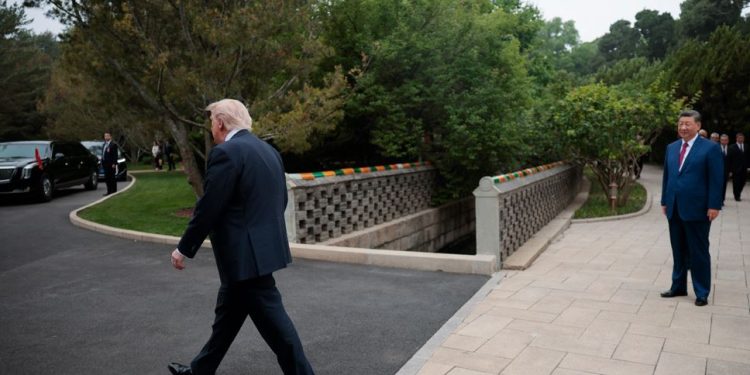
Russian President Vladimir Putin arrived for a visit to China on Tuesday, May 19, 2026, four days after US President Donald Trump departed the Chinese capital following a three-day visit spanning May 13–15.
There are visits that serve as a mirror reflecting the reality of international relations, much like what happened on December 16, 1949, when Mao Zedong, leader of the Chinese Communist Party, arrived in Moscow to be hosted by Stalin two and a half months after the Communists took control of the Chinese mainland. That visit explicitly announced the beginning of an alliance between two states ruled by the Communist Party in the face of the American-European West, which had established the North Atlantic Treaty Organization (NATO) on April 4, 1949, to counter Stalin’s expansion in Europe after he built an Iron Curtain in Central Europe, dividing it between East and West. The Soviet-Chinese alliance was soon translated the following year when Stalin and Mao supported the North Korean invasion of the South, signaling the start of the Korean War (1950–1953). This war nearly devolved into a direct military confrontation between the White House and the Kremlin—a direct confrontational scenario that was repeated only twice thereafter: in Cuba in 1962 and the October War of 1973—while the general trajectory of the Cold War (1947–1989) played out through proxy wars and confrontations between the Americans and the Soviets.
From this perspective, it can be said that the scenes of “Trump in Beijing” and “Putin in Beijing” could together form a mirror image of international relations, just as the image of “Mao Zedong in Stalin’s Moscow” once did. This is particularly true at the moment of an American war on Iran, which is, in a way, an American war on China. Prior to this, and specifically during the Ukrainian war, a tripartite Chinese-Russian-Iranian alliance manifested. Since the days following Putin’s invasion of Ukraine in 2022, there has been an American-European view that complacency with Putin in Ukraine would encourage China to do in Taiwan what the Russians did in Ukraine. If the relationship of the Stalin-Mao duo with US President Harry Truman shaped international relations—not just at the moment of Mao’s visit to Moscow but for a period extending until the onset of the Sino-Soviet split in 1960—then the sight of the three now in Beijing (Donald Trump, Xi Jinping, and Vladimir Putin) charts the course of international relations and provides the space to interpret them through that image.
These three—meaning the Jinping-Putin duo versus Trump—are like the Stalin-Mao Zedong duo versus US President Harry Truman in 1949. The Chinese-Russian alliance emerged most prominently during the Ukrainian war (since February 24, 2022), and three weeks prior to its outbreak. During Putin’s visit to the Chinese capital, the joint statement spoke of a “no-limits bilateral partnership.” Despite China’s traditional anxieties regarding the alteration of existing international borders—which is what Putin seeks from his Ukrainian war—China stood behind him, even if obliquely, in that war. This war could set a precedent that reflects on unstable Chinese regions seeking separation (resembling the post-2014 unrest in the Russian-majority Ukrainian Donbas region), such as Tibet or the northwestern region of China inhabited by the Uyghurs. Furthermore, since collaborating with the Russians to establish the BRICS group of nations in 2009, the Chinese have sought alongside them to achieve a “multipolar world” in defiance of the American unipolarity that crystallized with Washington’s victory over Soviet Moscow in the Cold War in 1989.
Trump’s recent visit to China comes at Washington’s most difficult juncture since 1989, given that the lone American pole is unable to achieve its declared objectives in its war against a medium-power state like Iran (namely the goals of: dismantling the nuclear program, stripping and destroying ballistic weaponry, and severing Tehran’s links with its regional proxies). The American president came to China during the sixth week of the truce, after negotiations with the Iranians reached a deadlock similar to the stalemate of the American military effort in the Forty-Day War, when American weapons, in cooperation with the Israelis, failed to force the Iranians into submission.
From this vantage point, one can interpret Trump’s placating behavior toward the Chinese during his recent visit. This is the same man who, during his first term (2017–2021) and during his return to the White House since the beginning of 2025, had been in a confrontational state with them that culminated last year in the declaration of a global trade war against them. He is now in a predicament brought about by his Iranian war—a war that is not only directed against an ally of China, such as Nicolás Maduro’s Venezuela, whom Trump arrested at the beginning of this year, but is also an attempt to control a primary source of oil energy that Iran represents for China, much like Venezuela. The Chinese know they are in the position of a state that is not self-sufficient in oil, similar to Germany and Japan in World War II, along with the major vulnerability that reality posed to Hitler and the Japanese military. General Michael Kurilla, commander of US Central Command (CENTCOM), pointed to this as far back as 2023 when he noted that the Middle East is a primary source of Chinese oil imports, and that these imports pass through maritime straits like Hormuz and Malacca—the latter of which hosts a US military base.
In all likelihood, this placed the Chinese president in a position of strength before Trump in Beijing, and it is most probable that the American president returned from there “empty-handed” regarding Chinese assistance for his Iranian anxieties, and concerning his overall interests in US-China relations. This occurred despite his insinuations opposing “Taiwan independence,” a stance Washington has maintained since establishing diplomatic ties with the People’s Republic of China in late 1978 during the era of President Jimmy Carter and his National Security Advisor Zbigniew Brzezinski, while continuing to reject Beijing’s attempts to alter the status quo between the Chinese mainland and the island of Taiwan. Ever since his secret visit to China in July 1971 via the Pakistani intermediary channel, Henry Kissinger knew that leveraging the Sino-Soviet split in favor of the Americans to tilt the global balance against the Kremlin in the Cold War would cost the withdrawal of US recognition of “Nationalist China” (Taiwan) in favor of “People’s China.” Yet, because of the bilateral US-China balance—which tipped in Washington’s favor at the time—China was unable to guarantee that this recognition (which occurred in October 1971 and led to the People’s Republic of China taking Nationalist China’s seat at the UN Security Council) would include American recognition of the People’s Republic’s sovereignty over Taiwan, similar to what the British conceded regarding the Hong Kong issue.
Consequently, the atmosphere of Putin’s visit to Beijing was warmer than Trump’s visit. This stems from what unites Russia and China against the sole American pole and their shared goal of reaching a “multipolar world,” as well as their shared, tacit gratification regarding the American inability to achieve the objectives of the war on Iran. However, it is highly probable that the proposal put forward by Putin to Xi to make Russia the primary source of China’s oil and gas imports will cause the Chinese president much hesitation. Xi recalls China’s experience with the Soviet Union in 1960, when Nikita Khrushchev withdrew Soviet experts from China, nearly causing the collapse of the Chinese economy. In that year, Xi’s father was China’s deputy prime minister, prior to being purged from his position by Mao and persecuted during the Cultural Revolution (1966–1969).
In synthesis: the relationship of the Washington-Beijing-Moscow triad is pivotal to understanding international relations, given that these three have been the most influential forces in the course of international relations from the second half of the twentieth century to the present. Many historians consider the Soviet-Chinese alliance of the 1949–1960 period to be what placed the American-European West on the defensive. From its atmosphere, the Non-Aligned Movement emerged. Within its climate, Western European Communist parties experienced a prolonged period of ascendancy. Many historians also contend that the retreat of the global leftist wave, whose momentum began with the October Revolution of 1917, commenced with the Sino-Soviet split in 1960. Anyone reading Henry Kissinger’s memoirs can observe how he calculated that Washington’s rapprochement with China would compel the North Vietnamese to concede or soften their stance in negotiations, compel the Soviets to soften their position in strategic arms limitation talks, and create a situation that would tilt the balance of power between the two superpowers in Washington’s favor. This appears to have been Moscow’s view as well; in conversations with foreign visitors, Chinese Communist Party leader Hua Guofeng (1976–1981) revealed that Chinese Defense Minister Lin Biao’s coup attempt (September 1971) was instigated by Moscow to derail the Sino-American rapprochement. Notably, it occurred two months after Kissinger’s secret visit to China. Following its failure, Biao—who opposed rapprochement with Washington—attempted to flee to the Soviet Union aboard a plane that crashed due to a technical malfunction or was shot down over Mongolian airspace. Since the 1990s, after China came to be viewed as the primary competitor to the Americans, successive White House administrations moved toward drawing the Russians closer to detach them from the Chinese. This continued until 2017, when the “US National Security Strategy” report was issued, placing China and Russia in the same category as threats to the United States. Red lights flashed in America with the emergence of the Chinese-Russian alliance following the Ukrainian war. Judging by Trump’s 28 points on Ukraine, it appears that since last year he has been attempting to pull Russia away from China by feeding them “Ukrainian sweets,” despite this move provoking the ire of the Europeans. His war on Iran is, in a sense, a war on the triad of the Chinese-Russian duo, and it may be his faltering in that war that made him soften his stance in Beijing; yet it seems he failed to achieve his desired outcome from that visit.