


In 1889, Russian engineers proposed a canal linking the Caspian Sea to the Indian Ocean off the southern coast of Persia (Iran since 1935), east of the port of Bandar Abbas. Naser al-Din Shah Qajar (1848–1896) hesitated to accept the plan, fearing the British, who throughout the 19th century had been engaged in a major rivalry with the Russians over Persia and Afghanistan, as the Russians began expanding southward. London stood as a barrier to the Russians’ attempts to control the Bosphorus and Dardanelles straits after the Russian state expanded towards the Sea of Azov and the Crimean Peninsula in the 1760s and 1770s. The Slavic Question and the Balkan conflicts served as pretexts for instigating wars with the Ottomans, aiming to weaken the Ottoman Empire and achieve Russian control of the Bosphorus and Dardanelles, thereby gaining access to warm-water ports.
The Russians felt (and still feel) that the Black Sea was like a bottle blocked by the straits, so they tried through wars with the Ottomans to break that blockage. The British barrier was an obstacle, and when they agreed to kill the “sick man” in the 1915 and 1916 agreements and divide his possessions, the straits were at the top of the Russians’ demands from the British and French.
The “Bosphorus-Dardanelles” knot was behind that Russian project to bypass them by sea via a new maritime canal dug in the Iranian land, later named “Iran Rud: Iran River,” during the reign of Shah Mohammad Reza Pahlavi when the project was studied again in 1968. Under American pressure, it was shelved, then revived during the time of the Islamic Republic, only to be shelved again due to the fear of the companies nominated to implement it of the sword of American sanctions.
These Russian attempts to circumvent the Bosphorus and Dardanelles straits by sea via a canal being dug in Iran did not prevent them from considering a land route to bypass these straits. This involved a railway project parallel to the western coast of the Caspian Sea, linking Russia and Iran through Azerbaijan. The agreement was signed on May 17, 2023, and the railway would connect Iran to Bandar Abbas. Notably, India also showed interest in this project, proposing a sea link between Mumbai and Bandar Abbas for the export and import of goods to Europe and then on to India. This was before the Indian Corridor project, launched on September 10, 2023, under US auspices. The Indian Corridor project planned to connect Mumbai to the UAE coast or the coast of Oman, and from there overland to the port of Haifa, and then by sea to Europe and vice versa.
If the Russians have the Bosphorus-Dardanelles strait, then China has the Strait of Malacca, located between the Indian and Pacific Oceans. It lies between the western coast of Malaysia and the eastern coast of the Indonesian island of Sumatra, with the strait’s opening at Singapore, where a US military base is located. Eighty percent of China’s energy imports pass through this strait (50% of China’s oil imports come from the Middle East; according to 2024 figures, China needs 16 million barrels of oil per day, 11 million of which are imported, with 90% of oil imports arriving by sea and the remainder overland via Russia). It is the most important global strait, serving as a passage for 25% of global trade, 35% of seaborne oil, and 20% of liquefied natural gas (LNG) (2024 figures). This is in comparison to the one-fifth of oil and LNG that passes through the Strait of Hormuz, 12% of global trade that passes through the Bab el-Mandeb Strait, and 10% through the Suez Canal. Suez.
The Chinese, therefore, devised ways to circumvent Malacca: First, by leasing the port of Gwadar in Pakistan since 2013 and connecting it overland via highways and railways to transport Chinese exports and imports. A planned oil pipeline from Gwadar to mainland China, however, was hampered by the mountainous terrain. A Chinese-Iranian initiative, which Pakistan has been hesitant about and continues to be hesitant to pursue, aimed to connect Iran’s South Pars gas field to Gwadar and then on to China. Second, via the coast of Myanmar (Burma) at the port of Kayakvyu since 2013, which connects to mainland China via oil and gas pipelines, including those carrying Myanmar oil and gas, as well as oil and liquefied natural gas imported to China from the Middle East, along with highways and railways to transport Chinese imports and exports. Third, there was a project presented by China to Thailand in 2015 to construct a canal linking Thailand’s western coast on the Indian Ocean (the Andaman Sea) with its eastern coast on the Gulf of Thailand (on the South China Sea). Thailand hesitated under American pressure to build this 102-kilometer-long, 400-meter-wide, and 25-meter-deep canal, which, if built, would save China, Japan, and all of East Asia 1,200 kilometers of sea travel. Fourth, there is the Belt and Road Initiative, proposed by China in 2013, which, in addition to the aforementioned bypass roads, includes the Eurasian Road (China – Kazakhstan – Russia – Ukraine – Europe) and the Middle Eastern Road (China – Pakistan – Iran – Turkey – Europe), for transporting Chinese goods via highways and railways.
This situation, which includes an open war with a strait controller (Russia and the Ottomans) and a latent, silent, cold, or anticipated war with a strait controller (China and America controlling the Strait of Malacca), saw Iraq find itself in the first instance during the Iran-Iraq War of 1980-1988. Therefore, it extended the Zubair-Yanbu oil pipeline (1.6 million barrels per day) on the Saudi coast of the Red Sea to bypass the Strait of Hormuz. Similarly, Saudi Arabia found itself in the second instance with Iran during the same period. Therefore, it extended the East-West oil pipeline from the Abqaiq field to Yanbu, with a capacity of 7 million barrels per day. Since 2015, which coincided with the Saudi military campaign on Yemen after the Houthis took control of Sana’a, Saudi Arabia has been considering the construction of the “Salman Canal,” which extends from the Saudi coast on the Gulf separating the UAE and Qatar to the Yemeni coast at Hadhramaut (or Al-Mahra), with a length of 950 km, a width of 150 meters, and a depth of 25 meters. This could enable the Gulf states and Iraq to bypass the Strait of Hormuz. It is likely that the Saudi-Emirati confrontation that took place at the beginning of 2026, through local proxies, to control Hadhramaut and Al-Mahra, was motivated by this Saudi thinking in Riyadh.
Here, it should be noted that the (Indian Corridor) project, September 10, 2023, which was signed in New Delhi in the presence of US President Joe Biden and the absence of the Chinese President during the G20 summit, includes a bypass of the Straits of Hormuz and Bab al-Mandab and the Suez Canal, through a sea route extending from Mumbai to the UAE coast on the Gulf of Oman (or the Omani coast) and then overland to Haifa and then by sea towards the Greek or Italian coast, and in both directions. But just as American companies withdrew themselves from the EastMed project in 2022, signed between Israel, Cyprus and Greece in 2020 to extend a gas pipeline under the sea from Israel to Greece and from there to Europe via the islands of Cyprus and Crete, due to the obstacles of the seismic line located on the eastern coast of the Mediterranean Sea that threatens the pipelines if they are built, and due to a sea depth of up to three thousand meters that is uneven, which makes the pipeline on slopes and elevations, in addition to the fact that the Turkish-Libyan maritime border agreement in 2019 cuts off the way for (EastMed) in the maritime area between Cyprus and Crete, it is likely for the same reasons that the (Indian Corridor) to Europe will be overland via Syria and Turkey and not sea, including that the Syrian-Turkish overland route will be the Israeli and Egyptian gas pipelines (the latter: via Jordan and Syria) to Europe.
Avoiding bypassing maritime straits may be for economic reasons, related to shorter distances, lower costs, and faster delivery times, as seen in the Kirkuk-Haifa oil pipeline (1932), the Kirkuk-Banias oil pipeline (1952), and the Tapline oil pipeline (1950) extending from Saudi Arabia to Lebanon via Jordan and Syria. The obstruction of this bypass route may also be due to political clashes and conflicts with the authority controlling the bypass, prompting the oil-producing country to construct an alternative pipeline. Iraq did this in 1976 and 1987 when it built the Kirkuk-Ceyhan pipelines on the Turkish coast as a result of the rivalry between Baghdad and Damascus, stemming from tensions that began in 1975 and culminated in the closure of the Kirkuk-Banias pipeline in 1982.
These detours may be economical in form, but in essence or depth, they are part of a major international competition, such as the Qatari gas project towards Europe via Saudi Arabia, Jordan, Syria and Turkey, which was rejected by Bashar al-Assad in 2009, as the Americans and also the Europeans thought that this line, along with the Nabucco gas pipeline, signed in 2009, coming from Turkmenistan and Azerbaijan via Georgia and Turkey, would be an alternative to Russian gas.
Some dates can have significance in these major international competitions, such as the following dates: February 4, 2026, Chevron’s contract regarding gas and oil on the Syrian coast; February 16, 2026, Chevron’s contract to invest in gas on the southern coast of Greece; February 23, 2026, Chevron’s contract with Basra Oil Company to invest in oil fields that constitute 12% of Iraq’s oil.
It should be noted here that Chevron entered into investment in the Egyptian offshore gas fields in 2019, and in 2020 it entered into a partnership to invest in the Tamar and Leviathan gas fields off the coast of Israel, and in 2020 Chevron entered into investment in the Aphrodite gas field off the southern coast of Cyprus.
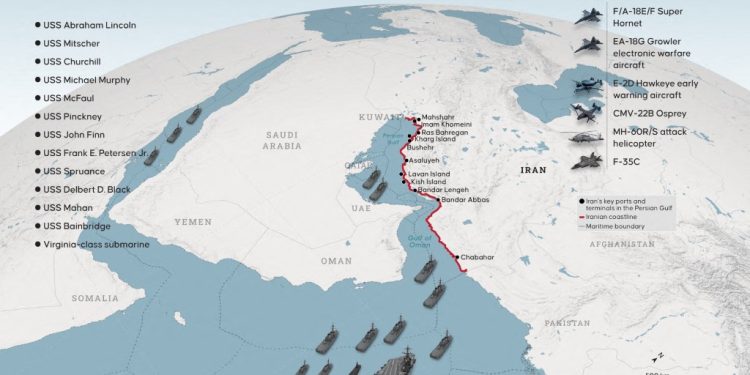
The question now is: Will the (Strait of Hormuz crisis), which erupted with and after the forty-day war, increase the international tendency towards circumventing maritime straits in order to “retire them”?
Sources for further reading
Myanmar’s pipeline for Chinese energy imports
Thai Canal Project
https://www.geopoliticalmonitor.com/kra-canal-the-impossible-dream-of-southeast-asia-shipping/
Qatar Gas Pipeline
Arab Gas Pipeline – Egypt
Islamic Gas Pipeline – Iran
All of these were offered in the first decade of the 21st century via Syria and Türkiye to Europe as an alternative to Russian gas.
https://smallwarsjournal.com/2025/02/05/assads-fall-and-the-qatari-gas-pipeline/
Iran Road
https://en.wikipedia.org/wiki/Iranrud
Salman Channel
Saad bin Omar, head of the “Arab Century” Center for Studies in Riyadh, revealed the preparation of a comprehensive study to link the Arabian Gulf by sea to the Arabian Sea via a waterway. (September 2015)
EastMed Gas Pipeline Project (Leviathan Field in Israel – Aphrodite Field – Cyprus – Crete – Greece)
https://www.gem.wiki/EastMed_Gas_Pipeline
Geological obstacles to the EastMed underwater project
Eastern Mediterranean Basin Gas (Syria – Lebanon – Israel – Palestine – Egypt)