


With the accelerating pace of transformations occurring in the structure of the international system and the increasing competition among major powers, the Sino-Iranian rapprochement emerges as one of the most influential paths shaping the Middle East. This rapprochement is closely linked to Beijing’s growing need to diversify its energy sources and ensure the security of its supplies. It is also intertwined with Tehran’s efforts to break free from Western sanctions and strengthen its economic and political position through Asian partnerships, especially following recent military confrontations with Israel. Given the multiplicity of driving and pressing factors, it is crucial to anticipate potential scenarios of this rapprochement and monitor its repercussions on regional power balances. This understanding can assist decision-makers and researchers in grasping its future directions and outcomes.
First: Determinants of the Sino-Iranian Rapprochement
Energy and Economy
Iranian oil exports constitute the cornerstone of the relationship between Beijing and Tehran—not only as a commercial exchange but also as a strategic mechanism that grants both parties leverage and maneuvering space. The importance of this is evident on several levels:
Volume and Direction of Exports: China’s imports of Iranian oil reached between 1.3 and 1.4 million barrels per day during the first half of 2025. Despite the restrictions imposed on Tehran, this dependence remains steady. Most of these shipments are sold to independent Chinese refineries (or “teapots”) based in Shandong Province. These refineries are more flexible than other major national refineries, making them an ideal channel for absorbing Iranian oil away from international scrutiny.
Discounts and Pricing: Tehran is compelled to offer increasing discounts, sometimes ranging from $8 to $12 per barrel compared to Brent crude or even competing Gulf crudes. This mechanism achieves two parallel benefits: firstly, Beijing obtains supplies at lower prices during an economic slowdown with weak energy demand, reducing costs for domestic industries and bolstering its strategic reserves; secondly, dollar revenues continue to flow into Iran, even if at reduced prices, providing it with vital cash flow to fund its budget and circumvent banking restrictions.
Risk and Inventory Management: Although the “teapots” refineries have reduced their purchasing pace due to overflowing storage and declining domestic demand, China continues to import for reasons beyond immediate needs. These include increasing strategic reserves in anticipation of future disruptions in global energy markets and diversifying supply sources to reduce dependence on traditional Gulf oil or Russian imports, which face harsher sanctions.
Sanctions Circumvention: Beijing offers Tehran practical means to bypass US sanctions through complex payment methods, including settlements in Chinese yuan or barter exchanges for goods and services. This ensures Iran’s continued oil trade outside Western financial systems, while China enhances the international use of its currency.
This dynamic grants both sides a geopolitical leverage: Iran uses its exports to China as a “safety net” to sustain its economy despite sanctions, while China leverages Iran as a bargaining chip in its relations with Washington and the European Union, emphasizing that its energy alternatives extend beyond the Gulf or Russia.
Second: The Diplomatic and Legal Path
At the international level, China’s stance is one of Tehran’s most important pillars in countering Western pressures, especially regarding attempts to reimpose sanctions through the “snapback” or “trigger mechanism,” which was included in the 2015 agreement. This mechanism stipulates the automatic reimposition of international sanctions if Iran violates the agreement’s terms, without requiring a Security Council vote, thereby avoiding the possibility of China or Russia exercising their veto rights. This is reflected in several aspects:
The current position within the Security Council: Beijing, in coordination with Moscow, has led efforts to oppose activating the “snapback” mechanism, arguing that Washington lost its legal legitimacy to invoke this measure after withdrawing from the nuclear deal in 2018. This stance has provided Iran with strong political cover at the United Nations and sent a message that it has allies among the permanent members of the Council.
Prolonging negotiations: China seeks to buy time by advocating for extending negotiation deadlines rather than rushing into the reimposition of comprehensive sanctions. This serves Tehran’s interests, which require more time to ease pressure, and also benefits Beijing, which views continued negotiations as a means to contain escalation between Washington and Tehran, thus helping maintain relative stability in energy markets.
Confrontation at the United Nations: When the Security Council failed to prevent the reimposition of sanctions due to a US-EU veto, Beijing explicitly announced its stance in the UN General Assembly, rejecting what it called “coercive dictation” in the reimposition of sanctions. This was more than a diplomatic statement; it was a symbolic move that reinforced China’s image as a defender of international multilateralism and opposed the US’s unilateral sanctions approach.
Overall, this positioning has allowed Iran to reinforce its political narrative that it is not isolated internationally, and that major powers (namely China and Russia) consider sanctions illegitimate. It has also opened the door to temporary agreements with Chinese and Russian companies, benefiting from political cover that offers some protection from Western pressures. Moreover, this stance has helped keep the prospects for understanding open, enabling Iran to maneuver between partial compliance with the nuclear deal and strategic pressure, such as increasing uranium enrichment levels.
On a broader strategic level, China’s support for Iran extends beyond legal considerations; it fits within its overarching vision of opposing US dominance in the international system. Whenever Washington confronts Tehran, Beijing seizes the opportunity to position itself as a counterbalance to American unilateralism and as a strategic partner for countries facing sanctions.
Third: Multilateral Frameworks and Long-term Agreements
The Strategic Cooperation Agreement signed between Beijing and Tehran in March 2021 is one of the most prominent symbols of their mutual desire to establish a long-term partnership. Although most of its provisions remain within the realm of political declarations rather than concrete commitments, it carries several significant implications:
Economic and investment framework: The agreement initially envisions broad cooperation encompassing energy, infrastructure, communications, technology, and even military and security collaboration. Despite initial expectations of Chinese investments potentially reaching $400 billion, actual implementation has been modest and sporadic. This is due to major Chinese companies’ caution about exposure to US sanctions, the weaknesses in Iran’s financial and banking infrastructure, and China’s prioritization of more stable investment opportunities in the Gulf or Africa over the Iranian market.
Symbolic and strategic dimension: Despite limited implementation, the agreement provides a “political umbrella” reflecting China’s long-term vision regarding its relationship with Iran. It offers Tehran a sense of security that it is not entirely isolated or constrained within the US-dominated international order.
Multilateralism through international organizations: Iran’s accession to multilateral frameworks such as the Shanghai Cooperation Organization (SCO) gives it opportunities to participate in regional energy and transportation projects and provides channels for security coordination with major powers like China, Russia, and India. It also enhances Iran’s political legitimacy as part of a bloc advocating “multipolarity” and offers avenues for conducting trade in national currencies, reducing reliance on the dollar.
Although joining these frameworks has yet to yield immediate economic benefits or substantial investments, their value lies in expanding trade channels (albeit within limited scope), granting political legitimacy to the Iranian regime by demonstrating its recognition in alternative international institutions, and bolstering the narrative of resistance against Western hegemony—an approach Iran aims to strengthen both domestically and internationally.
Fourth: Security and Mediation
China’s approach toward Iran is primarily organizational and mediatory rather than based on a direct military alliance. Beijing is keen to utilize its diplomatic tools to maintain regional stability without slipping into comprehensive defense partnerships. At the regional mediation level, China played a prominent role in the Saudi-Iranian reconciliation announced in March 2023. This diplomatic achievement elevated Beijing’s position as an acceptable mediator for both parties, especially at a time when the United States had a reduced presence in the issue. This mediation exemplifies China’s role as a “regional balancer,” prioritizing rapprochement over taking sides, in line with its vision of energy security and the stability of trade routes. Despite this, Beijing seeks to maintain a balance in its regional relations, particularly with Gulf countries such as Saudi Arabia and the UAE, which are primary sources of its oil imports. Simultaneously, Beijing maintains communication channels with Israel, especially in technology and investments, which prevents it from fully siding with Tehran on sensitive issues such as the nuclear program or regional conflicts.
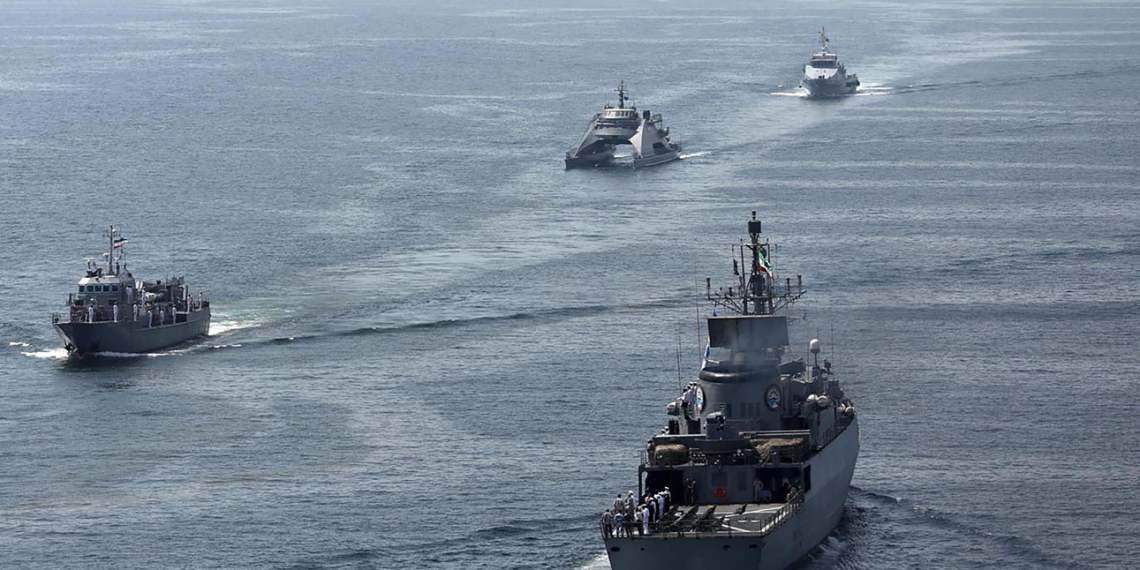
This approach is reflected in the increasing levels of defense cooperation across multiple dimensions, such as joint naval exercises with Russia and Iran in the Indian Ocean and the Gulf of Oman. These send symbolic messages of strategic rapprochement. There is also growing interest in enhancing cooperation in non-traditional defense areas such as cybersecurity and dual-use military technology. However, this cooperation remains limited in scope and impact, especially compared to Iran’s military cooperation with Russia, or China’s arms purchases from more stable countries.
Nonetheless, this approach is not without constraints and strategic considerations. Beijing does not wish to turn Iran into a full-fledged military partner, fearing it may provoke the United States or undermine its economic relations with the Gulf. Therefore, its main focus remains on protecting maritime trade routes and ensuring stability in the Strait of Hormuz and the Arabian Sea. This explains China’s preference for mediation rather than outright alliances.
Potential Regional Impacts
The above developments carry several potential regional implications, which can be summarized as follows:
Energy markets and supply chains, The continued flow of Iranian oil to China provides a vital financial lever for Iran, helping to mitigate the impact of Western sanctions and enabling Tehran to fund its regional networks in Iraq, Syria, Lebanon, and Yemen. Reliance on “shadow fleets” for oil transportation and the lack of transparency regarding Chinese oil inventories create information gaps that contribute to increased volatility in global oil prices. These fluctuations generally affect the budgets of regional oil-exporting countries (such as Saudi Arabia and Iraq), which are impacted by fluctuating oil revenues, posing challenges to development plans and public spending. Similarly, oil-importing countries (such as Egypt, Jordan, and Morocco) face greater budgetary pressures due to rising import costs and fuel price volatility.
Deterrence in maritime corridors, As Iran’s financial capacity improves thanks to oil revenues, its ability to withstand pressures and costs associated with escalatory activities in sensitive maritime areas like the Arabian Gulf and the Red Sea increases. This means Tehran will continue relying on indirect tools such as proxies to threaten navigation or increase deterrence costs for adversaries. However, China remains keen to avoid widespread disruptions to trade flows, as maritime stability is vital for the Belt and Road Initiative and Chinese energy security. Thus, the relationship between Beijing and Tehran influences Iran’s behavior, balancing tactical escalation with a commitment to overall strategic stability.
Sanctions and compliance, Even if UN sanctions are reactivated, China remains a key route for Iran to circumvent the sanctions regime, whether through yuan-based settlements or indirect trade mediated by third countries. However, this increases compliance risks for Middle Eastern banks and companies involved, especially those indirectly connected to Iranian-Chinese oil trade. Any unintended involvement could lead to secondary sanctions against entities in Arab or Asian countries, fostering a climate of heightened caution in commercial and financial dealings.
Diplomatic influence, China is strengthening its capacity to act as a pragmatic mediator in the region, leveraging its success in sponsoring the Saudi-Iranian agreement in 2023. This gives Beijing additional leverage as an alternative negotiating channel to Western diplomacy and reduces, at least temporarily, the effectiveness of US and European pressure. However, China’s role remains primarily diplomatic and organizational; it has not evolved into a direct “security guarantor” like the United States. Its influence, therefore, remains limited in managing major military crises.
The Iranian-Chinese rapprochement ranges between the following scenarios:
Scenario 1: Deepening the Economic Partnership Without Security Breakthroughs
In this scenario, China is expected to diversify its energy sources, reduce supply costs, and strengthen influence over supply corridors. For Iran, this would translate into maximizing revenues amid restrictions and securing financing for infrastructure, refining, and petrochemical projects. This could be achieved through various mechanisms, such as long-term supply contracts with flexible discount systems, settlements in yuan, or swaps (oil or petrochemicals for equipment and infrastructure). Additionally, discounts on Iranian crude could expand to Asian markets, shipments could increase, and new credit lines, alternative payment mechanisms, and intermediary banks could be activated, supported by projects in ports, economic zones, renewable energy, and transportation networks.
However, this scenario might face constraints such as the tightening of secondary sanctions on Chinese companies and banks, as well as insurance risks for vessels. These factors could, in turn, enhance Iran’s financial resilience while allowing China to increase its influence in the regional energy market without provoking security escalation.
Scenario 2: A Cautious Balance with a “Regional De-escalation Architecture”
China is keen to avoid losing Gulf markets, thus limiting the security dimension and emphasizing its mediating role. This is achieved through maritime security dialogues and arrangements for de-escalation in waterways such as the Strait of Hormuz, the Arabian Sea, and the Red Sea. China seeks to balance economic contracts with Tehran and reassurance guarantees to Gulf partners, which reduces risks to navigation and insurance, and maintains Iran’s economic integration without a binding security alliance.
Recently, China has issued repeated statements of “restraint,” along with convening maritime working groups and three joint meetings involving Iran and Gulf states. Nonetheless, this approach could be challenged by sudden maritime incidents or proxy strikes that disrupt the de-escalation process, posing risks to navigation and security, and potentially limiting Iran’s economic integration without a formal security commitment.
Scenario 3: Gradual Strategic Escalation
The ongoing structural tensions with Washington could prompt Beijing to expand its indirect deterrence measures and assist Iran in acquiring dual-use technology. This might involve advanced naval exercises, cooperation in reconnaissance and surveillance, dual-use communication platforms, or commercial satellites, as well as technology transfers in industrial and cyber sectors to bolster Iran’s economy.
However, this scenario faces significant obstacles, including the imposition of severe sanctions and possible counter-responses from Washington, Israel, and Gulf states, especially in maritime security. Such developments could lead to an arms race, mutual deterrence escalation, and increased tensions in shipping and insurance markets.
Scenario 4: Setbacks and Stumbles Due to Secondary Sanctions and Tightened Chinese Compliance
The costs of compliance for Chinese firms might surpass the benefits gained from the Iranian market under mounting pressure. This could involve blacklisting intermediary banks or shipping companies, along with compliance warnings issued to Chinese financial institutions. Such restrictions might lead to transactions being diverted to more costly and less sustainable channels, thereby slowing Belt and Road projects in Iran, and increasing supply and price volatility for Iran’s economy.
Scenario 5: Institutional Deepening Through Multipolar Blocs
This involves building institutional networks to counteract dollar dependence and sanctions, activating alternative corridors within the Belt and Road Initiative. Measures could include local currency clearing agreements, establishing joint banking or funding institutions, and developing railway and port links connecting Iran with Central Asia and the Caucasus.
However, infrastructural gaps and conflicting interests among Russia, Turkey, and Gulf states could pose significant challenges. Increased regional interconnectivity and supply chain reengineering might broaden Iran’s engagement opportunities, creating a longer-term, gradual path of institutional integration.
Conclusion:
Based on the current dynamics, the most probable scenario appears to be the deepening of the energy-related economic partnership between China and Iran. Beijing aims to secure low-cost energy supplies and expand its logistical influence, while Tehran views this rapprochement as a strategic tool to offset sanctions and enhance resilience.
Nevertheless, this path is likely to be maintained with a cautious balance—preserving communication channels with Gulf partners and avoiding full security alliances. Other scenarios, such as military escalation or setbacks caused by sanctions, are less probable or contingent on exceptional circumstances. Meanwhile, institutional deepening through multilateral platforms like BRICS and the Shanghai Cooperation Organization remains a long-term, incremental approach.