

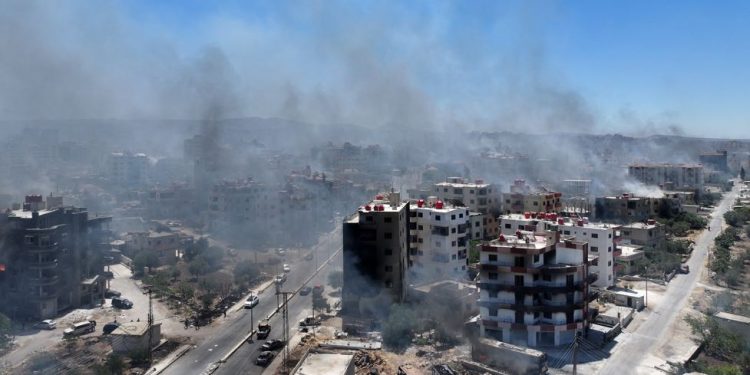
Since what was termed the “Arab Spring,” the Middle East region has endured a tragic state in its contemporary history. There is a catastrophic situation of urban devastation and destruction of cities and social life in general, and massacres with sectarian and religious dimensions have occurred: the genocide against the Yazidis by ISIS in Iraq and Syria; the sectarian genocide against both the Alawites and the Druze by forces affiliated with the “Transitional Government” in Syria; the extermination of over 800 Israeli civilians, according to France-Presse (which has not happened to Jews since World War II), by the Hamas movement during the so-called “Al-Aqsa Flood” operation on October 7th, followed by the killing of tens of thousands of Palestinians in the Israeli counter-attack that lasted almost two years. Moreover, there is a common factor for all these genocides: identity.
Simultaneously with these disasters and genocides, a type of identity discourse is intensely active in this region. It inherently carries one-dimensional, often violently exclusionary characteristics, occurring both at the level of government policies and local organizations, particularly the armed ones. Regional powers (led by Turkey and Israel) and international powers (the United States of America and countries from the European Union) also support this identity discourse, seeking to contend for influence in the region after dismantling the alliances of Iran and its affiliated militias, or what was called the “Axis of Resistance.”
Is it possible to find alternatives outside the logic of the deadly conflict of identities? And what are the mechanisms for producing these alternatives that might lead to new, less violent and destructive values and commonalities?
The “Racialization” of Identity
During the Syrian civil war “in its second phase,” as some call it, the question of national identity emerged differently among political and social forces in Syria. In a country dismantled by war, the current authority and its public communicate in the language of “victimhood” and “reaction” to what happened during the civil war “in its first phase,” and governance models are proposed as solutions to the new reality, such as federalism and decentralization, among others.
In reality, the massacres against the Alawites and Druze since the fall of the Assad regime were often due to the inherited national identity that began forming since independence, expressed through the concept of the religious majority, which is fundamentally based on exclusion and marginalization of any difference. The state, in our case, produces its religiously and nationally biased national identity through its policies and ideological apparatus (the education system, media, official holidays, legal code, state constitution, etc.).
The Syrian national identity appears to grant a privilege of governance to a specific group (Arab Sunni Muslims) on the pretext of numerical dominance linked to religion and nationalism at times, or through the Sunni victimhood narrative alleged to be the result of the rule of the Assads (father and son) at other times.
Even the slogan “One, One, the Syrian People are One” during the period of the so-called “Syrian Revolution” in the context of the “Arab Spring,” concealed a great deal of repression and violence. This “oneness” is nothing but a repressive expression of the manifestations of difference and variation among the peoples and societies of Syria.
But to understand how identity transforms into a violent symbolic system that justifies murder, we must define the meaning of identity and how it is formed.
Identity arises by linking two distinct entities into a single social equation:
1. “ I ”, belong to certain individual attributes (the individual self).
2. “We,” our social existence expresses a collective affiliation (the collective self). Every individual reference to a specific attribute is linked, one way or another, to what exists outside the individual self, meaning it is linked to a higher and more comprehensive self, which is the collective self.
As a result of this correlation between the individual and collective levels, identity is formed as a socio-cultural construct that crystallizes in a specific political reality. But what if this socio-cultural construct becomes the basis for sectarian political action within society?
In this case, this construct may lead to the desire to express an autonomous will of identity, demanding sectarian legitimacy and special rights (We are the majority, and the rightful rulers, because our religious identity holds a higher rank than other identities). This rank is called, for example, in the Syrian legal code, the “Most Noble Religion,” which is Islam. In the context of Arab political culture generally, Islam is the “religion of the state” and a source for legal legislation, public morals, and societal values.
Consequently, the motto “We first” will be the foundation of the dangerous battles of identities; this motto may become the basis for sovereign right and legitimacy, implying the priority of rights (which in this case take on a regional/sectarian dimension) over any rational communication and broader social discussion.
The concept of “Racialization” (or ‘Arqa-na’) of Identity refers to the attribution of a biological dimension to what is a socio-cultural construct. Identity thus becomes as if it were the product of a genetic inheritance process (just as a person inherits their skin or eye color), instead of being a socio-cultural fact, the product of free complex individual choices, and a complex process of socialization. The concept of “Racialization” aims to undermine any individual dynamism or social interaction, while affirming the genetic determinism of identity. The danger of this understanding of identity is that it undermines any individual right to expression or change of belief on one hand, and expresses an essentialist and reductionist tendency of identity on the other.
The process of the “Racialization” of Identity may become a justification for persecution, or even mass killing and genocide, as long as “all” those who belong to a specific identity, according to the logic of this concept, automatically and collectively carry the same pre-defined characteristics. Therefore, the “We first” discourse against the “They” becomes the actual driver for deadly battles based on identity, or even the justification for massacres and genocide. In our region, many suffer from the “Racialization” of Identity, where people often lose their lives after being asked about their affiliation.
In this context, it is important to define what the word “genocide” means. According to the United Nations definitions of genocide, it refers to the total or partial destruction of an ethnic or religious group through: killing members of the group; causing serious bodily or mental harm to members of the group; deliberately inflicting on the group conditions of life calculated to bring about its physical destruction in whole or in part.
Can’t the rights in our countries (especially the right to life and the right to expression) be viewed as primarily individual? On the other hand, wouldn’t it be better to consider the committed crimes as crimes with a designated perpetrator (at least legally/judicially) and an ideological background, rather than crimes based on the identity into which an individual is born? Weren’t the Yazidis exterminated based on this “Racialization” of their religious identity? It seems that the mentality of ISIS followed a very modern political pattern, even if it relied on religious heritage texts; that is, it operated according to the following logic: We are the “Islamic Nation” embodied in the “Islamic State of Iraq and Sham,” and “We” alone possess sovereignty and legitimacy, and these Yazidis are an ethnic/religious group that must be enslaved or exterminated.
ISIS resembles the nationalist ideological pattern that was deeply rooted in the Ba’ath regimes (Saddam Hussein and Assad), which is primarily based on unifying the “Nation” into one “Arab Homeland,” with all the exclusion, displacement, and massacres against minorities and other nationalities that this “Homeland” entails (what happened to the Kurds in Syria, for example, during the displacement of Kurdish farmers by the Ba’ath regime in what is known as the “Arab Belt” in Hasakah Governorate).
Moreover, Hay’at Tahrir al-Sham (formerly Jabhat al-Nusra), which, after the fall of the Assad regime, merged into the current authority in Damascus, is the ideological heir to the idea of the monolithic Nation embodied in the State, and is always ready to commit massacres against religious minorities and other nationalities.
The War of Discourses
After the fall of the regime and the escape of Bashar al-Assad in December of last year, some popular songs emerged in Syria that rely on history. In one of those songs, we find phrases like: “God favored the Umayyads” and “Sunnis, we are the identity, Sunnis from the Umayyads.” Regardless of the ignorance of many of these people about the history they sing about, this process of historical invocation resembles elements of Fascism and Nazism, through the historical return to former European empires and then their glorification as a kind of supremacy for the identity they are producing in an exclusionary and violent manner.
The return to history in this way is done through what we call the Historical/Political Discourse; meaning this historical invocation in the production of identity is a pure ideological/discursive manufacturing, whereby identity becomes an ideological tool for political battles in the present. But how do discourses intertwine with power? And how do these history-based discourses/ideologies justify the processes of genocide?
In his famous lecture “Society Must Be Defended” at the Collège de France, Michel Foucault discusses the development of patterns of sovereign power and its discourse on legitimacy, in light of the historical transformations of the exercise of power and its relationship with knowledge. The Philosophical/Legal
Discourse emerged at a stage preceding the Historical/Political Discourse, and that emergence carries two fundamental dimensions:
• The subject that produces the Philosophical/Legal Discourse, which is the subject of philosophers and jurists.
• The universality and normativity of truth.
In the seventeenth and eighteenth centuries, with the beginning of the formation of disciplinary power, according to the French philosopher, internal social/political conflicts emerged in Britain and France, based on questioning the singularity and normativity of the Philosophical/Legal Discourse.
The concept of truth, after this stage of conflicts, became linked to social positions and political interests. It also became clear that laws are not neutral either, so the Historical/Political Discourse transformed into a counter-front to the official narrative presented by the Philosophical/Legal Discourse.
In the nineteenth century, bio-power emerged and became the basis of modern state policies. However, Foucault wants to write an anti-history to the official legal narrative, so he reverts to using the Historical/Political Discourse to write what he calls the “Counter-History.” He does not deny the importance of the Philosophical/Legal Discourse but tries to expose what this discourse silences.
Jürgen Habermas directs a critique at Foucault’s theory of power, as the German sociologist believes that Foucault makes truth linked to relations of power and discourse, instead of the possibility of truth existing outside those relations; that is, instead of power being linked to truth, and not the opposite. If truth is always linked to the discourse of power, no general standard, or common legal formula, can be determined and appealed to.
The Nazis used the Historical/Political Discourse during their rule. This discourse coincided with the “Racialization” of both German and Jewish identities to justify the genocide of the Jews. During what is known in Germany as the “Historians’ Dispute,” Habermas stood against the theses of some German historians, including Ernst Nolte. The latter tried to alleviate the horror of the Nazi genocide against the Jews through his “Totalitarian Theory” thesis. Habermas defended the exceptionalism and uniqueness of the genocide that occurred against the Jews by the Nazis, considering it a genocide that cannot be compared to any other event. The motive for this was the fear of the return of the ghosts of Nazi ideology and the necessity of preventing the repetition of the disasters that resulted from it during World War II.
In stark contrast to the concept of “Uniqueness of the Event” defended by Habermas concerning the Holocaust, there is another concept that can be called the “Relativization of Events” (or Relativierung der Ereignisse in German). This means understanding a specific event by comparing it to other events, i.e., understanding the event in a broader historical context. For example, Nazi crimes are compared to Stalinism, which makes the genocide committed by the Nazis against the Jews a non-exceptional event (stripping the genocide of its uniqueness). In other words, the genocide becomes an ordinary event when it is understood in broader historical contexts.
In Syria, for example, the current authority uses the concept of the “Relativization of Events” when it is held responsible for the sectarian genocide it committed against the Alawites on the Syrian coast and against the Druze in the Sweida governorate. At times, this authority claims that what happened were merely “individual cases” carried out by “uncontrolled elements” affiliated with it, and at other times we hear a statement from the Syrian Foreign Minister, Asaad al-Shaibani, saying that what happened in Sweida was “a trap we all fell into.”
The concept of the “Relativization of Events” works through two specific directions:
• Generalizing the action to “everyone,” so that the events appear to have occurred between parties of equal power.
• Distributing responsibility and victims among these parties with the aim of blurring the event and hiding the real perpetrators. Therefore, this concept relies on a paradox: making “everyone” responsible with the aim of not identifying any specific perpetrator, i.e., hiding the real perpetrator by saying that “everyone” is responsible.
Returning to Al-Shaibani’s statement, we find this “Relativization of Events” in his words regarding what happened in the city of Sweida, when he attributed the event to “everyone,” in order to evade judicial responsibility before the courts on one hand, and to blur the event and alleviate the horror of the crime (sectarian genocide) committed by the forces affiliated with the ruling authority on the other. Because the event is blurred and the perpetrator is not identified through the discussion of “everyone,” sectarian crimes will repeat, as long as there is an ideological machine of justification operating according to the two previous logics of the “Relativization of Events.” Just as ISIS committed genocide against the Yazidis, the ruling authority in Damascus also committed sectarian genocide against the Alawites and Druze. These genocides will continue to repeat as long as the event and the perpetrators are blurred, meaning as long as we do not consider that sectarian genocide is an event with its uniqueness and exceptionalism; that it has designated perpetrators; and a specific justifying ideology (perhaps we can also add that genocide has its society or public always capable of producing and reproducing political movements and systems of government always ready for extermination).
Habermas sought to link German identity with the concept of “Constitutional Patriotism” and the idea of the legal social contract, so that the political existence of the people is not linked to a national or ethnic identity that precedes this legal contract or rational communication.
The concept of “Constitutional Patriotism” might be useful in our countries for producing political entities away from Arab nationalism ideology and Political Islam, as these ideologies are entrenched in the cultural and political structures of the Arab state entity, meaning they have become the basis of legitimacy and sovereignty for states like Syria and Iraq. The societal destruction and suppression of freedoms we see today in these countries are mostly the result of the dominance of Arab nationalism ideology and Political Islam over the governance of these societies.
Nazi ideology primarily depended on anti-Semitism, and without anti-Semitism, there would have been no justification for the genocide of the Jews.
In contemporary Arab political culture, the Historical/Political Discourse dominates, and this discourse takes the form of violent conflict of identities in most countries. Without activating a communicative reason that produces a shared Philosophical/Legal Discourse for us, we may remain stuck in the cycle of violence.
The Philosophical/Legal Discourse requires rational, intersubjective communication and dialogue, through which we exchange arguments and ideas within the public sphere of society to subsequently produce common general values. Bloody internal conflicts cannot subside as long as we fail to produce this pattern of rational discourse. Perhaps the first step in building such a discourse is to establish the recognition of the other’s right to expression and life; for without this recognition, modern social life cannot even be formed. The goal is the continuation of life and the survival of societies, not their destruction or sacrifice under any pretext, such as “revolution” or “the cause.”