


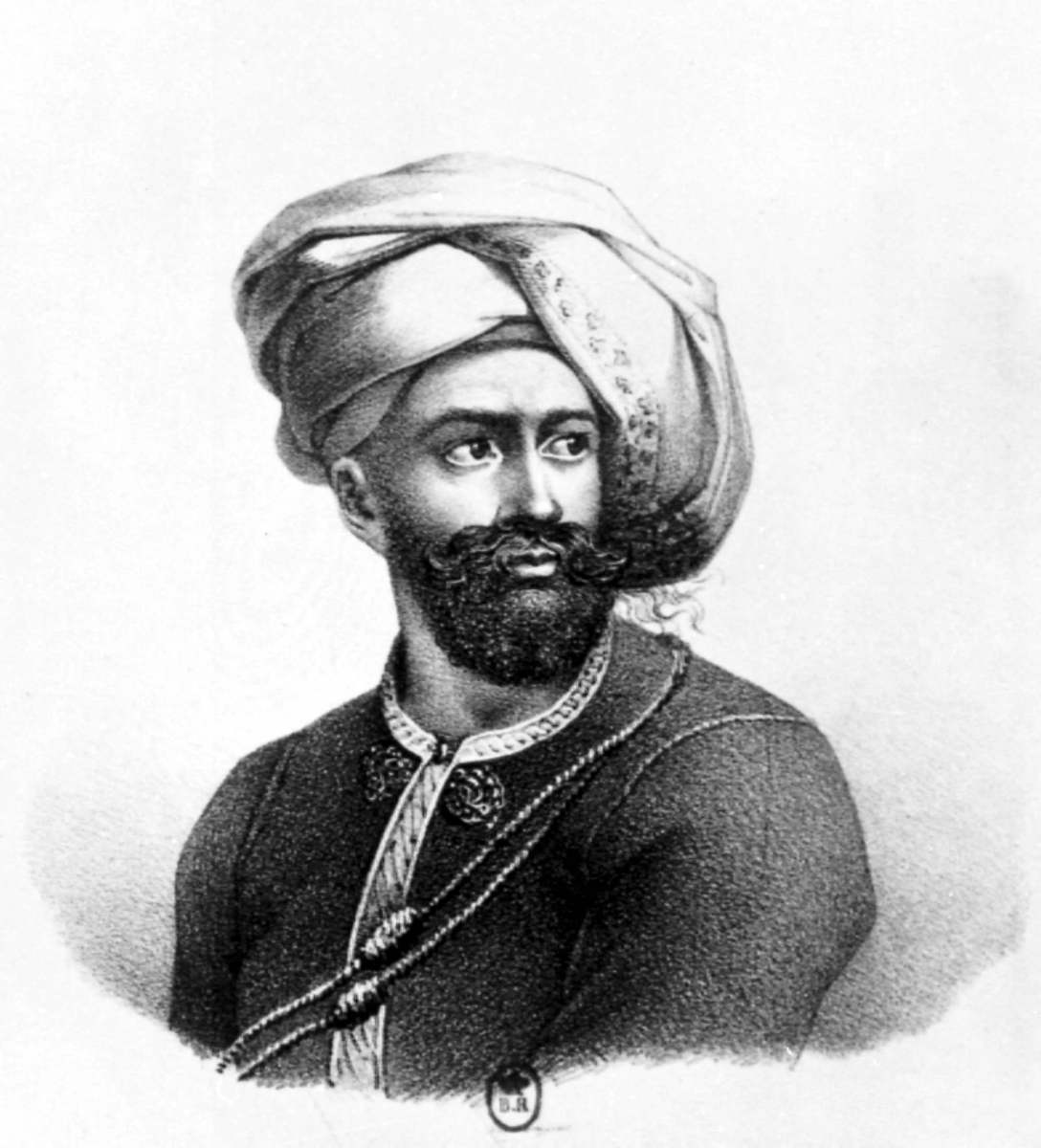
Konya and Nazib feature high and fill a large place in Turkish history and collective memory not as two important cultural metropolises, rather as the scene of two battlegrounds that bring back to memory two routing defeats inflicted on Sultan Mahmoud II, at the hands of Ibrahim Pasha, son of Mohamed Ali, his Egyptian vassal. The Kurds are not unrelated.
Between Konya, known otherwise as the First Syrian War (21 December 1832), and Nazib –the Second Syrian War (24 June 1839), is sandwiched a ruthless campaign of pacification and deportation of Kurds, and banishment of particularly their chiefs.
It is indeed quite ironic to know the campaign has its roots in the two Ottoman defeats, in that it is the slave- turned- commanders of Konya and Nazib who put the Kurds to the sword and to fire, as the most bloodstained figures in history, and the true embodiment of absolute murderers, as if, with his mother’s milk, they imbibed a hatred for the Kurd.
By an Ottoman habit of conquest, the aggressor Ottomans carried away the cream of the conquered races. Of all the countries that fell to the house of Osman, Georgia and Circassia furnished the empire with the best slaves- male and female.
While the females were entrusted to the Harem of the Sultan, and employed in the most menial jobs, the males were made into ruthless warriors. Those having special warring skills were organized into a form of military service, and made their way to high-ranking positions in the army, throwing their support completely behind their Ottoman masters.
Whatever its origin, the system of slaves- recruiting precedes the Ottomans. It was primarily this notorious system, combined with the animal ferocity of Bashi- Bazoukh hordes, and the hope for booty, that enabled Mahmoud and his son, Abdul Majid, to drive the Kurds out of their historical land.
Our narrative begins in 1832, with the unopposed advance of Ibrahim Pasha in Syria. Sultan Mahmud II had already detailed Hussein Pasha of Adrianople, the former head of Janissaries, to put a stop to Ibrahim’s Syrian adventure. He could not.
Mahmoud now dispatched to summon the grand vizier, Ibrahim’s former comrade- in- arms, in Missolonghi, was to step on to the scene of action; Rashid Mohamed Pasha.
Rashid Pasha, a Georgian slave- turned- master, had catapulted into notoriety for his ruthless methods against the indigenous peoples of the Balkans. However, quite sarcastically, unable to stop Ibrahim, he blunders into the Egyptian army. Rashid was taken prisoner to Cairo.
The defeat in Konya was a blow to the heart, and the very existence of the Ottoman Empire. Culturally, Konya was one of the most ancient and important cities of Asia Minor.
Oddly enough, Salim I had, back in 1415, induced the Kurds to the Turkish side by the kind force of persuasion, and diplomacy. Now, that policy had fallen into disuse, and Mahmoud, quite contrastingly, was emphatically to induce the Kurds to his side by the force of arms.
Putting the indocile Janissaries to rest in 1826, Turkey had no army worthy of the name. Mahmud had, since 1830, embarked on building a new army modeled somewhat on the European lines.
Turkey was proper floating on a sea of troubles. Due to dire circumstances, a momentous decision was to be made at the Sublime Porte in Constantinople in November 1833, which would, in the result, totally transform the prospects of the Kurdish population.
Released from captivity, with all fingers pointed at him, the heavy- hearted Rashid was appointed to the governorship of the ethnically diverse and statically important Sivas province. He lost no time in establishing his authority.
In March 1834, the two eyalets of Amed and Raqqa were included in his governorship. By this time, he had deployed the imperial army to the plain below Kharput, to prepare for war against the hitherto autonomous Kurdish autonomies.
An alliance of Kurdish tribes in Kharput, which refused to submit to Rashid, decided to make a stand. War broke out. Rashid, in the consequence, captured Ishaq Pasha of Mazira. He was sent to Constantinople where he was decapitated.
In advancing rapidly into the plain of Kharput, Rashid forces bypassed the Alawite Kurds of Akhja Dagh, who repaired to the fastnesses of their impenetrable mountains.
In the spring of 1835, he embarked on his major offensive. He had now to converge on north and east of Amed, where Kurdish chiefs and pashas had never submitted to an Ottoman pasha nor paid him taxes. Momentarily, the Silvan and Hazro Kurds, submitted to the show of force.
Rashid installed a mutasalim in Amed with a small force, but the Kurds revolted against him. The revolt was crushed and Kurdish cavalry dispersed. Mirza Agha of Banuka, and Rajab Bey of Hazro, with their families, were forced to live in Amed under the surveillance of Rashid’s mutasalim. Many perished in hard conditions, to which they were not accustomed.
Later, that same year, a second revolt broke out. Hussein Agha of Lice, and Tamr Agha of Hine, combined forces with the Zarki Kurds of Hazro, and Zalal Agha of Badikanli Kurds. They put up a joint Kurdish- Armenian resistance against Ottoman subjugation. In the village of Darakol, somewhere between Mush and Kharput, Armenians joined the Kurdish resistance against Rashid Pasha.
Taking the field in person, Rashid defeated Zalal and destroyed his residence in Nerjiki, then he proceeded to Hasankey, Inicak, Lice, Hine, and Hazro, in the Sanjak of Tevrik. Castles were destroyed and entire villages put to the torch, after being plundered.
Tamr Agha, Rajab Bey, Ismail Bey of Hine, and Bayram, son of Hussein, were sent into exile in Adrianople. Zalal was exiled to Amed. To send a strict message, their followers were sold into slavery.
Rashid focused his efforts on clearing the way from Mardin to Mosul in order to relieve the eyalet of Baghdad, which was isolated from the rest of the empire. He had now the intelligence of a new coalition of Kurdish tribes in Mardin.
In September, he was engaged with the Kurdish tribes of Bakran and Rashkotan east of Mardin, scene of one of the most contested battles of the 1835 campaign. Mardin capitulated to the Ottoman much superior army, not before been reduced to a heap of ruins proper.
The Mardin battle was a charnel house. The Kurds lost nearly 3000 men. In an act of brutality, Rashid is reported to have decapitated 200 people, and impaled on bayonets an unknown number.
The area between Mardin and Amed was still under the control of the Millan confederation, dominating the east bank of Euphrates. They recognized the authority of Sultan, but not that of Rashid, and remitted little or nothing to the Sultan’s treasury.
The west bank, up to River Sajur, was under the authority of Ibrahim Pasha. Rashid pressed down the Millans, but dared not venture into a full- scale war. Tightening the screw on the Millans could have pushed them to the side of the Egyptians.
Cognizant of ills and dangers attendant on engaging with Ayub of the Millans, Rashid preferred to focus his efforts east of Amed. He was not to remain idle. He eliminated the Kurds in the kazas of Sirvan and Garzan (largely Yazidi), in Sirt, as well as the mixed village of Azakh, in Sharnakh.
Up to this point, it could arguably be said that Rashid had somewhat restored his reputation and allayed Mahmoud’s fears. Yet Rashid assiduously draws Mahmoud’s attention to the influence of Ibrahim’s reforms on the Kurds, who seemingly began to imbibe liberal ideas. This claim is totally confirmed by British officer, Captain Bucknall Estcourt, who was on a tour in Amed and the surrounding areas in 1835.
Rashid’s repressive campaigns against the Kurds grabbed the headlines. Dispatch after dispatch, British agents and ambassador, John Ponsonby, sent, ineffectually though, to London detailing the harrowing injustices and disruption ravaging Kurdistan.
Ponsonby had, in December 1832, been appointed Ambassador Plenipotentiary to the Porte. He would play a key role in the politics of Syria, Kurdistan, and the Porte in the fateful decade.
Ponsonby hated Ibrahim Pasha and his father to the bone. Through Riza Bey, the reigning man in the Seraglio, he was able to incite Mahmoud to go to Nazib. Ponsonby poisoned the mind of Foreign Secretary, Henry John Temple, aka, Lord Palmerston, who acted upon his advice. The
On this point, there is an almost complete consensus of opinion. It is important to bear in mind a most singular fact that Palmerston was the chief architect of British foreign policy, who, by and large, reflects the spirit of Victorian Era.
British policy in Asia was professedly governed by preserving the caliphate, and when Palmerston conceived British interests were threatened by the action of Ibrahim Pasha in Syria, he did not hesitate to declare the anxious desire of his government to maintain unimpaired its relation with Mahmoud.
Further, by a secret article in Hunkar Iskelesi, 1833, the Russian Tsar had bound the Porte to close the Straits in the face of men- of- wars of all Great Powers. Britain, secretly but energetically, was to win over Mahmoud. Kurds were victims of a blind regime that was free from any reference for human rights.
The 1830s, is generally seen as the golden decade of European exploration. The difficult and unexplored fastnesses of Kurdish mountains was also an exciting filed which aroused the interest of exploration.
By way of illustration, James Brant, the British Vice- Consul in Trabzon, set in 1835 on a mission to explore the eastern provinces of the empire; Kurdistan. Interestingly, he follows the military route made recently by Rashid.
Most importantly, in April, the expedition for the survey of the Euphrates river, under the superintendence of Colonel Francis R. Chesney arrives in Swediye, on the Mediterranean, and forms a camp.
Some time back in 1829, Chesney had been tasked to determine the depth and current of the Euphrates for the proposed route to India. Throughout the years 1830, 1831, and 1832, he carried out individual journeys and researches in the Euphrates valley and elsewhere.
Chesney, who threw himself heart and soul into the project, declared to Queen Victoria that the idea of Euphrates navigation to India was a practicable one. In consequence of the results obtained, the expedition was undertaken. The chief obstacle in the way of the expedition was to secure the area of survey, which was a most turbulent one.
With his preference for the Euphrates route to India, Palmerston could not see Syria in the hands of Ibrahim, who was in cordial harmony with the Kurds. The area under survey was under the control of Ibrahim, who was not cooperative — at least from the British viewpoint. Ponsonby, characteristically, made mountains of molehills.
The connection between hostilities and European exploration is highlighted by Helmuth Karl von Moltke, who observes that areas north of Palo remained closed to European explorations because they had not been subjugated yet.
More gravely, British diplomats and officers of that time attributed the actual unhinged state of Turkey to Russian ubiquity. Every single movement of a Kurd, was imputed either to Russia or Cairo, with whom he was perceived a collaborator.
In the Russo- Turkish war of 1828, 1829, the Kurds of Erivan, under Hussein Pasha, sided with the invading Russian Army, and more recently, a Millan chief, took the side of Ibrahim Pasha in the decisive battle of Homs, July 8, 1832. Nor was this all.
Scenting a danger to the empire, and having the Convention of Kutahya signed in May 1833, which installed Ibrahim in the government of Syria and Adana, Mahmoud have all the time to break the power of the Kurds, who were impressed by the orderly administration of Egyptians.
The story had also a personal dimension. Beaten in the field, the defeat injured Mahmoud seriously in the eyes of his subjects, whose suspicion casted doubts over the continuity of the empire. He, thereupon, needed a victory at any cost to restore his prestige among his subjects.
Mahmoud had become uneasy for his importuning request of European officers and instructors. He was not marking time. In 1836, he ordained the establishment of a Janissary- styled organization of an armed militia all over Turkey, named the Radif, preparatory to engagement against the Kurds, responsible to none but itself.
That same year, Rashid greased the wheel, and resumed his military operations. In the spring, he ordered a division of his forces to put down the rebellion of Mirza Agha at Silvan. Then, he blew the whistle on Soran. It was, perhaps, the most important of all operations.
Mir Mohamed of Rawanduz, had gone so independent, to the effect that Ali Ridha Pasha of Baghdad was compelled to acknowledge him as Pasha of one tail. At some points, his authority extended to the margins of Mardin. Coins were minted bearing his name.
Before that, Rashid had to terminate the emirate of Botan. Badr Khan Bey was relieved by Khan Mahmud of Mukus. The former retreated to his castle at Dergule, close to Mount Judi, while the latter retreated to Mount Ardos.
Rashid has now wrested control over the plains stretching from Amed to Cizre. The plain which had abounded in villages under the chief of Botan, was almost in ruins, and the most desolation existed there.
Cizre, the capital of Botan was made into ashes, and its master, who refused to pay tribute or acknowledge subjection to the Sultan, was now living in the mountains.
Mir Mohamed was the last obstacle in the re-establishment of communications to the eyalet of Baghdad. Ince Bairakdar of Mosul and Ali Ridha were to put the Mir between a rock and a hard place. By June, Rashid began to tighten the screw on one of the most ever formidable Kurdish chiefs.
The Mir, who retired into the castle of Rawanduz, situated on most inaccessible summits in a mountainous country, was filled with utmost courage and devotion. The Soran chief defended himself valiantly, and could have laughed the combined forces to scorn. But more lay beneath the surface.
In July, a faction of Persian army headed to Hakkari, ostensibly to give support to Kurds, but in actual reality to seize Sulaimaniye. Justin Shiel, second in command of the British military mission to Persia, was ordered to proceed to Rashid’s camp to warn him.
Added to this, wild rumros had filled the air to the effect that an Egyptian irregular force, that had taken Deir Ezzor, was to advance next on Baghdad. The claim was not groundless. When this news came to the ears of Rashid, he acceded to negotiations.
Elsewhere, Richard Wood had, under the cover of exploring River Tigris, reached Rashid’s residence in Duhok. He was to play mediator. Wood was Ponsonby’s confidential agent. In 1835, he was dispatched to Syria to ascertain, among other things, the strength of Turkish army and the fidelity of Rashid. He was now dispatched to Kurdistan. He could not convince Rashid from day one.
Following long months of battles, siege ensued. In the heat of events, one of the most sarcastic fatwas was made in human history, congruous, one way another, with the spirit of Kurdish mentality of the day, when Sheikh Mohamed Khati, of Soran, passed a verdict branding with blasphemy those intending to fight soldiers of the Caliph — the God’s image on earth!
With the rapidity of the wind, the fatwa wafted to the far- off corners of Soran. The community was no longer to stand together. Mir Mohamed could no longer obtain the sinew of war. The tide had turned. It was substantially this extremely sensitive breach that made the Mir of Rawanduz kneel.
At long last, intense negotiations bore fruit. The Mir acquiesced on the promise that Ponsonby would interpose for him with the Sultan. On September 3, Mir Mohamed threw the towel. He was escorted to Constantinople. No fulfilment of the promise was made. He never saw Rawanduz again.
It must be admitted that the Mir’s stony severity, depredations against Yazidis, and employing Tay Arabs within his army against Kurdish opponents, a most notorious demerit of all, among others, must have trifled away the sympathy of his men, which reduced the prospects of his survival, and eventually played into Rashid’s hands.
The final episode in the career of the red Georgian occurred after Rawanduz. On his way back, Rashid made two punitive inroads. One into the Redwan Emirate in Arzanene, and a second into Mount Sinjar. By this time, Wood was back in northern Syria to report on the fortifications of Ibrahim Pasha.
In January 1837, Rashid abruptly died of cholera, passing the iron baton to a man of no less notoriety, and not the reverse in that respect to himself; Hafiz Mohamed Pasha, a Circassian who, like Rashid, had attained great victories in the Balkans, and witnessed the routing of the Ottomans the Homs and Konya, and recently the Rawanduz affair.
Upon Rashid’s death, Hafiz was given the command of Amed and Raqqa, which were previously in the control of Rashid Pasha. His name would be associated, first and foremost, with Yazidi atrocities in Redwan, southeast of Amed, Sinjar and Sheikha, where he slew thousands of Yazidis.
During the reign of Rashid, Mirza Agha, the Yazidi chief of Redwan, had agreed to receive Amin Agha, a Turkish governor, in his castle. Not long, the Ottoman chief carried away, by force, the beautiful wife of the Yazidi chief. Amin and his followers fell victims to Mirza’s revenge.
Being called away against Soran, Rashid set the issue of Redwan aside. After the successful termination of the expedition against Rawanduz, Mirza Agha submitted to Rashid, and was appointed governor in the Castle of Redwan, overlooking the Garzan branch of the Tigris.
Hafiz Pasha’s top priority was to reopen the route to Mosul and establish contact with Baghdad. The track from Nusaybin to Mosul was the closed by depredations of Yazidi tribes whom he decided to subjugate.
In the spring of 1837, Hafiz ordered Ince Bairakdar to advance on Sinjar, while he attacked them from the west. In a three- month period, they subjugated the mountain. In the campaign against Sinjar, British Consul- General, Captain Patrick Campbell and Colonel Considine, volunteered to the help of Hafiz.
Misled to the supposition that Hafiz was bound to defeat in the plains and hills of Sinjar, the Kurds in the north revolted again. Hafiz Pasha, who had now the company and aid of four Prussian army officers, was more resolute to succeed where his master had failed.
Some time back in 1834, Palmerston had offered to train and advise Turkish officers. At the time, Mahmoud favored French experts. In 1837, Prussian officers Friedrich von Laue, Heinrich von Mulbach, and Moltke have been detailed to Hafiz Pasha’s Army of Taurus.
By August, Hafiz Pasha was in Malatya, then a small provincial town, and Akhja Dagh, the latter Rashid had in 1835 failed to bring into subservience. The Kurds, though retreated to mountains, suffered a great loss.
The war against Akhja Dagh bore overtures of religious cleansing. French historian, Baptistin Poujoulat, an eye witness, reported 15 villages were destroyed, and 1500 Alawite Kurds were killed by the Ottoman artillery in Akhja Dagh. The remainder, 5000 men, women, and children were uprooted from their home. Poujoulat somewhat helped publicize the drama unfolding in Kurdistan.
Having breathed a sigh of relief, Hafiz had to settle the old issue with Mirza. Hafiz, surpassing his predecessor in canning and malice, ensnared Mirza into a trap and killed him.
Moltke observes Hafiz Pasha had, in 1838, driven the inhabitants of Garzan Dagh, with fire and sword, into their highest and most inaccessible hiding-places.” Redwan became history, and its Yazidis and Daqqouri inhabitants sought refuge in Sinjar.
In May 1838, Ince Bairakdar with the aid of Moltke’s canons and mines, induced Said Bey in Botan to surrender. Having razed Said’s castle on Tigris to the ground, Ince headed north to Hizan, where Rashid had two years ago failed to subjugate the locality. Hafiz Pasha was not doing things by halves.
There was no language too strong to picture the misery which existed. Brant throws a good deal of light on horrors, saying “the Kurds showed determined bravery, they and their wives fought with desperation, and the slaughter among them was immense because they were attacked in the villages.”
The carnage was further exacerbated with the Turkish system of reward, which increased murder and pillage. Every Kurd that fell into their hands was massacred. “Soldiers,” reports anther account, “were paid 20 piasters for the head of a Kurd, and a half for ears, arms, or leg.”
Barbaric acts gave goosebumps to Mulbach, who was with Hafiz Pasha throughout the campaign. Mulbach urged Hafiz to abandon the brutal system of reward. The pasha did. By July, 1838, the pacification of Kurdistan was almost complete. Only Dersim was unsubdued. The sultan’s clock was ticking.
Dersim had to be shelved for a while as Mahmoud was running out of patience to eject Ibrahim Pasha from Syria. He had never felt peace with Ibrahim patrolling the confines of his much- truncated empire.
Hafiz Pasha had made a promise to put Mahmoud’s mind at ease. He doggedly prepared for the war, yet in Winter, his army was afflicted with a plague in Malatya. On June 24, 1839, the Sultan’s army was completely routed. This time in the village of Nazib. Kurdish desertion had its salutary effect on the battle. The news of the Sultan’s army’s defeat made the headlines.
Hafiz Pasha’s proverbially foolish indiscretion account for the loss. On him, huge blame was casted, yet he was let off the hook. Not long after Nazib (Sept. 6, 1839), Mardin — the Quito of Mesopotamia — was in the grip of an unhinged anarchy.
War was imminent, and again troops were on the march. Such was the state of affairs under Mahmoud, who died with no knowledge of Nazib, and such they continued to be under his child successor; Abdul Majid. Kurdistan was ravaged. Palmerston somewhat brings home the truth of the day to the posterity, when, replying to a Consular report, in 1835, the Foreign Secretary remarks”
“This is a curious paper and shews what has been one of the most active causes in converting into desert wastes those fertile districts which under the vigorous police of the Roman Empire were full of cities and of fixed inhabitants.”
What boggles the mind is the fact that Palmerston steered that line of British policy, and this constitutes only the exposure of a few samples, and to uncover the whole truth would be quite next to impossible.
Some selected references:
1-Adolphus Slade, Turkey, Greece, and Malta, 1837, in 2 volumes.
2-Andrew A. Paton, a History of the Egyptian Revolution from the period of the Mamelukes to the Death of Mohammed Ali, 1863, v ii.
3-Edward Barker, Syria and Egypt under the Last Five Sultans of Turkey, v ii, 1876.
4-Francis Rawdon Chesney, Narrative of the Euphrates Expedition carried on by order of the British Government, 1868, in 3 volumes.
5-Helmuth von Moltke, Essays, Speeches, and Memoirs, 1893, in 2 volumes.
6-James Brant, Journey Through a Part of Armenia and Asia Minor, in the Year 1835.
7-John Guest, The Yezidis, A Study in Survival, 1987.
8-John M. Kineir, a Journey Through Asia Minor, Armenia, and Koordistan in the Years 1813- 1814, London 1818.
9-Nelida Fuccaro, Aspects of the Social and Political History of the Yazidi enclave of Jabal Sinjar (Iraq) under the British Mandate, 1919-1932, Durham University 1995.
10-Sir Charles Webster, the Foreign Policy of Palmerston, 1830- 1841, Britain, the Liberal Movement and the Eastern Question, in 2 volumes, 1951.
11-Sona Vardanyan, the Socio- economic picture and political situation of the eastern provinces of the Ottoman Empire in the 1830s and 1840s.
12-Walter Goerlitz, History of the German General Staff, 1657- 1945.
13-Wayne Monteith, Kars and Erzeroum with the campaigns of Prince Paskiewitch in 1828, and 1829, 1856.
14-William F. Ainsworth, Travels and researches in Asia Minor, Mesopotamia, Chaldea and Armenia, in 2 volumes.