


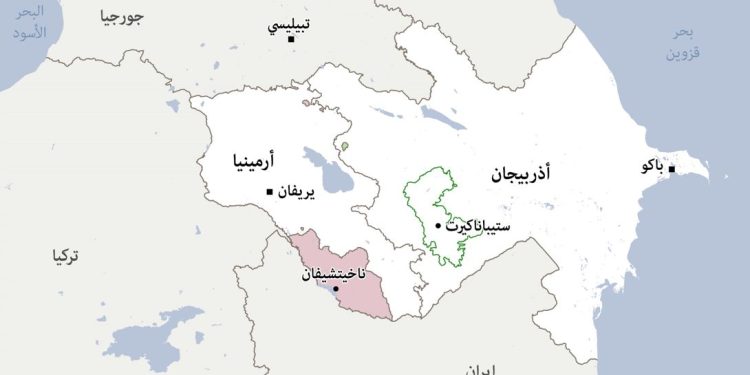
A few days ago, the South Caucasus region witnessed a significant historic event, the signing of a preliminary memorandum of understanding between Armenian Prime Minister Nikol Pashinyan and Azerbaijani President Ilham Aliyev, under the auspices of U.S. President Donald Trump at a trilateral summit in Washington.
The agreement, which came after decades of bloody conflict over Nagorno-Karabakh, holds great hope for ending one of the region’s longest-running disputes. However, it also opens a new horizon of geopolitical challenges amid profound shifts in the trajectories of both countries and the region as a whole.
Context of the Peace Agreement and the Strategic Corridor
Since the recent 2020 Nagorno-Karabakh war, and over nearly five years, there has been recurring talk of a potential peace agreement between Azerbaijan and Armenia, linked to a strategic framework through the so-called “Zangezur Corridor.” This corridor has tantalized Turkey with visions of direct access to Azerbaijan and, from there, to the Turkic world via the Caspian Sea all the way to China.
However, U.S. President Donald Trump did not relinquish the privilege of presenting the peace agreement, which had been under preparation for several years and was largely finalized last March. The Americans also took control of the strategic corridor project, outsourcing it to American companies. Its name was later changed to the “Trump Roadmap for International Peace and Prosperity,” abbreviated as “TRIPP.”
At the Washington trilateral summit, a joint declaration was signed, described as a “roadmap for peace.” Pashinyan and Aliyev signed a memorandum of understanding expressing their intention to sign a peace agreement, with Trump adding his signature as mediator and witness.
The agreement has not yet been finalized, as Azerbaijan has additional demands, most notably amending the Armenian constitution to remove any mention of Armenia’s claim to Nagorno-Karabakh.
Trump stated that the agreement commits to ending conflicts, establishing trade and diplomatic relations, and respecting mutual territorial integrity. He also announced the lifting of sanctions on Azerbaijan’s defense industry. Nonetheless, some issues remain unresolved, including the need for Armenian constitutional amendments, the opening of regional transit routes, and the return of Armenians who left or were expelled from Nagorno-Karabakh.
Additionally, a joint letter was signed at the summit calling for the dissolution of the Minsk Group, which had been mediating between the two countries and composed of the United States, France, and Russia. This stance has long been favored by Turkey and Azerbaijan, who consider the group responsible for prolonging the crisis and leaving it unresolved.
Gains and Losses for Both Sides
The agreement represents a diplomatic and strategic victory for Azerbaijan, which has finally regained control over the entire Nagorno-Karabakh region, long the focal point of conflict with Armenia. It paves the way for Baku to address other sensitive regional issues without the fear of foreign interference or renewed hostilities with its neighbor.
Another significant achievement for Azerbaijan under this agreement is the corridor, now known as the “Trump Route,” which runs through Armenia’s Syunik region, connecting Azerbaijani territory to the geographically isolated Nakhchivan Autonomous Republic. This strategic corridor strengthens Azerbaijan’s territorial integrity and allows direct, unobstructed access through Armenian territory—a major geopolitical gain.
Furthermore, the agreement has bolstered Azerbaijan’s relations with the United States, positioning Washington as a key partner within the framework of the peace process. This enhances Baku’s political and military standing, reduces its previous reliance on Russia, and affirms its role as a regional power.
The agreement has also contributed to diversifying Azerbaijan’s sources of military supplies and cooperation by opening up U.S. arms markets, supplementing its previous acquisitions through Israeli and Turkish channels. This increases Azerbaijan’s defense capabilities and lessens its dependence on Russia.
Economically, the agreement opens new transportation and trade routes, facilitating connectivity between the Caucasus, Turkey, Central Asia, and Europe, with significant potential for investments in infrastructure and energy sectors.
Challenges and Potential Losses for Azerbaijan
Despite these substantial gains, Azerbaijan faces several challenges. Most notably, the joint management of the Zangezur Corridor, as stipulated in the agreement, will be overseen by the United States and Armenia, which could limit Azerbaijan’s operational freedom in the corridor and potentially become a future point of contention.
Additionally, internal political challenges exist, with various factions holding differing views that could obstruct the implementation of the agreement, especially if they believe that its provisions do not fully safeguard Azerbaijan’s rights.
Armenia’s Gains Despite Declining of its (power maybe better) Influence
Despite Armenia’s setback in territorial control, the agreement offers some relative gains that can be highlighted. Yerevan has lost full administrative control over the corridor, but it will remain under official Armenian sovereignty, with a commitment to joint management that could attract significant U.S. investments to develop the region. This could open new prospects for development and economic growth.
The agreement also paves the way for increased international cooperation, especially as Armenia becomes more open to U.S. support and aims to build economic relations with Turkey. It is well known that Armenia suffers from geographical isolation, with completely closed borders with both Azerbaijan to the east and Turkey to the west. Despite having an open border with Iran to the south, Iran’s own isolation limits the practicality of that border crossing. As a result, Armenia’s only active gateway to the outside world remains its border with Georgia, which is unstable.
If fully implemented, the agreement will lead to the opening of borders with both Turkey and Azerbaijan, reviving hopes for economic and political development. It would also help stabilize the region by ending a long-standing conflict and reducing internal and regional tensions.
Armenia’s Losses and Internal/External Challenges
Armenia faces significant internal and external losses and challenges. Strategically, it has lost control over the corridor in the south of the country, which reflects considerable geographic and political pressures—especially considering the joint management arrangement, which could limit Armenia’s ability to control Azerbaijani movements through its territory.
Internal political and social tensions remain high, with widespread opposition to the agreement within the opposition circles, who fear the further loss of sovereignty and rights.
Meanwhile, the process of normalization with Turkey faces many obstacles, foremost among them the Armenian Genocide issue, which remains a major political and moral sticking point. Armenia insists on official recognition, while Turkey refuses to acknowledge it.
There are also strong internal currents within Armenia opposing any rapprochement with Turkey without a comprehensive resolution of human rights and sovereignty issues.
Furthermore, the Armenia-Azerbaijan relationship remains tense, which could hinder Turkish-Armenian normalization efforts—especially given Russia’s declining influence in Armenia, following its reduced role in security and strategic matters. This situation leaves Armenia in a fragile position in the face of increasing Turkish influence.
Finally, Armenia faces difficulties in maintaining its political and economic stability amid this new openness and multiple internal challenges.
Winners and Losers Among Regional and International Powers
The United States emerges as one of the biggest winners, having succeeded in establishing a central role in the South Caucasus after decades of limited influence. By sponsoring the agreement and imposing joint management of the vital corridor, the U.S. positions itself strongly in a region long considered Moscow’s backyard and a vital part of its national security sphere.
This strategic corridor significantly enhances U.S. influence in the region, providing Washington with greater capacity to manage political and economic balances across the Caucasus.
Turkey also benefits from this agreement, which could open avenues for economic, trade, and military gains in the Caucasus and Central Asia. It would strengthen Turkey’s trade, transportation, and energy links with Azerbaijan and Europe—particularly as Russian influence in the Caucasus continues to wane due to this agreement.
Azerbaijan, on its part, consolidates its status as a strong and independent regional player, capitalizing on the national and strategic gains achieved through the deal.
Conversely, Russia clearly appears as the main loser, suffering a significant setback in influence over the South Caucasus. Its role as a primary security and strategic guarantor has diminished, with Armenia distancing itself from Moscow and increasing U.S. and Turkish influence within its sphere of influence.
Russia’s influence in the Caucasus has declined sharply due to Moscow’s preoccupations with the war in Ukraine and its internal and external issues. This has reduced its ability to exert real influence, and its role has become more passive—merely observing the developments.
Despite this, Russia still retains limited influence in the North Caucasus, Abkhazia, South Ossetia, and some security links with Armenia. However, it is no longer the dominant power it once was. Russia is likely to seek repositioning in the future, especially after the Ukraine conflict ends, but it will face stiff competition from the U.S. and Turkey.
The decision of Armenia to withdraw from the Collective Security Treaty Organization (CSTO) and to open relations with the U.S. and Turkey marks a strategic shift in regional alliances.
Iran has also experienced a decline in influence, as Armenia’s reliance on Tehran diminishes and pressure from the presence of a U.S.-Turkish corridor near its borders increases. This development poses a threat to Iran’s regional and strategic interests.
The existence of this corridor exerts regional pressure on both Iran and Russia, who see it as a direct threat to their interests. This could escalate tensions and trigger unforeseen regional conflicts.
Broader Regional Implications
The agreement contributes to shaping a new security architecture in the Caucasus, in which the United States plays a leading role as the primary security guarantor, alongside Turkey, while Russian and Iranian influence wanes.
This development has also prompted Iran to reassess its strategic position in the south, especially as Armenia’s dependence on Iran for security and energy diminishes.
However, the risks of future escalations remain, given the intensifying competition among major powers. Side conflicts or security challenges could emerge if the regional balance is not managed carefully.
Conclusion
The peace agreement between Armenia and Azerbaijan presents a unique opportunity to reevaluate Armenian-Turkish relations, which have long been marred by historical and political tensions. Despite the considerable challenges ahead, these new developments open the door to a fresh era of cooperation and understanding, contingent upon genuine political will and balanced regional and international collaboration.
The initial peace agreement, sponsored by Trump, marks a historic milestone in the South Caucasus, heralding a potential new phase of peace. However, it also introduces a complex landscape of political, legal, and geopolitical challenges. The gains realized by Azerbaijan, Turkey, and the United States, alongside the significant setbacks for Russia and Iran, reflect profound shifts in the regional and global balance of power.
Nonetheless, the region remains dynamic and in flux, with the potential for radical transformations that could reshape its political and strategic landscape—effects that may extend to the North Caucasus, Turkey, and Iran.