

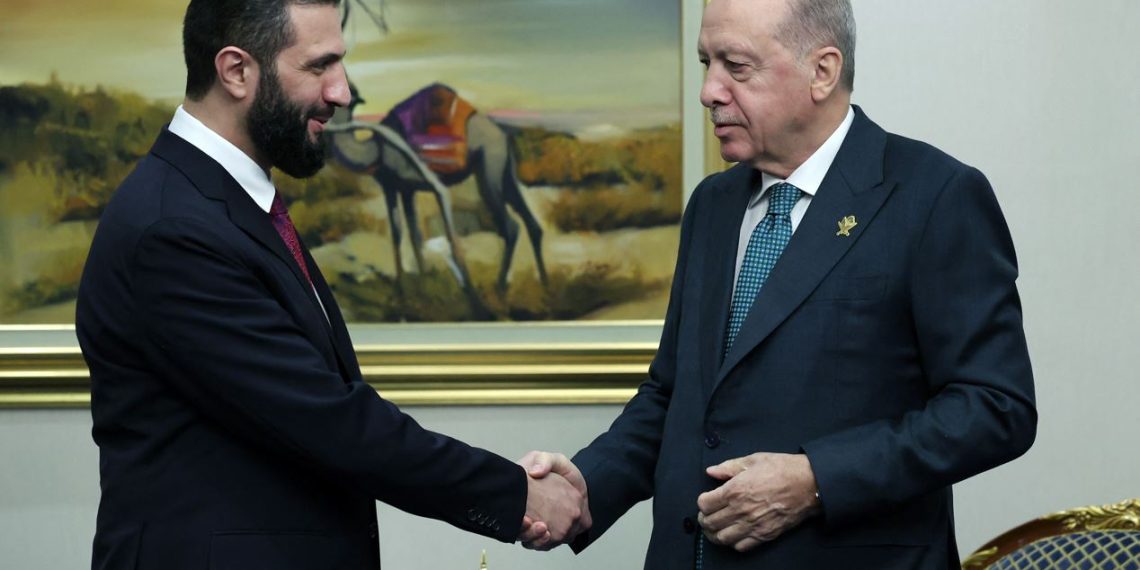
Many platforms and websites have circulated statements attributed to the Syrian interim president, Ahmed al-Sharaa published by the Turkish newspaper “Milliyet.” These statements included threats against Northern and Eastern Syria and the Syrian Democratic Forces (SDF). Several points can be confirmed from al-Sharaa’s statements to the Turkish newspaper, which are mostly accusations and threats directed at the SDF, sometimes spoken by al-Sharaa himself, and other times attributed to the Turkish state:
– Turkey will move militarily against the Syrian Democratic Forces if “integration” is not achieved by December of this year.
– There are “wings” within the SDF that reject the March 10 agreement.
– The situation in northern and eastern Syria and the SDF constitutes a “threat to the national security” of both Turkey and Iraq.
– Syrian society rejects discussions of federal systems and considers all demands for decentralization as camouflage and “various forms” of separatism.
It is clear from these points that al-Sharaa and his authority are continuing to evade and disavow the implementation of the March 10 agreement, which they were the first to violate when they issued the constitutional declaration on March 13, which did not refer to the March 10 agreement or to what was included in it regarding constitutional rights and citizenship for the Kurdish community. Moreover, it did not include recognition of the rights of representation and participation for all Syrians in political processes and institutions based on competence, regardless of their religious or ethnic backgrounds.
Following the signing of the agreement between al-Sharaa and General Mazlum Abdi, a series of violations occurred against most of the agreement’s provisions, especially the third clause, which emphasized a ceasefire across all Syrian territories. The regime carried out attacks against the Druze component in Sahnaya and Jarmana in rural Damascusat the end of April, and launched a major assault on Sweida in mid-July, resulting in the death and injury of thousands of Druze civilians.
Regarding the Kurdish issue in Syria, the regime has provided no reassurance to the Kurdish component. On the contrary, it rejected the outcomes of the Kurdish unity conference held in Qamishli at the end of April, considering it “a threat to the unity of the country,” and has not yet accepted to host a Kurdish delegation. On the ground, there has been no positive development concerning the return of property, lands, and estates of Kurdish citizens in areas such as Afrin, Serekaniye/Ras al-Ain, and Tel Abyad, which remain controlled by armed groups affiliated with what is called the “Syrian National Army,” which is officially part of the Syrian army. These groups control the property of Kurdish citizens, and neighborhoods like Sheikh Maqsoud and Ashrafieh in Aleppo are under siege and harassment, with regime drones flying over these districts to intimidate residents.
Additionally, these groups resort to cutting roads, kidnapping Kurdish citizens based on ethnicity, and demanding large ransoms for their release. The regime itself also tightens restrictions on Kurdish citizens in major Syrian cities like Aleppo and Damascus, often accusing them of “supporting the SDF.”
The regime’s policies are not limited to using force; it also employs a rhetoric of incitement and aggression in its media outlets, spreading various accusations against northern and eastern Syria and the SDF. It has opened its media platforms to inciting voices, some calling for civil war and military action against northeast Syria, further fueling a toxic environment. This climate has diminished calls for national consensus, dialogue, negotiations, and de-escalation, and silenced voices advocating for reconciliation and bilateral meetings, whether in northeast Syria or in Damascus.
From al-Sharaa’s statements to “Milliyet,” it is evident that he rejects all forms of decentralization, claiming that they will lead to separation, and that the Syrian people oppose them. This indicates his and his regime’s insistence on a highly centralized system and their refusal to participate in political sharing or national consensus, aiming instead to build a totalitarian state ruled by a known ideological faction, with himself at the helm.
He also relies on Turkey and adopts its narrative that “wings” within the SDF reject the March 10 agreement. Furthermore, he considers decentralization and the “situation in northeast Syria” a threat to the national security of both Turkey and Iraq. However, he perhaps overlooks that Iraq, as a state, has accepted the federal structure of the Kurdistan Region, which is constitutionally recognized. He also neglects, or perhaps is unaware of, the ongoing peace process in Turkey between the Kurdistan Workers’ Party (PKK), representing the Kurdish people, and the Turkish state. A parliamentary committee called “Committee for National Solidarity, Brotherhood, and Democracy” has been convening over ten times to discuss constitutional and legal reforms to resolve the Kurdish issue in Turkey. Turkish Parliament Speaker has acknowledged that the military and security crackdown on Kurds has cost the state around 2 trillion dollars.
Currently, Al-Sharaa has no political visions or any national basis for implementing the provisions of the March 10 agreement. He does not want to accept the existence of any Syrian component or political force, nor does he accept decentralization. Therefore, he and his regime are completely unqualified to be partners in successfully executing any internal Syrian reconciliation process. He considers the file of northern and eastern Syria, the Syrian Democratic Forces, and the Syrian Kurdish component as “security files,” and he wants to entrust their management to Turkey.
Turkey rejects any solution based on decentralization, national consensus, and political participation because it seeks a centralized state monopolized and governed by its allies within the military faction, which Ankara claims to have been instrumental in bringing to power in Damascus. Al-Sharaa rejects the political aspect of the agreement and wants to present it as a security agreement, which is why he needs to rely on Turkey and its army.
He has an old approach, viewing Turkey as an enemy of the Kurds, and therefore believes Turkey will side with him. He is also hardened against the Kurds, northeast Syria, and the Syrian Democratic Forces, and he does not object to using his authority as a tool to serve Turkey, which is hostile to the Kurds!
We cannot ignore the significance of his recent visit to the US and his statements about being willing to sign an agreement with Israel, believing that this enhances his strength. These statements seem to undermine the support from the SDF’s allies, similar to his approach during his meeting with Israeli officials in Baku, Azerbaijan, where he thought he received a “green light” to attack Sweida and commit massacres against Druze civilians. He later described the attacks on Sweida as a “pre-planned trap.”
Furthermore, al-Sharaa overlooks the military capabilities and field experience of the SDF, while the momentum of tribal mobilizations and general conscription has diminished after the Sweida events, especially after the regime agreed to decentralization demands in the recent international-backed agreement, which included the interim authority, Jordan and the US.
He is aware that any full-scale military confrontation with the SDF would differ significantly from the limited fighting with a few thausends of Druze fighters in Sweida, who were lightly armed. Such a confrontation would likely result in heavy losses, external intervention, internationalization of the issue, and perhaps turning the March 10 agreement into an international case similar to the Sweida situation, with new guarantors entering the scene to limit the regime’s transitional authority as a party to the agreement.