
Immediately after news broke of the arrival of a delegation from the Syrian Democratic Forces (SDF) and the Autonomous Administration in Damascus to complete negotiations on the agreement reached on March 10, conflicting speculations swirled on social media. Some optimistic reports suggested that white smoke would rise from Tishreen Palace, while others believed the purpose of the meeting was to accelerate the implementation of the Abdi-Sharaa agreement under US auspices, led by Washington’s representative, Thomas Barrack. This appeared plausible, given the sluggishness and delays in implementing the agreement’s terms on the ground.
Interim President Ahmed al-Sharaa was absent from the most important national meeting, as there had been no other gathering reflecting Syrian unity since the fall of the Assad regime. He delegated the task to a team representing the sovereign ministries and the head of the intelligence services. Without disclosing the reason for his absence, Sharaa appeared to meet with the team working on producing the “visual identity” at the People’s Palace, rather than with the team that might contribute to shaping the “national identity” (namely, the Autonomous Administration and the SDF). In reality, he sought to downplay the significance of the negotiation meeting, relying on Trump’s open support for him. This support is reflected on the ground by Thomas Barrack, who shows a strong bias toward Damascus, undermining the concept of neutral mediation between Damascus and the Autonomous Administration.
Barrack claimed that the SDF was delaying the implementation of the agreement, without blaming Damascus for the delays in executing its obligations, such as the return of forcibly displaced persons and other provisions. Furthermore, the US envoy stated that the SDF had no choice but to turn to Damascus. By doing so, Barrack exerted misplaced psychological pressure, even though the SDF, the Autonomous Administration, and all Kurdish nationalist parties have not contradicted the US envoy’s statements. Moreover, Kurdish political literature for decades has maintained that the solution to the Kurdish issue in Syria lies in Damascus.
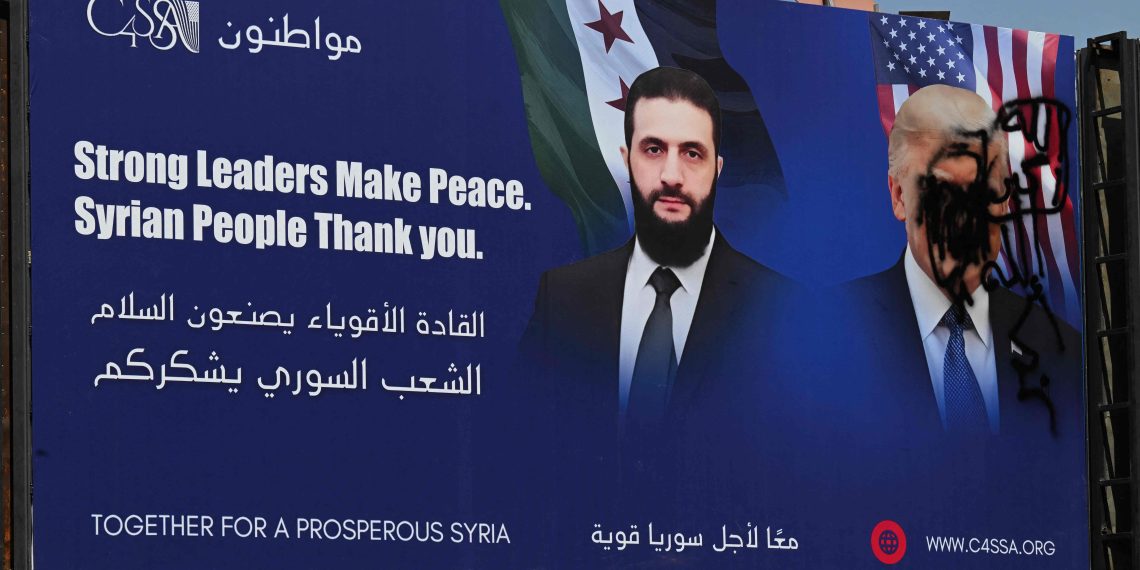
US President Donald Trump’s showy rhetoric and unconditional support for Sharaa can be understood as based on the belief that support can be provided to the Syrian government in a way that aligns it with Washington and its regional policies. Although Syria has been in the orbit of Russian influence since the late 1950s, the model of Syria nurtured by layers of regional and international alliances remains the only viable path forward. Damascus has found a new international patron in the United States.
The cost of Sharaa and his ruling group accepting to orbit Trump’s policies is based on a principle: retaining power in exchange for full conformity to Washington’s regional interests. Trump is completely indifferent to the gender of his allies, whether they are democratic or dictatorial. This was reflected by Barrack when he stated, “The era of Western intervention is over,” implying that the period of imposing democracy through the harsh methods of George Bush has ended, as has the era of soft intervention under Obama and Biden.
This new American message contradicts the short-lived policy during the final days of Joe Biden’s presidency, when Assistant Secretary of State Barbara Leaf presented a set of conditions for developing relations with the Sharaa administration and lifting sanctions. Trump abandoned all these essential conditions for any alliance between Washington and Damascus, replacing them with a formula based on Syria’s accession to the Abraham Accords and finding a solution to the final status of the Golan Heights. To this end, Thomas Barrack demonstrated bias during his first attempt at managing the Syrian internal file by suggesting that he did not side with the SDF and without blaming Damascus. Perhaps this Machiavellian tactic aimed to gain Damascus’s trust until it was included among the signatories of the Abraham Accords — a move that Damascus has indicated to Western diplomats and Tel Aviv would ultimately happen.
No sooner had the doors of the negotiation hall closed than the Sharaa government issued a statement written in arrogant, harsh language, closely resembling the rhetoric of the Assad regime. The statement’s slogan read: “One Syria, One Army, One Government.” Barrack repeated these words outside the negotiation hall between the two delegations. However, this phrase warrants scrutiny and objection due to its deceptive content. The objection is not to the lofty ideals they represent, which Syrians generally agree upon, but to the way they are used to justify a distorted reality. A “united Syria” should not be transformed into a “fiefdom” designated for a specific authority, ethnicity, sect, or class. The condition for Syrian unity is that it be for all Syrians, without racial or regional exclusions. Yet, the government’s actions and daily practices do not reflect this belief.
As for a “united army,” it must be achieved with full adherence to principles of professionalism and competence, regardless of ethnic or sectarian background. It should not remain an army manufactured in the laboratories of the military forces that arrived in Damascus before others, during the disintegration of Bashar al-Assad’s army. Regarding the phrase “one government,” it clearly implies that Syrians must submit to a government that is neither representative nor inclusive of Syria’s diverse political and ethnic components. This form of submission resembles a contract of obedience, whose signing or expiration date remains unknown. If this slogan is not critically examined and its implementation reconsidered, it could pave the way for the establishment of a fascist state or regime.
Among Barak’s biased statements was his unequivocal assertion that “federalism does not work in Syria,” a Kurdish demand concerning the form of governance. Naturally, this stance supports the authority of Damascus and the Turkish government, both of which insist on keeping Syria a highly centralized state. Building on Barak’s position, a statement was issued by the official news agency (SANA), which quoted the words of the Washington representative and expanded upon them. The government’s statement “categorically rejected any form of division or federalism that contradicts the sovereignty of the Syrian Arab Republic and its territorial integrity.”
The equivalence drawn between division and federalism, beyond the sheer ignorance and deliberate confusion of the concepts, obscures the fact that federalism or demands for some degree of decentralization do not, in any way, imply division or secession.
In any case, Barak’s words were incorporated into the “government statement,” thereby implying that the US representative was fully supporting Sharaa against the delegations of the Autonomous Administration and its trusted ally for nearly ten years, the SDF. All of this was aimed at proving that Washington bears no obligations toward the Syrians, and that the authorities are free to decide their fate as they see fit.
This implication gave Damascus a sense of excessive confidence, which could lead to miscalculations such as increasing ethnic tensions and polarization, endorsing hate speech and remaining silent about it, and perhaps tightening restrictions on Kurdish citizens outside northeastern Syria.
In contrast to Damascus’s arrogance and its insistence on negotiations under American and French auspices, it appears that these negotiations are the only remaining option in light of the lack of prospects for war and the ongoing attempts to impose wills by force. This is, perhaps, the positive aspect amidst the sabotage that has occurred over the past two days in Damascus.