


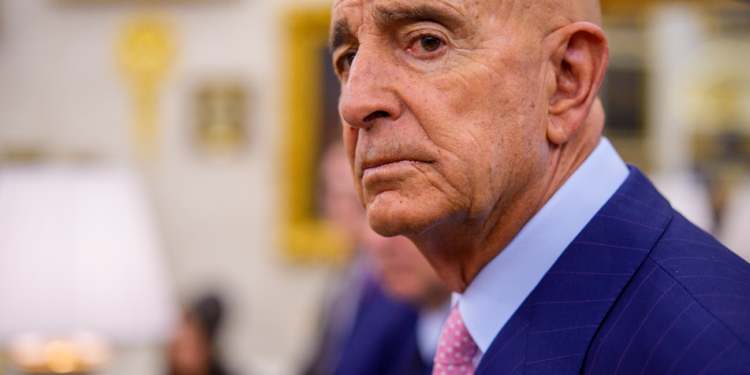
U.S. Special Envoy for Syria and Ambassador to Turkey Tom Barrack drew significant criticism from pro-Israeli circles while speaking at the Antalya Diplomacy Forum on April 17, 2026, after stating that “Turkey is not a country to be messed with.” He received further backlash after comparing Hezbollah to Israel, suggesting that both were equally untrustworthy.
The fallout from Ambassador Barrack’s comments in Antalya has dwarfed that seen in January, when the United States abandoned the Kurds and supported the absorption or integration of the Syrian Democratic Forces (SDF) into the Syrian state. In January, Ambassador Barrack suggested that the purpose of the primary anti-ISIS force on the ground had largely expired, and urged the Kurds to work with Damascus. Nevertheless, on January 21, the editorial board of The Wall Street Journal also published a piece criticizing the U.S. envoy for abandoning the Kurds and “jeopardizing the anti-ISIS mission.”
According to Sam Heller, a Beirut-based researcher and analyst, and fellow at Century International, there are a few key distinctions between these two cases.
“First, during the Syrian government’s offensive against the SDF, aside from Tom Barrack’s extended X posts saying the US-SDF relationship had run its course, he mainly spoke publicly about de-escalation—ceasefires and agreements to stop the fighting. So I don’t think he was out in front saying especially aggressive things, even if you could assign him some responsibility for the Syrian military’s attack.
“Second, I don’t think the SDF Kurds have the same type of U.S. political support that Israel does. To the extent they do, it’s more limited—though there is some overlap on Capitol Hill, including among pro-Israel officials and groups.”
The increased criticism of the U.S. envoy should be understood in the context of growing competition between the Israeli and Turkish governments, which has intensified since the October 7 war, alongside fears in Turkey that it could become the “next target” after Iran. However, such concerns remain largely speculative, as it is highly unlikely that Israel would launch attacks on a NATO member like Turkey, as it has done against Iran. Moreover, Israel does not have the manpower to expand much beyond its current borders. Israel might try to target Hamas leaders on Turkish soil through assassinations, but it is unlikely to launch operations against Turkey itself.
Israel has delivered a big blow to Iran’s proxy networks since the October 7 war, eliminating many leaders from Hezbollah, Hamas, and the Iranian leadership itself after the outbreak of war on February 28. Iran’s proxies also lost influence in Syria after the fall of the Assad regime in December 2024. While Iran’s proxy networks in the region have been severely weakened, Turkey’s role has expanded, and it has improved its relations with Arab countries like Saudi Arabia and Egypt.
Two months ago, former Israeli Prime Minister Naftali Bennett referred to Turkey as the “new Iran” during a conference in Jerusalem, accusing Turkey’s President Recep Tayyip Erdogan of forming a Sunni axis against Israel. One of the potential reasons that the Turkish government has engaged in a peace process with the Kurdistan Workers’ Party (PKK) is fear that Israel could exploit the conflict and support the Kurds. During the January conflict between the SDF and Damascus, there were reportedly contacts made between Kurdish officials and Israel. The United States and Israel also initially contemplated supporting an armed Kurdish rebellion in Iran during the February 28 war, a plan heavily opposed by Ankara.
Another source of tension is the role the Turkish government is playing in Lebanon, Gaza and Iran. The Turkish government has actively opposed the war against Iran and offered to mediate an arrangement involving Hezbollah. In December last year, Hezbollah MP Ammar al-Moussawi also participated in a conference in Turkey, much to the annoyance of Israel. Israel has also opposed Turkish armed forces joining an international force in Gaza.
In a piece on April 24, the U.S.-based think tank Foundation for Defense of Democracies criticized Ambassador Barrack for advising Turkey to allow troops in Gaza and not pressuring the Turkish government to cut ties with Hamas. Additionally, on April 21 the editorial board of the Wall Street Journal criticized Ambassador Barrack for defending his host country against U.S. policy. The editorial board lambasted Ambassador Barrack, claiming he that over the course of the conference he “[counseled] the Middle East against democracy, [pushed] cooperation with Hezbollah, [mocked] the Lebanon cease-fire, [called] to include Iran in Lebanon talks, [played] down Turkey’s purchase of Russian air defenses, and [threatened] Israel on Turkey’s behalf.”
The American-Israeli lawyer and chairman of Republicans Overseas Israel Marc Zell also posted on X after the Antalya Forum, claiming that Ambassador Barrack “appears to align more closely with Turkish interests than with his duty to represent American policy and taxpayers.”
According to Heller, an anti-Turkish position has been building in some U.S. circles, with additional pressure from Israel targeting Turkey and Turkish-linked interests in the region. “I see this as cumulative, something that has built over time, before and after events in January.
“This matters because Barrack often says controversial things in interviews and unscripted appearances—more so than in his social media posts, which seem more carefully drafted. In extended interviews, he sparks more controversy. In this case, my understanding is that he angered some pro-Israel groups and also upset many Turks with his comments about the viability of democracy in the region,” Heller said.
Nicholas Heras, the Executive Director at the Washington-based Middle East Policy Council, added that the “policy climate in Washington, D.C. is becoming explosive because there is a conflict between supporters of Israel and opponents of Israel, whether they are American or foreign. Ambassador Barrack is being increasingly viewed by pro-Israel proponents as a sort of proxy for Erdogan in American policy-making that undermines Israel’s position on a wide range of difficult and controversial topics.
“In D.C., the Kurds in the are now frequently associated with the Israeli camp and the idea that by supporting minorities in the region, you are supporting Israel-friendly actors,” he added.
Heller concluded that there is “substantial U.S. right-wing discontent with Barrack, but on Capitol Hill and within the U.S. government there are limits to what can be done, given his proximity to Donald Trump, which effectively makes him untouchable.
“That’s why it makes sense that some of this criticism is now being voiced by outlets like The Wall Street Journal,” he added.