


The current question touches the very core of the transitional phase in Syria: Was the Constitutional Declaration a step toward establishing a new social contract, or merely a reproduction of power in a temporary form?
After more than a year, the Constitutional Declaration can be evaluated through several fundamental criteria.
In terms of legitimacy, constitutional declarations are typically issued during transitional moments. However, the problem in the Syrian case is that it did not emerge from a broad representative process (such as a national conference or a constituent assembly) nor did it rely on a clear popular mandate. Consequently, its legitimacy remained a matter of fait accompli more than national consensus. This weakens its ability to serve as a permanent foundation.
In terms of content, some of the perceived positives (if any) — such as stipulating certain general rights (freedom of expression, equality, etc.), attempting to organize the authorities, even if only formally, and providing a legal framework to avoid a vacuum — serve as cover for the fundamental issues that have disappointed Syrian aspirations, such as: a clear concentration of executive power; ambiguity or weakness in guaranteeing the independence of the judiciary; the absence of effective mechanisms for holding authority accountable; a failure to genuinely address the issue of national and political pluralism; and treating rights as “principles” rather than justiciable rights. In other words, while the text may appear linguistically modern, it remains structurally traditional. In terms of application — and this is the most important criterion — it has failed to achieve actual respect for freedoms. No genuine political life (political parties, independent media, etc.) has emerged, nor has the role of the security apparatus been curtailed.
The problem lies not in the text itself, but in the transformation of the Constitutional Declaration into a cover for managing the stage rather than a tool for changing it. If practices remain the same, the declaration becomes mere legal decor.
In terms of the general political impact after one year, the declaration did not contribute to opening a new political horizon; instead, it solidified the existing authority. If the result is continued political exclusion, the absence of national partnership, and weak trust between the state and society, then it has failed its transitional function. In fact, it has obstructed it, representing a significant retreat from the aspirations of Syrians. After years of conflict, Syrians looked forward to a constitution that establishes a state of citizenship, a real separation of powers, and guarantees for the rights of groups and individuals, to end the logic of hegemony. In this respect, a declaration that does not meet these elements constitutes a retreat compared to those aspirations.
From the perspective of political reality, the new authority may view itself in a stage of “stabilization” rather than “transformation,” producing a conservative text that ensures control before any opening. Here, the classic tension appears between the logic of the state (stability) and the logic of revolution/transformation (freedom).
After one year, the Constitutional Declaration can be described as: a transitional legal framework with weak representation, a conservative political structure, and a limited impact on democratic transformation. It is closer to managing the stage than founding a new republic — closer to a diluted reproduction of power than a rupture with the past. The question now is: what should come after this declaration? The answer lies in considering: an elected constituent assembly, a supra-constitutional “Declaration of Principles” that guarantees rights, and linking the constitution to the concept of “genuine citizenship.” This is the way out of a constitutional declaration that carries its failure within the folds of its own drafting.
So what future constitution can we aspire to for Syria? This is not just a legal question; it is a question about the form of the social contract that can save Syria from reproducing conflict. A future constitution must not only be “modern” in its language but must establish a deep shift in the relationship between the state and society. Among the foundations and principles that connect constitutional philosophy to the Syrian reality, the principle of citizenship comes first. Citizenship is the source of rights and duties — not religion, not ethnicity, not sect — and all Syrians are equal before the law without any discrimination. This means, practically, the abolition of any legal privilege based on identity, transforming the state from a “state of groups” to a “state of individuals.” But without denying the existence of groups; rather, organizing it constitutionally. This leads to the recognition and guarantee of pluralism, for Syria is not a homogeneous society; it is a society diverse in ethnicity (Arabs, Kurds, Syriacs…), religion (Muslims, Christians, Yazidis…), and culture and language. Therefore, the constitution must explicitly recognize this diversity, protect cultural and linguistic rights, and guarantee freedom of belief.
This is not “tolerance” by the state; it is an inalienable original right. Also among the fundamental principles is the genuine separation of powers, for any constitution that does not break the centralization of power is a reproduction of tyranny. With guarantees such as: no accumulation of powers, term limits, clear mechanisms for removal and accountability. Another important principle is the rule of law and the independence of the judiciary, for no constitutional text has value without an independent judiciary. A strong constitutional court must be established, its functions being: protecting rights, nullifying laws that violate the constitution, and separating powers. The judiciary here is not a body, but “the guardian of the social contract.”
In Syria, the constitution requires genuine democratic decentralization, because extreme centralization was one of the causes of the explosion. The constitution should adopt political and administrative decentralization, transferring real powers to the regions. This allows for the management of diversity, reducing tension, and broader participation in decision-making, without meaning the division of the state. Another general principle is the guarantee of rights and freedoms as justiciable rights. Rights must be: clear, detailed, and subject to judicial accountability. Including freedom of expression, freedom of political organization, freedom of the media, women’s rights, and minority rights. Most importantly, the citizen must be able to sue the state if these rights are violated.
The principle of the state’s positive neutrality toward religion: this is a sensitive but crucial point. The state does not adopt a dominant official religion; rather, it guarantees freedom of belief for all, protects religion from politicization, and protects politics from clericalism. This is not against religion, but against its use as a tool of power.
Many points can be considered, and one might consider a “Declaration of Principles” that cannot be easily amended, encompassing fundamental rights, the form of the state, and pluralism, to protect the constitution from being overturned. Any successful Syrian constitution must achieve a difficult equation: a strong state, but not tyrannical; a diverse society, but not fragmented; and a political authority, but one that is accountable.
The Kurds in Syria and the Constitution
The question here is not just about “protecting the Kurds” or any specific component, but about how to build a constitution that prevents the logic of exclusion from arising in the first place. Because the Syrian experience has shown that the problem is not the absence of texts, but the absence of a constitutional structure that guarantees diversity. The answer to how the constitution can provide actual protection for all components, especially the Kurds, within a unifying national framework, is by recognizing the components as partners in founding the state, not as groups in need of protection. Constitutionally, it must be stipulated that Syria is a “multi-national and multi-cultural state,” considering diversity as part of the state’s identity itself, with explicit constitutional recognition of the Kurds and their rights.
Any explicit disregard for this issue reproduces the crisis. What is required is a democratic decentralized system that allows the Kurds to manage their own affairs within the decentralized state. This is not a threat to unity; it is a condition for it. Therefore, it is necessary to: adopt a fair electoral system (proportional representation), with the possibility of allocating representational guarantees (if necessary); involve the components in the state’s higher institutions; and constitutionally protect cultural and linguistic rights. A strong constitutional court is the guarantor of all rights that remain meaningless without a protection mechanism. It is also necessary to address: the exceptional census, deprivation of citizenship, and policies of demographic change. The constitution that protects the Kurds and all components is not a constitution of special protection; it is a constitution based on: citizenship, recognition, decentralization, and judicial guarantees.
Revitalizing the Constitutional Struggle
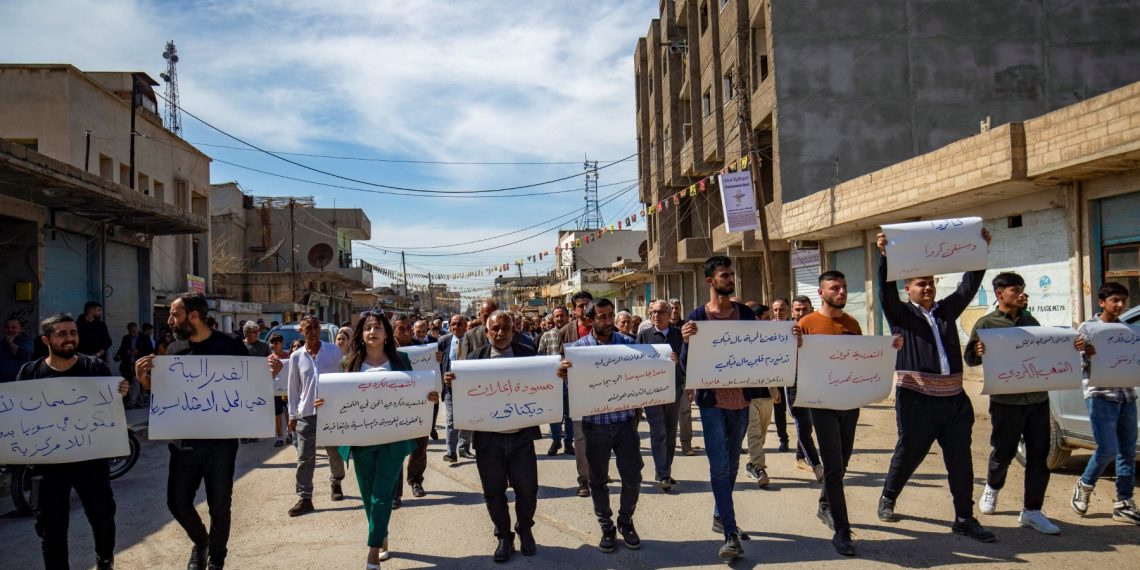
Bringing the constitutional issue back to the forefront is not only a legal matter but a battle over who owns the right to found the state: authority or society. In the Syrian case, where authority tends to manage the transition rather than open it up, the role of societal and political forces is to transform the constitution from a postponed file into a pressing national demand. This requires building a collective constitutional narrative, moving the discussion from “legal texts” to a matter of daily dignity and rights, and linking the constitution to: security (protection from arbitrary arrest), economy (justice and equal opportunity), and identity (recognition of all components).
A discourse must be launched focusing on the idea that “the constitution is not a document for elites, but a contract that protects people’s lives.” Then, a cross-identity societal bloc must be formed, building a broad civil-political alliance that includes: Arab, Kurdish, and Syriac forces, civil society organizations, unions, youth initiatives, and independent figures, with the aim of producing a national pressure group close to the idea of a “historical bloc” — an alliance around a state project, not around an identity. An alternative must be presented by drafting a declaration of constitutional principles, or a short draft constitution, giving people a tangible picture. Even by internationalizing the issue without losing its national character, it is possible to communicate with the United Nations, the European Union, and international actors, provided that the constitution is presented as a popular national demand, not a project imposed from outside. Legitimacy is built internally and partially protected externally.
There is a need to use tools of peaceful pressure, because without pressure, the constitution remains postponed. The constitution must also be linked to political legitimacy: any authority that does not pass through a consensual constitution is an authority of incomplete legitimacy. Therefore, political forces can link their participation in any political process to a clear constitutional path, refusing to grant free legitimacy. The transitional moment must be exploited — every transitional phase carries a window of economic crises, regional transformations, and the need for international recognition. Here, pressure can be exerted under the slogan: “No stability without a constitution.” In Syria, the constitution is not merely a document; it is the final battlefield between the logic of authority and the logic of society.