


In January 2011, two months before the outbreak of Syria’s most severe crisis, UK’s National Security Advisor, Jonathan Powell, founded Inter Mediate, a secret society with the ostensible object of ending armed conflicts.
In March 2012, considering that time had come to make the final preparations for the attack on Baathist tyranny, Powell’s team cut the first turf of its Syrian adventure. Two years later, he put to publicity Talking to Terrorists, his ideal on how to end armed conflicts.
The crisis in Syria paved the way for Inter Mediate on behalf of the Government, and in connivance with Secret Intelligence Services (MI6), to meddle in the country, and destroy in the result the regime of Bashar Assad, ridiculously in cooperation with Islamists.
Of Inter Mediate little can be said. Yet Syria’s existing state of things is reassuringly the society’s making. Profound discontent in consequence of the internecine war, prepared the ground for the greatest conspiracy to go ahead.
Powell’s ideal of engaging with terrorists to end armed conflicts, has somewhat roots in Samuel Huntington’s “The Clash of Civilizations,” that argues cultural and religious tenets will be the primary source of armed conflicts in the Post- Cold War era. What Huntington had previsioned in 1993 would come to pass in Syria.
Markedly, the Syrian civil strife, falling deep into the weeds with Sunni Islamists, well attests to Huntington’s theory. Yet the nuts and bolts of Powell’s ideal predates by all appearances Huntington by many decades.
The idea, perhaps, no exaggeration to say, spans three centuries. Journeying to the past, reveals Powell does not reinvent the wheel. So much has changed. Yet somewhat, much has remained the same.
In 1881, Wilfrid Scawen Blunt, a prodigious yet highly disregarded poet, wrote a series of essays which were published a year later under The Future of Islam. Even in England today, people barely recognize his name. Yet during his lifetime, it was a very different story.
Like Charles Doughty and Richard Burton, Blunt is a pioneer of British Arabists, who nurtured deep interest in Arab (Muslim) history and affairs. Yet contrast to his fellow countrymen, Blunt was an unsparing critic of London’s policy towards Arabia and Islam.
Wonderful to say, he devoted himself with single- minded zeal to the Eastern cause. Blunt vigorously called on his own country to renounce its crooked policy and come instead to an understanding with Muslims, when time was deemed ripe.
No one was better acquainted with the Ottoman Empire than Blunt, an Arab more than Arabs. He saw the meteoric rise of Kaiser Wilhelm II to secure Germany’s place in the sun. The East was the only territory in the world which was not been swallowed up by a Great Power.
Further still, Kaiser’s ubiquitous agents in every part of the empire were undermining the British prestige. He, therefore, besieged successive governments with his daring scheme calling for change.
In many aspects, Blunt and Powell, or rather more precisely, their models, seem quite inseparable. They meet in one important point; a strong and inspiring leadership that could make a stand, and hold the nation spellbound. Piecing together both notions enables somehow to understand the connection between Powell and Blunt.
The Future of Islam explores inestimably the historical and political landscape of Islam in the Middle East, at a time when the Turkish religious and political authority was receding into its Ottoman shell.
Powell’s model is part of a strange, yet fruit- bearing strategy which is mediation. Be that as it may, Powell’s model as far as Syria is concerned, transcends mediation. It is all about transforming. It may be, at first blush, difficult to hold to the idea, but to mediate for peace is superior to continue fighting inexorably, Powell argues.
It may seem, and it ought to be, unnatural for Great Britain to engage with terrorists, yet the recrudescence of war makes it imperative to engage in talks with the evil. With hindsight, the first time London talked to “terrorists” (Irish Nationalists) was in 1920.
London has a rich history of talking to terrorists. The famous statement made once by former Labor Party leader, Hugh Gaitskell, that “all terrorists, at the invitation of the Government, end up with drinks in the Dorchester,” tends quite to give credence to such a claim.
Blunt’s view is that it is only by the ‘knowledge’ of the elements of which Islam is made that we can guess its future. Powell seems to have recognized these elements and adjusted them to the spirit of the age.
For Powell, leadership is the most compelling a factor to grind an armed conflict to a halt. Powell argues that experience has shown that capturing or killing an armed group’s leader does not bring the group into subservience nor terminates it.
This, more or less, evokes Blunt’s remarks that Great Britain cannot destroy Islam, nor dissolve her own connection with her. “Therefore,” Blunt reasons “in God’s name, let her take Islam by the hand and encourage her boldly in the path of virtue.”
Additionally, with variances though, Powell’s interest in talking to Islamist extremists bears one way or another a striking resemblance to Blunt’s admiration for the Wahabist ideal, which is not inscrutable as it seems for the first impression.
During his first ever visit to the Levant in 1873, he saw first- hand what was happening in the land of the caliph. Every part of the empire seems to have been permeated with liberal ideas. He was not self-seeking, if he cherished ambition, it was for the country’s cause.
The Ottoman Empire is, according to Blunt, a corrupt and a rotten one, teetering on the brink of collapse. Blunt is plain in giving ample utterance to his contempt for the Turk. In a sense, this is an echo of a Wahabist doctrine that the Ottoman Empire was the true manifestation of a pagan empire.
The Ottoman decline coincides with the arrival in Egypt in particular of a reform, which makes it incumbent on Great Britain to lead such a reform. Faced with such dramatic a change, Great Britain was asked to undergo a change of heart.
In estimating the future of Islam as a political body, he proposes, for the British gain, and benefit of Arabia, Great Britain serve as the protector of Islam. He rested on a deep-seated belief that the Arabs were better able or had the advantage to run a caliphate than the Turks.
With Great Britain ought to be the natural protector of Islam, it was realized that the fall of the Ottomans does not strike a blow to the neck of Muslims, but a new spirit would be infused into the religion of Prophet Muhammad, to keep Great Britain in the game of big powers.
Yet if Great Britain was eager to assume the position of the “guide and arbiter” of Islam, it was asked to reverse the policy of religious zeal of recovering the Christian lands in the Levant lost to infidels (Muslims).
The whole thing seems to be a piece of romantic fooling. But the British cassandra would turn these romances into performance. Blunt’s prophecies would soon come true by the developing events against the Khedivate in 1879, and the French protectorate over Tunisia in 1881.
He argues subjugating the East culturally and religiously is futile. It is, therefore, wisdom to respect, not wound, the religious sentiments of the Muslim (Arab) world. That is, he ventures to say, is quite much better than a whole century of Crusade.
However, by the time The Future of Islam was published, the government of Cairo had passed into the hands of London. The British under William Gladstone were already making themselves masters of Cairo.
Blunt astutely calls attention to the fact that the Caliphate is a weapon “forged for any hand” – for Russia’s at Baghdad, for France’s at Damascus, or for Holland’s (call it one day Germany’s) in Great Britain’s stead at Mecca. He also believes his country occupies a unique position in the Muslim world, different to all European countries. This is echoed elsewhere.
British Prime Minster, Robert Gascoyne Cecil, known for his statement that a phase of European, preferably British, rule was indispensable for the advancement of the backward peoples, claimed Britain was the greatest Islamic empire on earth.
Cecil himself was ahead of Huntington in acutely grasping the cultural differences between the East and the West. Just like Huntington, Cecil saw that Islam was unamenable to the European reform.
This partly justifies why Cecil was so intrinsically averse to imperial occupation and forcible expansion in the land of Islam. To add insult to injury, a decree dated March 27, 1892, laid down that Egypt was part of the Turkish Empire. Blunt did not burn his bridges nor acquiesced.
Blunt’s name was in full execration with Irish and Egyptian Nationalists as the author of British headaches. This tarnished his name and isolated him from politicians. Three times he run for the Parliament. Three times he lost.
Reading the runes, Blunt, quite prophetically, believed that the death or fall of Sultan Abdul Hamid, whenever it happens, would terminate the Ottoman Caliphate. Five and a half centuries have passed since the Turks had seized the possession of the decaying Byzantine Empire. Their clock was ticking.
He was not building castles in the air. At the time, there arose a conviction at home and abroad that Abdul Hamid would appear in the canals of history not the Sultan that saved the empire, but as the one who might have saved it and did not
His three-decade-long reign was a one of terror, and the most unhappy and disastrous of the empire’s long history. His policy was directed by a very narrow fanaticism. He was living on borrowed time.
Yet Blunt did not call for the deposition of Sultan Abdul Hamid by the use of force since he was deemed to collapse sooner or later. At home, while it was realized that the Sultan would yield to nothing but force, the sultan had recently developed an enemy of a different character; the Young Turk Party.
Furtively, they were in harmony with Great Britain. At about this time, interpretations of the Quran that breathed the spirit of reform and tolerance hatched up in London began to pervade the body of the empire. Propaganda depicted the Sultan as the worst enemy of Islam.
They were momentarily suppressed by the sultan’s terror, yet “the school was far from dead,” he observed. The fact that Great Britain was no longer Abdul Hamid’s most reliable ally and mentor, must have encouraged Blunt.
The situation in the Balkan Peninsula tends to give credence to Blunt’s prophecy. The ‘Bulgarian atrocities’ of 1876, at the hands of Turkish Bashi-Bazoukh militias, produced a most salutary effect to punish the Turk.
Yet geopolitically, a greater Bulgaria to serve at the time as a breakwater against expansionist Russia outweighed rescuing the unlucky south Slavic nation.
Akin somewhat to events of 1876, a similar situation arose in 1894 and again in 1896. The ‘Armenian massacres’ of Sasoun adds to the Ottoman predicament. This time, Cecil was deeply troubled and touched to the chord.
It was felt necessary that some steps should be taken to bridle Bashi-Bazoukhs, and save Christian lives. London was inclined to take military action against Abdul Hamid. There was much delay. Kaiser blocked the way.
Yet with confidence, he waited for the dissolution of the Ottoman Empire. At this juncture, the role of England in regard to Islam, as the world’s greatest power, commences. However, once the empire falls, there arises the problem of picking out the new seat of the successor caliphate.
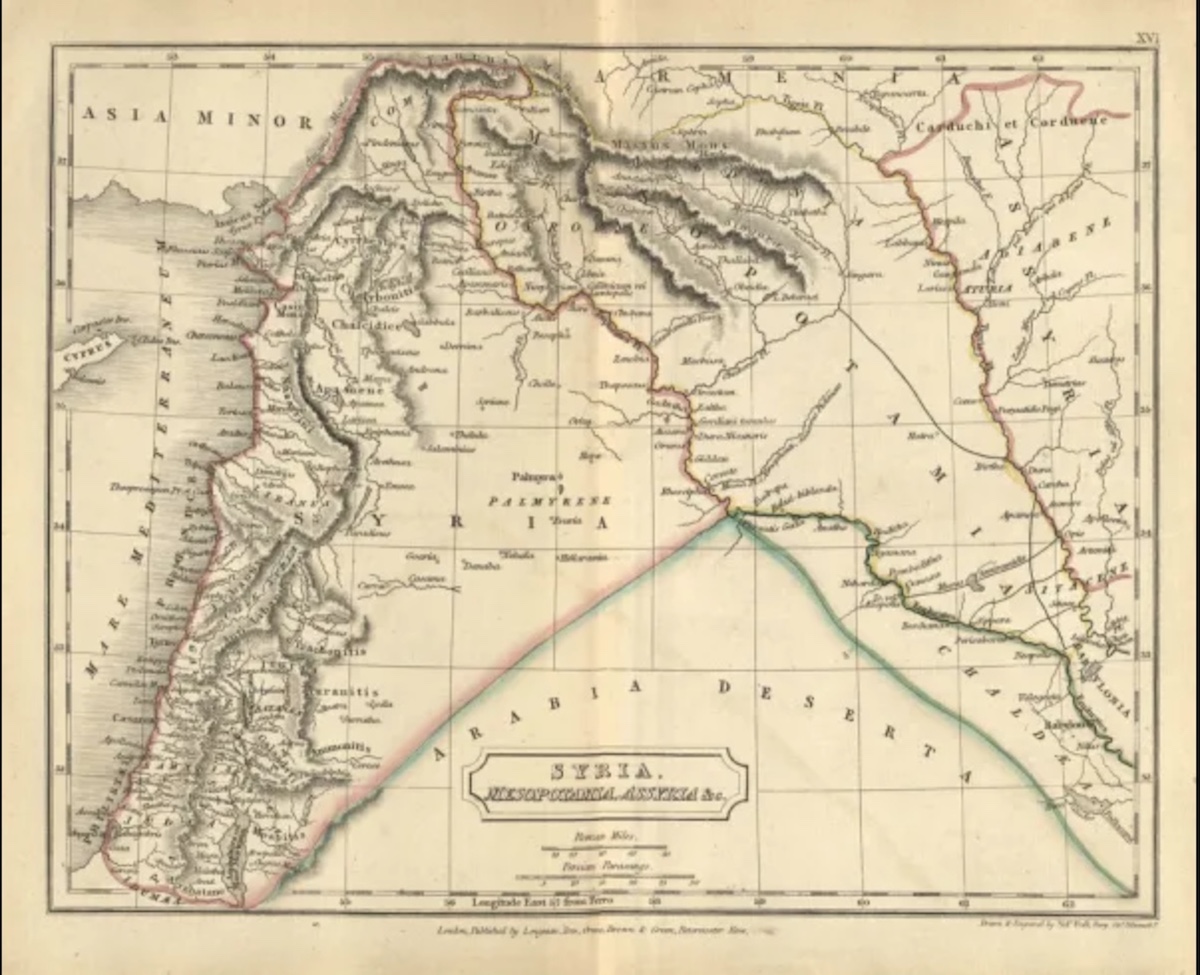
Not without reasoning, Blunt proposes that Hijaz might be the natural appanage of the Caliphate. Yet he firmly supported Damascus, Syria’s historic city, be the metropolis of the caliphate and be a permanent makeweight to Constantinople. Damascus is regarded as the very keystone of the imperial arch.
There were good reasons for choosing this portion of the empire as their strategic base of the caliphate. Syria’s location on the Mediterranean makes it easy for the British to defend it against any foreign hand, Blunt explains.
He was fully alive to the political and strategic value of a railway from the Gulf of Alexandretta to the Euphrates, and having a sort of FOBs, that could secure such a caliphate from potential Russian threat in the north.
On the whole, success of such a “protectorate” depends in the first place on the support of the Muslims of Syria, and on the British backing on the second. Lest we forget, Syria that Blunt meant – as it had always been – never encroached upon East Euphrates.
The importance of possessing Syria has always been known to every colonial power. Yet, while the Land of the Pharaohs was in 1882 taken by the British, to secure the safety of the Suez Canal, the spinal cord of the British empire, Syria was steered through the British greed, until suddenly, like a bolt from the blue, opportunity offered itself in an ample manner.
The decade preceding the Great War (1914- 1918) marks a turning point in Great Britain’s engagement with Islam, and put Blunt’s model into practice. The year 1903 is phenomenally fundamental. Blunt establishes a strange and yet a curious friendship with Winston Churchill, the quintessence of British Imperialism.
It must have come as no surprise when during the war Turkey proclaimed Jihad against the enemies of Islam (Britain, France, and Russia), the al-Azhar, in the name of the Prophet, issued instructions to the people to keep peace. Arab and Muslim worlds did not deviate from al-Azhar.
Pervious to the war, save by a few earnest admirers, fewer people in Great Britain paid attention to Blunt and his preaching, yet Blunt seems to have engaged the attention, and captured the hearts of those charged with settling the region down to the ground.
Churchill oversaw the creation of nominally independent Arab states run by the Hashemites, under informal British control. Except for Syria, traces of Blunt’s thinking are obvious in the ‘Sharifian Solution’ adopted after the war.
The transference to the French flag of Syria was a historic error. Mark Sykes is mainly at fault. The “caricaturist” had, by a wartime agreement, promised it to France back in 1916, for which he was later forced to eat humble pie.
Blunt was largely satisfied with ‘Sharifian Solution,’ the credit of which he attributed to Lawrence, Churchill’s special advisor on Arab affairs. Blunt believed Lawrence forced his policy on the Foreign Office, the Colonial Office and on Winston Churchill, the Colonial Secretary.
Churchill introduced Lawrence to Blunt before the Cairo Conference. They met after the conference in 1921. Churchill and Blunt were enamored with Lawrence, who put Blunt on a pedestal, proclaiming him “Prophet of Arab affairs.”
Directly, or indirectly, Blunt’s model helped draw a British colonial policy in the region – past and present. In 1884, he said the government of his country was undermining The Future of Islam by “adopting” it and using it for its own “purposes.”
In his diary of Sep. 13, 1883, Blunt meets sheikh Jamal Addine al-Afghani in Paris. Blunt is told it is rumored that the British were “going to set up a sham caliphate in Arabia, under a child, whom they would use to make themselves masters of the holy places.”
Converting Syria to a caliphate, with the lapse of a century, is an element of Blunt’s thinking. People with the exact knowledge of the of affair, who tumbled the country down like a house of cards, do not hesitate to make the admittance.
Morphing Jihadists into statesmen, and murderers into military commanders hammers the idea home. Who may foretell today ?