

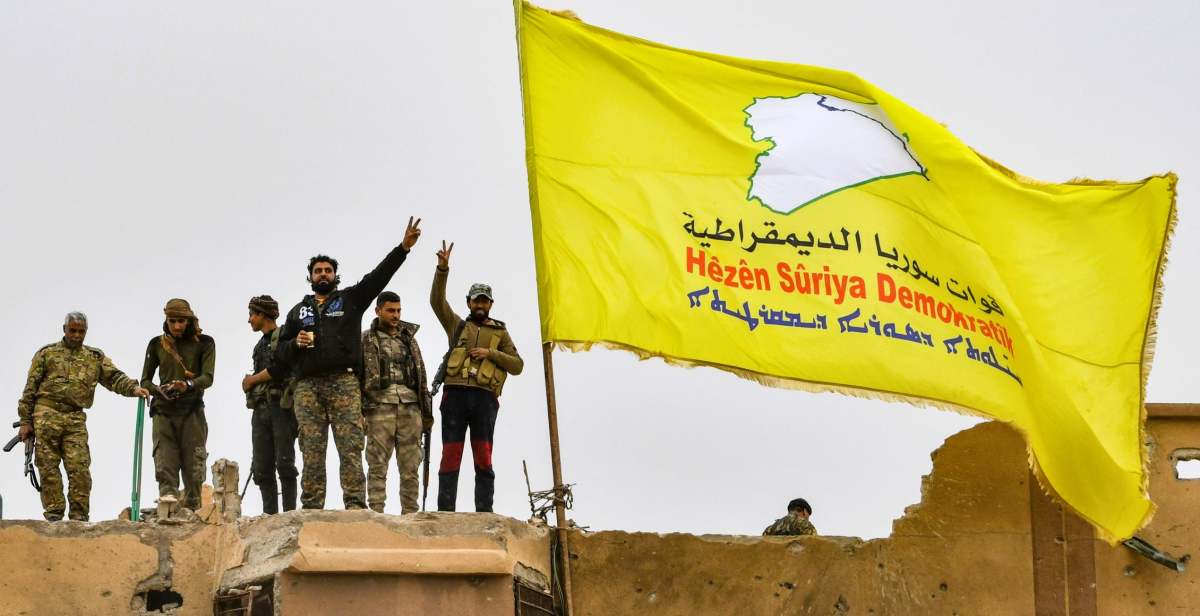
Syrian Democratic Forces (SDF) Commander-in-Chief General Mazloum Abdi and the Co-Chair of the Autonomous Administration’s (AANES) Foreign Relations Committee, Elham Ahmed for the first time joined the Munich Security Conference (February 13-15) in Germany, which indicates a more open policy of Germany towards the SDF, particularly since the fall of the Assad regime in December 2024 and the March 10 agreement between the SDF and Damascus.
The Consulate General of Germany in Erbil in a post on X on Feb. 17, confirmed that they played a role in facilitating Mazloum Abdi’s participation in the Munich Security Conference and posted a picture of General Mazloum Abdi, with German Consul General Albrecht von Wittke.
In the past, such a picture was unimaginable since the German state often prioritized its economic and political relations with the Turkish government over relations with the SDF, also due to the 2016 EU-Turkey refugee deal to stop the influx of refugees in Europe, which was strongly supported by Germany. Since the beginning of the Syrian uprising, Germany has dealt with a huge refugee influx of Syrians, and 973,000 Syrians were living in Germany at the end of 2023.Germany has also been a member of the U.S.-led Coalition against ISIS, and its troops have armed and trained the Peshmerga forces in Iraqi Kurdistan, but in Syria, Germany did not play such a role.
“We are trying to help via the Red Cross, Red Crescent and United Nations. However, we have virtually no influence on the military power architecture,” then-German Foreign Minister Sigmar Gabriel told the Braunschweiger Zeitung in 2018. A number of countries have been also militarily involved in Syria on the ground, such as France, the US, and the UK. Germany nevertheless provided a lot of aid and supported the Syria Recovery Trust Fund (SRTF) with millions.
“We have made available 360 million through this instrument for agriculture issues for job opportunities, which was quite successful in the last years,” Germany’s Syria Envoy Stefan Schneck, told Rudaw in late December 2024.
Furthermore, in the past, often the participation of the SDF was blocked from international conferences, due to the opposition of the Turkish government. Even in Iraqi Kurdistan, Turkish opposition created obstacles for SDF or AANES leaders to join the many conferences. But recently as shown by the participation of SDF and AANES officials in the MERI Forum in Oct. 2024 and the MEPS Forum in November last year, it showed there is a different position on the SDF. Kurdistan Region President Nechirvan Barzani also played a big role in the participation of General Abdi in Germany.
Avoiding SDF Relations
The German relationship with the SDF has also significantly changed over the years. The then-German FM Gabriel told the Braunschweiger Zeitung also in 2018 that he had once been married to a Turkish woman and referred to the Kurdish People’s Protection Units (YPG) as a ‘militia that was reaching out to Assad.’
He also added that Turkey was concerned about YPG territorial control, viewing the group as the Syrian wing of the Kurdistan Workers’ Party (PKK), which is also banned in Germany. Although German officials always underlined their understanding of Turkish security concerns, Germany has always criticized and opposed Turkish military operations against the SDF in Syria and in 2018 from an international law point of view, Germany put plans on hold to upgrade German-made tanks used by Turkey after a Turkish offensive in Afrin in 2018 Jan-March.
Germany also had a strong link with the Turkish-backed Syrian National Coalition for Syrian Revolutionary and Opposition Forces (SNC) and German officials joined the opening of a Coalition Liaison office in Berlin in 2013 and recognized the group as legitimate representatives.
This was in stark contrast in its relations with the Democratic Union Party (PYD) and the AANES. Nevertheless, the Autonomous Administration opened an office in Berlin in 2016. However, this office was not an official diplomatic office, and as such did not need recognition by Germany. Other such offices were also opened in other European countries, like Sweden and the Netherlands.
Before 2019, the German Foreign Ministry stated that it won’t deal directly with the Autonomous Administration (AANES) to repatriate German nationals that joined ISIS. The then-German Foreign Minister Heiko Maas told reporters in 2019 that Germany does not recognize the Syrian Kurdish autonomous region, it is not possible to check detainees’ identity. However, slowly the German policy started to change under pressure due to the ISIS file, and started to repatriate German nationals in 2019 in coordination with AANES officials. In 2021, a German delegation led by the-then Consul General of Germany repatriated a number of German nationals.
There was also a slight shift in policy, when German Foreign Minister Annalena Baerbock, was appointed in 2021 (until 2025), who came from the Alliance 90/The Greens party, and was in office during the Assad regime’s fall.
Fall of Assad Regime
After the fall of the Assad-regime in December 2024, then–German Foreign Minister Baerbock told journalists that there is a need for security for Kurds, following a meeting with Turkish Foreign Minister Hakan Fidan on Dec. 20, warning against any Turkish military escalation, when there were fears the Turkish army might launch offensives against Kobani, and heavy clashes continued between the Turkish-backed Syrian National Army and the SDF.
Nevertheless, at the same time she said that Kurdish groups should be disarmed and integrated in the national security structure, angering the Kurdish diaspora.
A Kurdish source who is familiar with the German-SDF relations said that while in the past there were some relations between the SDF and Germany, “but after the Assad regime fell, the relations improved, and became clearer, and after the signing of the 10 March agreement” (between SDF and Damascus).
Another factor that also made it a little bit easier was the ongoing peace process between the PKK and the Turkish state, started in October 2024.
In December, the German Syria Envoy Schneck also confirmed to Rudaw that they met with General Mazloum Abdi. “We were looking for a way forward, and General Mazloum also put some important ideas on the table. Leaving of all foreign (PKK) fighters.”
“I think the most important is that those groups who are now on the ground, that they sit together to build up a common security structure, which includes HTS and SDF,” he said.
Also the Director Middle East and North Africa, Federal Foreign Office Tobias Tunke on Jan 19, 2025·posted on X on meeting with General Mazloum Abdi, which also included Rohilat Afrin, General Commander of the Women’s Defense Units (YPJ), where they discussed contacts between the “SDF and HTS (Hay’at Tahrir al-Sham) leadership” and joint efforts against ISIS. On March 13,, Tunkel also welcomed the agreement between the SDF and Damascus, and called General Mazloum Abdi and encouraged quick implementation.
On Jan 9, Tunkel again spoke with General Mazlou Abdi over the outbreak of violence between Damascus and the SDF, and urged a stop in fighting and the implementation of the March 10 deal. Also on Jan. 20, Tunkel spoke with Elham Ahmed, and underlined the need to stop the fighting and continued talks between Damascus and SDF for a political agreement.
Germany has also expressed support of the new Syrian government, and reopened its embassy in March 2025 in presence of the German FM Baerbock. This is also due to the fact that Germany wants to repatriate Syrians. In November, the German Chancellor Friedrich Merz invited Syrian Interim President Ahmed al-Sharaa to Germany to discuss deporting Syrian citizens, but President al-Sharaa canceled his visit amidst fighting between Damascus and the SDF. In a joint statement with France, the UK, and the US, Germany also called for a permanent ceasefire and a peaceful integration of the SDF into Syrian state institutions.
Finally, in February this year, on the sidelines of the Munich Security Forum, for the first time there was also a meeting between the German Federal Minister for Foreign Affairs of Germany Johann Wadephul and the SDF delegation.
On Feb. 15, the German Foreign Office posted on X that the German FM Wadephul underlined his support for the last Jan. 29 agreement between the Syrian government and the SDF, and encouraged its implementation for peace and security in Syria.
Kurdish psychologist Jan Ilhan Kizilhan, who was awarded the Federal Cross of Merit by Germany’s Minister of Foreign Affairs Annalena Baerbock in March last year, underlined that Germany’s shift in its approach to the SDF did not happen overnight.
“It began gradually, particularly after the attack on Aleppo, which increased political pressure on Damascus and exposed the fragility of the post-Assad transition. At the same time, Kurdish representatives in Germany intensified their diplomatic engagement, holding numerous meetings with the Foreign Ministry and political actors across party lines. This sustained dialogue contributed to a cautious but noticeable adjustment in Berlin’s position,” he told The Kurdish Center for Studies.
A Pragmatic Policy
“An important moment in this process was the Munich conference initiative, which was brought forward with strong encouragement from the United States. Germany’s willingness to allow Mazloum Abdi and Ilham Ahmad to participate signaled a practical recognition that the SDF and the Autonomous Administration cannot be excluded from serious discussions about Syria’s future. That step reflected a growing understanding in Berlin that stability requires the inclusion of those who effectively govern and secure territory on the ground.”
However, Kizilhan warned that this does not mean that Germany is unconditionally supportive of the SDF. “The relationship remains pragmatic and careful. Berlin continues to balance regional stability, relations with Turkey, counterterrorism priorities, and the future political structure of Syria.”
Germany’s ambassador to Iraq Christiane Hohmann on February 26 last year at the Erbil Forum also underlined that Germany’s “positions are not set in stone. They are flexible. But we react either way. And that depends on what really happens on the ground.”
Kizilhan also added that another key factor in Germany’s shift on the SDF is “the political weakness and inconsistency of Ahmed al-Shar and his government. While presenting themselves internationally as architects of a new, inclusive Syrian state for all minorities, they simultaneously send contradictory signals — including references to an Islamist state model and recurring military actions against Druze, Alawite, or Kurdish communities. This double messaging has created skepticism in European capitals.”
“In that context, Germany increasingly views the SDF less as a controversial non-state actor and more as a necessary partner for stability, pluralism, and a decentralized Syrian framework. The evolving relationship reflects political realism rather than ideological alignment,” he concluded.