


Among the consequences of the collapse of multi-national states—or those descending into cycles of civil war, armed conflict, and the rise of factional (nationalist or religious) authorities—is the revival of discourse regarding the right to self-determination for cultural and ethnic groups and peoples.
Perhaps a portion of this revival is currently being witnessed in Syria through discussions of this “right” within Druze, Alawite, and certain Kurdish circles. Regardless of the seriousness of these proposals or the existence of a domestic consensus among these groups regarding the advocacy for self-determination, the angry Syrian debate often obscures the importance of this principle. It is a fundamental tenet in political literature that flourished shortly before World War I and spread in its aftermath.
After being a slogan championed by U.S. President Woodrow Wilson and, before him, the communist leader Vladimir Lenin in his famous 1914 essay “The Right of Nations to Self-Determination,” it served as an inspiration for peoples emerging from the wreckage of defeated empires. However, the discourse on self-determination has since become an omen of doom for states that emerged from the fragmentation of those very empires. Consequently, the state borders drawn by European colonialism became objects of sanctification and a new obsession with what would be termed the “territorial integrity” of states comprising diverse ethnic and sectarian mosaics.
Lenin and the Clashes of the Second International
The Second International (1889–1916) provided a platform for deep debate regarding the national question, including the right of nations to self-determination. Three distinct trends emerged, One of these was represented by the radical Rosa Luxemburg, who embodied the internationalist tendency; the second by Lenin, the absolute supporter and most prominent advocate for the right of nations to self-determination; and the third was manifested in the theory of Otto Bauer and his ambiguous project known as ‘National-Cultural Autonomy,’ which serves as a centrist synthesis between the two aforementioned positions.
In his 1914 article, Lenin pushed the concept to its furthest limits, stating that the right to self-determination clearly means “political secession and the formation of independent national states.” Lenin bolstered his position with evidence and examples, leaning on the writings of Kautsky and Plekhanov, but most importantly, on Marx’s reading of the separation of Ireland from England: “A nation that oppresses another nation forges its own chains.” Marx provided the raw material from which Lenin crafted his radical thinking—a position Lenin would reiterate while launching biting, satirical critiques against Rosa Luxemburg’s excessive internationalism at the expense of peoples’ rights. While Luxemburg rejected self-determination on the grounds that it leads to “bourgeois nationalism,” the astute Lenin did not overlook these warnings; he categorically linked the issue to the rejection of chauvinism, stating: “It is impossible to march toward this goal (self-determination) without fighting all forms of nationalism.”
For Lenin, the right to self-determination was the litmus paper that revealed the thinking of his communist comrades. Inspired by Marx’s habit of “examining the teeth” of his socialist acquaintances to verify their consciousness and the solidity of their doctrine, Lenin sought to examine many a socialist mouth during the Second International.
Lenin did not spare the moderation of the Austrians Otto Bauer and Karl Renner, who attempted, through “national-cultural autonomy,” to prevent the disintegration of the Austro-Hungarian Empire. Their principle was based on “encouraging international unity within national diversity.”
In 2017, a Russian group released a draft Syrian constitution, which the Russian delegation distributed during the Astana negotiations. It was rejected by both the regime and the opposition. At the time, Russian diplomats claimed the draft was merely the effort of experts and halted discussion to avoid a backlash. However, the striking element of that Russian project was Article 4, which discussed “Cultural Autonomy” in a manner identical to Otto Bauer’s vision. The Russian authors drew from the debates of the Second International what they deemed suitable for the Syrian case and an initial solution to the Kurdish issue. Article 4 (Paragraph 2) stated: “Kurdish cultural autonomy bodies and organizations shall use the Arabic and Kurdish languages as equal languages.” This was in addition to Article 2 (Paragraph 2), which spoke of the “multi-national and multi-confessional Syrian people” as the “sole source of state power.”
Regardless of the source of this “promising” Russian effort, the debate on self-determination and autonomy remained “desecrated ground” that both the Syrian regime and the opposition refused to tread upon. This refusal was driven by a centralized mentality and a pathological obsession with territorial integrity, compounded by regional factors rejecting any Syrian advancement toward decentralization. The refusal to engage in these discussions meant that the era of chronic internal problems would not end with either the victory or the collapse of the Assad regime.
Wilson’s Ambiguous Self-Determination
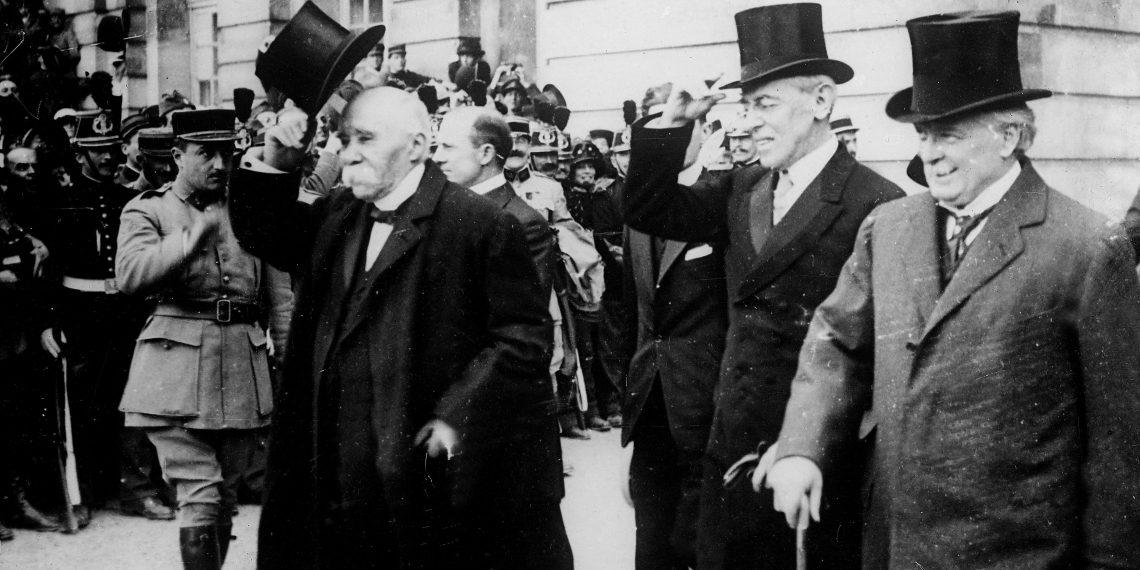
The name of U.S. President Woodrow Wilson came to prominence during his address to Congress on January 8, 1918, where he announced his country’s vision for the post-WWI, famously known as the “Fourteen Points.” Wilson brought this vision to the Paris Peace Conference on January 19, 1919. However, Wilson’s principle regarding the right of peoples to self-determination appeared so vague that the American diplomat and author Richard Holbrooke, who lauded the pioneering Wilsonian principles, criticized them for their degree of ambiguity.
In her distinguished work, How the West Stole Democracy from the Arabs, Elizabeth F. Thompson argues that the essence of Wilson’s expression regarding self-determination was originally intended within the context of “the right of a people to have a voice in the political process, rather than the right to secede or unilaterally declare independence.” Yet, Wilson’s admirers, particularly in Europe, maintained their own interpretation of the matter. Thompson faulted Wilson for failing to “correct that understanding,” thereby leaving it open to varied interpretations and divergent possibilities.
What remains clear in Wilson’s vision, despite the numerous ambiguities and confusion it stirred, is his support for the idea that peoples emerging from the shells of defeated empires should have a voice within the political process following the disintegration of those empires. After the collapse of the Ottoman Empire, “Syrians,” led by Sharif Faisal bin Al-Hussein, appeared to be pioneers in embracing these principles, calling for their right to self-determination to ensure they would not return to Ottoman rule and to stand firm against European colonial ambitions.
The reality is that the initial foundation of Syria was built upon the principle of the right to self-determination, signifying secession from the Ottoman State, followed by national political independence in the face of Western mandate powers. Today, more than a hundred years after the calls for self-determination, Syria is experiencing localized, miniature waves of advocacy for this right. These calls carry ambiguous dimensions that advocate for either secession or autonomy. In the case of secession/independence, one could speak of a return to the radical Leninist concept, which implies the impossibility of remaining within a monolithic religious, national, cultural, or perhaps factional state. Conversely, autonomy or federalism implies opening the door to political participation in the Wilsonian sense, subsequently reshaping the relationship between groups and peoples within a single state based on specific and clear contractual foundations.
The Internal/Subjective Factor
From a historical and contemporary perspective, the right to self-determination does not grow in a vacuum; it requires a major collapse of the existing structure in favor of rising new structures. Furthermore, self-determination cannot be imposed by a “supreme” external will, as attempted by Henri Gouraud’s project at the start of the Syrian mandate, which divided the Syrian portion of the Levant into four statelets.
Can Gouraud’s project be re-evaluated today? At the dawn of the Syrian entity, Syrians were not one distinct people as much as they were groups emerging from the explosion of the Ottoman State. The French project should not necessarily bear the sole burden of the legal, administrative, and social backwardness inherited from the Ottomans. Thus, the French vision faced two paths: separating the sectarian and regional Ottoman groups in the “New Syria,” or attempting to invent a new “nation.” Choosing the first path appeared “realistic” by French standards of the post-imperial world.
In other words, in the Syrian case, one must re-examine the historical stigma attached to the colonial principle of “divide and rule” for at least two reasons:
First, France could have ‘ruled’ regardless of whether it divided the local communities (Alawites, Sunnis, and Druze) and partitioned the Syrian map into two competing metropolises (Aleppo and Damascus), or consolidated all Syrians under a single administration; in both scenarios, France was capable of governing a weak and exhausted Syria.
The second reason can be attributed to the French ‘experimental philosophy,’ which struggled to interpret the perceived impossibility of the peoples of the old Ottoman world living under the formula of the nation-state. Consequently, France did not grant Syrians the opportunity to test their own visions for their new state or the position of minorities within it. As a result, ‘French Syria’ never experienced or trialed a stage of ‘voluntary coexistence.’
Ultimately, the essence of self-determination must spring from the collective imaginations that groups hold for themselves first, and their experimentation with the idea of a shared homeland—contingent upon conditions of recognition of particularity, representation, and equality. Most importantly, the politics of sectarian and ethnic groups are built upon the decisions made by the central authority; they depend, in the final analysis, on the competence of the Center in managing diversity and implementing policies grounded in social justice and balanced development.
In current Syrian circumstances, there is no one invoking Lenin or his comrades, regardless of their varying levels of awareness concerning the right to self-determination. Nor will we find anyone invoking Wilson’s principles or those who believed in his ideas of peace and the freedom of peoples—especially the Syrians of a century ago.
However, what is certain is that the group currently controlling the state is the very entity fueling the primal notions of the right to self-determination. It does so by erecting sharp barriers between groups in favor of an imagined religious and ethnic majority, thereby presenting the worst possible model for managing diversity—a model predicated on subjugation, humiliation, and exclusion from the sphere of state formation and participation in shaping its public identity.
The right to self-determination, in our case, is a natural reaction to the selfishness inherent in the centralized system, the excessive self-exaltation of the power dominating the state, and the disparagement of anyone who does not belong to the religious and ethnic field predefined by the authorities. For this reason, the coming years may carry all the seeds of a protracted internal conflict between those calling for self-determination and those chanting for the subjugation of the ‘Syrian Other’ to the central state through policies of repression, coercion, and the fait accompli.