

Feminist movements have a great deal of credit for developing a robust social, philosophical, and legal approach against the notion of “reaction” — not only as a justification for criminal practices but also as an integrated discourse based on implicit assumptions about society, power, hierarchies, and social roles. In the context of the debate surrounding sexual assault against women, feminist thinkers and legal scholars such as Catharine MacKinnon, Andrea Dworkin, and Susan Brownmiller argued that talk of “provocation” driving men to harassment and rape is but one aspect of “rape culture,” at a level even deeper than the cultural and artistic materials that depict women as sexual objects. Considering that women’s clothing, behavior, or gestures arouse an irresistible desire and drive men to aggressive “reactions” contains a series of conceptions about “nature” — that is, considering violent male sexual arousal as natural and inevitable, something that cannot be curbed; about “society,” in which men have the prerogative to discharge their “natural” desires onto women’s bodies; and about “morality,” which the female body must preserve and observe, lest it be subjected to a justified punishment by “nature” and “society.” Then comes “law” to legitimize all of this, asking women what they were wearing and doing before being subjected to harassment and rape, searching for a mitigating excuse for the criminal. This linkage and hierarchy among the “natural,” the “social,” and the “moral” constitutes an integrated ideology lurking at the heart of law and basic social institutions, making sexual violence against women institutionalized, not merely “individual acts.” Hence, sexual assault is not about sex per se as much as it is about power, and every act of harassment and rape contains within itself an authoritarian and ideological aspect, not a “reaction” stemming from lust.
What feminist thinkers and legal scholars did was to expose the structure of the so-called “reaction” at the level of sexual assault cases. The assault act is built on a prior power and discourse of “provocation” that the criminal experienced due to the woman’s clothing or behavior, and the “reaction” is predetermined within the structure of patriarchal society and is structurally prior — even if not temporally prior — to the stimulus that led to it. The rapist rapes because he sees it as his right and power, and perhaps morally punishes his victim, directly or indirectly, for not conforming to an ideal image in his mind, and the law implicitly affirms him in this. The issue is more complex than an uncontrollable desire; our desires operate within a world of powers, symbols, meanings, and power relations, all typically directed towards maintaining specific gender roles and social hierarchies.
These findings can be generalized beyond the framework of law and feminist studies because they are valid for analyzing the ideology of the discourse of “reaction” in general, based on two fundamental mechanisms whose juxtaposition constitutes a kind of rhetorical fraud: justification and normalization on one hand — i.e., attempting to mitigate the heinousness of the crime and linking it to “nature” and biological, social, and moral inevitabilities, making the criminal closer to an oppressed victim; and consolidating his power on the other hand, so that his practice of the criminal “reaction” is a natural and inherent right, and those who forgo practicing this right (not the right itself) deserve praise and honor, just as in the phrase “I am a good man because I do not rape.” What feminist analyses actually reveal is a broader discursive structure than the justifications for sexual assault, in which violence and criminality are presented as an inevitable result of external circumstances, thereby transforming human agency into mere “reaction” and concealing the power relations that make violence possible in the first place.
Despite the theoretical importance of this analysis and its significant potential for generalization in all directions, foremost among them politics, it was later emptied of its content by ideology and activist organizations that reclaimed the logic of “reaction” to make it a justification for practices and crimes committed by groups they consider “marginalized,” “weak,” or “suffering from historical wounds.” It suffices to classify certain individuals within one of these groups to justify all their crimes with the discourse of “reaction.” This is what happened, for example, in the case of the perpetrators of terrorist operations in Europe, which peaked in the middle of the last decade, coinciding with the rise of ISIS. With every operation, dozens of voices considered part of the so-called “liberal left” in Western countries would speak of the “colonial past” and “imperialist policies,” concluding that the terrorist act is justified to some extent as a “reaction.” Indeed, the massacre that occurred against cartoonists and writers at the French newspaper *Charlie Hebdo* in 2015 was considered a “reaction” to the newspaper’s provocation of religious sentiments. It went so far that about two hundred writers, mostly English-speaking and aligned with that ideological current, boycotted the PEN International ceremony dedicated to honoring the victims of the massacre, claiming that their “provocation” was not the best example of free expression, as they had practiced “Islamophobia” expressing a superior racism towards marginalized groups that had long suffered from French colonialism. This aroused the ire of British writer Salman Rushdie, who had long suffered from “reactions” of that kind. He initially cursed the boycotters harshly in a tweet on Twitter, then clarified that talk of a “reaction” from the weak is nothing but fraud. He stated that we are not actually talking about the “marginalized,” but about political Islam movements that have a vast base of funding and ideological support, direct and indirect, involving countries with huge budgets, not just the “Islamic State,” but countries like Turkey, Qatar, Saudi Arabia, and Iran, and cross-border organizations. This network of countries, organizations, and institutions has long oppressed millions of truly “weak,” unarmed, non-terrorist people.
Rushdie’s response alerts to more than the danger of political Islam networks and their naive portrayal by activists as groups of marginalized victims; rather, it alerts to a primitive concept of power that divides humans and the world into two homogeneous blocs: a class that holds all power, and a class completely deprived of it, which compensates for its deprivation through “reactions.” Thus, peaceful cartoonists become entirely equivalent to racist policemen or historical French colonial leaders in the unified bloc of the “white man” or “colonialism and imperialism”; while ISIS members, the Muslim Brotherhood, Yazidis, Kurds, Arabs, Algerians, Iranian mullahs, and their female and opposition victims all become homogeneous in the single bloc of “non-Westerners” or the “Global South.” Even more ironically, the terrorists — many of whom did not come from low social classes on the French and European level — became representatives of all this “non-Western South,” simply because Western activists assumed so.
Practically, the “reaction” denies agency to those presumed to be at the top of the power hierarchy (white men), while being used with all its ideological baggage to justify the act of those presumed to be below (non-Westerners), normalize it, and even sometimes endow it with a heroic and romantic aura, as in the case of the October 7, 2023 attack. This might perhaps indicate an attempt to “overturn the power hierarchy” — i.e., justifying a crime by someone presumed weak and oppressed in order to shatter the power of someone presumed strong — but it does not indicate any systematic awareness that can be taken seriously or an exit from the ideology of “reaction,” with its matrix of weak concepts, foremost among them the artificial and deterministic alignment of the natural, moral, and social in an attempt to prove that what happened was inevitable and the only expected outcome, thereby solidifying power relations with many victims, such as the power of militias, Islamic groups, Islamic states and republics, and patriarchal oppression (provided it is not “white”). In short, these are right-wing supporters of a specific pattern of power and its relations, including killing, repression, and exploitation, while their alleged leftism and liberalism are focused only on whom they consider the “enemy,” without the ability to define the self and the enemy convincingly.
Relatively apart from the direct political consequences, what happens to a culture that relies centrally on the notion of “reaction” in its analyses and interpretations? And what form of self-construction and social performances will it produce?
Interpretation and Justification
Many proponents of the “reaction” notion argue that they are not justifying crimes but rather attempting to interpret and understand them neutrally, without making value judgments. However, this does not seem convincing at all. Interpreting a political or military act — certainly resulting from extremely complex social factors and forces, contradictions or conflicts within the acting party itself, a complex ideology with its own specific discourse and symbolic system, an intertwined regional and international situation, and an accumulated history that changes dramatically — with a simple notion like a reaction from a party that is always weak, oppressed, and victimized towards a party that is always strong and unjust, contains none of the elements of serious interpretation. It is a binary division of the simplest kind that hinders actual interpretation and understanding and cannot be carried out except through extremely obvious processes of selecting facts, erasing differences, bypassing contradictions, ignoring structures or rendering them obscure, to reach a predetermined conclusion before the analysis begins: that it is the “oppressed’s reaction.”
This “interpretation” also bypasses the acting subject of those carrying out the “reaction.” Without this bypass, no such statement would hold. Here, there are no forces that are self-aware, aware of their project and ideas, making choices based on their perception of the world and history, their determination of the conflict and its goals, and the nature of the enemy. Rather, they are merely beings whose consciousness and self-expression seem unimportant or cannot be taken seriously, carrying out their reactions to injustice in a quasi-mechanical way, and their action is interpreted through simplified contexts, so context becomes a substitute for the actor.
The “reaction” interpretation is also based on the complete and total denial of all possible alternative actions. This seems very strange, as it is difficult to find a system or structure, however narrow and closed, that leaves only one possibility for action and reaction. Thus, the notion does not explain why this particular reaction occurred instead of other possibilities, as if dealing with a completely mechanical structure, or as if injustice will inevitably lead to one reaction, regardless of who carries it out. This means, for example, that Israeli injustice would inevitably lead to an operation like October 7, regardless of the party that would “react”; that the injustices of the Assad regime would necessarily lead to a “reaction” resembling the massacres of Alawites and Druze, regardless of the structure of the ruling terrorist militias in Syria; and that French colonialism would unquestionably drive the killing of an audience at the Bataclan theater in Paris.
This “understanding” also leads to a strange result: the existence of only one agent in existence, history, and society — the unjust party. As for the oppressed, “their action is created,” to use a term from Islamic theology; they acquire it from the sole agent, who even determines their bloody ideologies and their fascist and semi-fascist organizations, because all of this, again, as almost the only term in the interpretation, is a “reaction.”
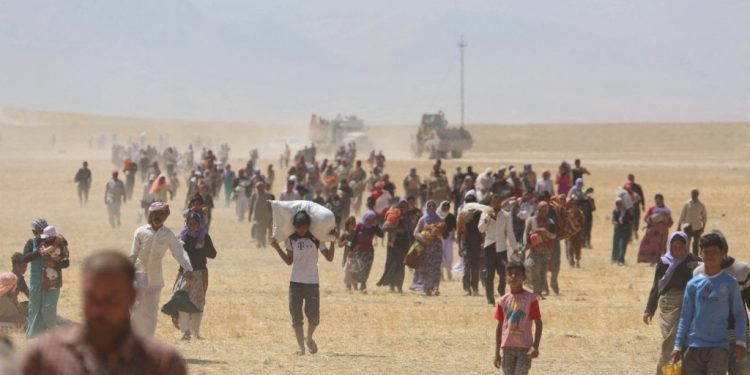
Moreover, this principle is expandable indefinitely, to the point of losing any meaning or interpretive capacity. If we assume that the massacres of Alawites are a “reaction” from victims of Assad who see his regime as Alawite, what about the massacres of Druze? If Islamic extremism is a result of colonial policies and the occupation of Iraq, what about the Yazidi genocide? And why all this bloody rage towards a weak, poor group of people? If the attacks in France are a result of the French colonial past, what about terrorist operations in Germany and Belgium? Did these countries also colonize the Maghreb? With this logic of “interpretation,” everything is a “reaction,” so there is no need for interpretation at all.
The notion of “reaction” has nothing to do with interpretation; it is justification based on an obvious ideological fraud and an implicit political bias towards the party that carried out the “reaction,” attempting to show its action as natural, social, and moral through a complete mechanical linkage between those levels.
Regardless of the notion’s methodological absurdity, it completely paralyzes the culture in which it spreads. It has one answer to every question and one option in every case, thereby canceling politics itself, which can hardly exist except through multiple conflicting or contending options. It also cancels the meaning of cultural work itself, as there remains no choice for the cultural producer except to “explain determinism” — i.e., affirm the inevitability of what happened and the correctness or necessity of the choices made by this militia or that state (since there is no other choice) — which bequeaths a kind of intellectual dullness and the futility of language itself. All words, concepts, and phrases become variations on a single theme, to the point of losing their meaning. As for ideological fraud, it leads to deliberate manipulation of facts and their meanings, describable only as obscurantism.
The Self of “Reaction”
The negative consequences of the “reaction” discourse are not limited to the loss of effectiveness of general culture; they also contribute to producing a mode of subjectivity that always justifies itself through a feeling resulting from the “reaction” and places the self above accountability. What applies to organizations, peoples, and states will also apply to the activist who justifies those entities.
This might be one of the most important reasons for the significant absence of critical reviews in contemporary Arab circles. Unlike older generations, which were known for “self-criticism” — whether within their organizations and parties, during their ideological and political shifts, or after “defeats” — the generation that participated in what is known as the “Arab Spring” has not produced significant literature reviewing its experience, criticizing it, and identifying its errors. What the activists did was mostly a “reaction” to the oppression of authoritarian regimes, driven by a deep feeling of pain, undying dreams, and a “subjective experience” considered the standard for all opinions and behaviors. As for failure, its cause is always “the other there” — the state, or “the Islamists who rode the revolution,” or colonialism and imperialism. This constant self-exoneration invariably leads to non-political stances that see themselves above social conflicts, do not define themselves by social position, ideology, and method, and thus fail to see their actual connections and position, which may lie within networks of loyalty, dependency, and interest describable only as corruption. Discourse is often limited to a set of generalities and rhetorical constructions that conceal or fail to realize their actual implications and biases. This might be a direct definition of activism: “specializing” in the activist’s “reaction” to certain injustices; not defining the self by social position; excessive moral and rights-based tendencies at the expense of political and theoretical thinking; and claiming to represent an identity merely by virtue of the individual’s belonging to it. One who possesses such a self cannot possibly err in order to criticize themselves; they present themselves as “outside the game,” speaking only of rights and ethics, and directing criticism at them constitutes an attack on an entire identity, and all of this is a “reaction” to something.
Perhaps there is little use left in criticizing this pattern of “reactions,” and it is more worthwhile to focus on the concept of “action” itself, as it is what contemporary Arabic-speaking culture lacks. If we look at ourselves as agents, and analyze the structure of action, its relationships, and its complex systems, we will likely arrive at another description of our world and ourselves that helps us formulate the subsequent action consciously, rather than remaining at the level of “reactions,” then bemoaning their consequences while simultaneously exonerating ourselves.