


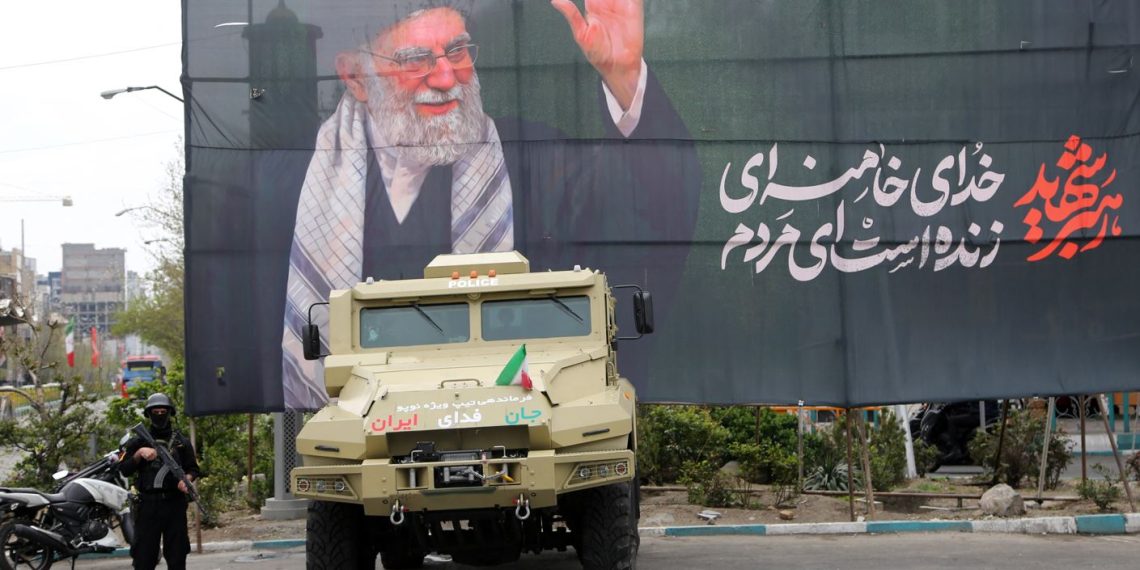
In 1966, Ali Khamenei wrote the following words in the introduction to his Persian translation of Sayyid Qutb’s book, The Future of This Religion: “The greedy invading powers found it necessary to suppress the moral strength in the East as a first step toward imposing hegemony, because this strength could constitute an obstacle to their expansionist ambitions. In the countries of the East, this moral strength was none other than Islam. For Islam grants its sons a personality in which they see themselves as the uppermost; they are called the Party of Allah (Hezbollah), and the Party of Allah are the victors… It promises them that they are the nation that will inherit the earth and be the middle witness on the stage of history, and it drives them toward a constant jihadist movement… It imposes upon them a stance of toughness and severity toward enemies and forbids leaning toward them.” (Full text of the introduction available at the link)
Here, anyone returning to Qutb’s aforementioned book—printed by Wahba Library in Cairo in 1960 while its author was still in prison—will see on pages 110, 111, and 112 of the said Cairo edition that Islam was not only a tool of resistance during the three stages (Crusader, Tatar, and Colonial) but also a spiritual-cultural “defier” (mūmani’), resistant to assimilation even “if apparent defeat occurs at times” (p. 113). It is the civilizational alternative “after the end of the era in which the white man prevails, because the white man’s civilization has exhausted its limited, immediate purposes” (p. 56). Qutb believes the substance of this civilizational alternative lies in the fact that: “Islam alone is capable of saving humanity from the imminent, crushing dangers toward which it is being led by the chains of glittering material civilization. It alone is capable of granting it the methodology suited to its nature and true needs, and it alone coordinates between its steps in material creativity and its steps in spiritual aspiration” (p. 109).
From the text of Ali Khamenei’s introduction, it appears that through Sayyid Qutb’s book, he perceives these three issues: Islam is a tool of resistance, a defiant moral force that prevents assimilation even in the face of “apparent defeat,” and the alternative that will make Muslims “the nation that will inherit the earth.”
Between the book’s publication in Egypt and the Persian translation in Iran, six years passed during which much water flowed under the bridge of resistance against what Khomeini and Khamenei later termed “the powers of global arrogance.” With the Sino-Soviet split in 1960, the tide of the international communist movement—which began with the October Revolution of 1917—started to recede. In 1962, the Cuban Missile Crisis demonstrated a decline in Kremlin power relative to the White House. When the American war on North Vietnam began (August 1964), Hanoi appeared abandoned due to the Sino-Soviet dispute. When the Cubans attempted to restore harmony—foremost among them Ernesto “Che” Guevara, who went to Beijing and met Mao Zedong in 1965 to bridge the rift with the Soviet Union in the post-Khrushchev era (October 1964) and failed—Guevara and Fidel Castro turned their gaze toward the “Three Continents” (Latin America, Africa, and Asia) and toward the concept of “South vs. North” and “Third Worldism.” They came to believe that the source of revolutionary power was no longer in Europe, as Marx, Engels, Lenin, and Stalin had thought, nor did the liberation of colonies depend on the realization of socialism in the colonizing countries—as Indian communists believed prior to the British departure in 1947. Instead, the revolution’s source and center had shifted to the South and the “Third World.”
Frantz Fanon, in his 1861 book The Wretched of the Earth, had launched this sentence, for which we find a counterpart in Sayyid Qutb’s book: “Let us move to the other side… let us leave this Europe which never stops talking of man yet massacres him at every one of its corners” (Dar al-Tali’a, Beirut 1966, p. 295). However, we find in Fanon’s book that national liberation from European colonialism is a process of violent resistance: “Whether we say national liberation, national renaissance, popular resurrection, or union between peoples, whatever the titles used and new terms, decolonization is always a violent event” (p. 41). It “aims at changing the order of the world… a program of complete disordering” (p. 41). He sees an alternative in “national culture” over the culture of the colonizer, but “national liberation and the resurrection of the state are a condition for the existence of culture” (p. 231); meaning, it is formed after them.
In 1965, Castro, Algerian President Ahmed Ben Bella, and Indonesian President Sukarno converged on the idea of the Tricontinental Conference. The coordinator for the preparatory work was the Moroccan politician Mehdi Ben Barka. It was agreed to hold the conference in the Cuban capital in the first month of 1966 (full details of the conference preparations are in Saverio Tutino’s book: History of the Cuban Revolution, Dar al-Haqiqa, Beirut 1971, pp. 286-288).
In June 1965, Ben Bella was overthrown in a military coup led by Houari Boumédiène. Then Sukarno was overthrown in a CIA-sponsored military coup in September. In October 1965, Mehdi Ben Barka was assassinated, liquidated, and his body disappeared in Paris in an operation whose details remain mysterious, though indicators point to the involvement of Moroccan, regional, and international intelligence services.
In September 1965, Castro announced “the secret departure of Ernesto Che Guevara toward other lands and other struggles” (Tutino, op. cit., p. 287), to meet his death in Bolivia in the autumn of 1867.
The Havana Conference was held on schedule, but the clouds of failure were clear in its atmosphere.
It is likely that Ali Khamenei (born 1939)—who was influenced by the Third Worldist tendencies that reached him from the Iranian thinker Ali Shariati (1933-1977), who was himself influenced by Frantz Fanon—was following these developments surrounding the Havana Conference. They were certainly in his mind when he wrote the introduction to Sayyid Qutb’s book in 1966. However, it is clear from the introduction that “Islam”—not Fanon’s “national culture” or the Marxism of Castro and Guevara—is the “Resistance,” the “Defiance,” and the “Civilizational Alternative” for Khamenei.
It is true that Khomeini, in his book Islamic Government (a series of lectures delivered in Najaf in 1970, collected into a book published in 1971, proposing the idea of Wilayat al-Faqih), sees Islam as “the religion of the mujahideen who want truth and justice, the religion of those who demand freedom and independence, and those who do not want to allow the disbelievers a way over the believers” (p. 8). It is also true that in his letter to Gorbachev in January 1989, he considers “Islam, in the face of the capitalist West and the communist East alike, as the only means for the comfort and salvation of peoples and the solution to all the basic crises suffered by humanity.” Yet, what Ali Khamenei proposed, based on Sayyid Qutb, remains the most detailed and clear in presenting the intellectual foundations for the line of “Resistance and Defiance” (al-muqawama wa al-mumana’a). Sayyid Qutb had proposed this idea—which Khomeini presents in his letter to Gorbachev (i.e., the meeting of the White House and the Kremlin in principles despite a dispute over interests, and that it is a shallow division)—since his book Social Justice in Islam published in 1949. Speaking of the post-1945 division between the Western and Eastern camps: “As for us, we believe it is an apparent, not real, division; it is a division over interests, not principles, and a conflict over goods and markets, not creeds and ideas. The nature of European-American thinking does not differ in its reality from the nature of Russian thinking; both are based on the arbitration of the material idea in life” (p. 214, Dar al-Shorouk edition, Cairo 1993). It is likely from this Qutbian idea that the notion of “Neither East nor West, but Islamic” emerged, which the Iranian revolution put forward since 1979—but considering America as the “Great Satan” and the Soviet Union as the “Lesser Satan.” Likely, the disappearance of the Soviet Union in 1991 made Iran less wary of allying with Vladimir Putin’s Russia.
Here, it can be said that what Ali Khamenei provided, after assuming the position of “Supreme Leader” following Khomeini’s death on June 4, 1989, until his death in an Israeli-American raid on February 28, 2026, represents the practical exercise of the line of (Resistance and Defiance). He is the founder of what was termed the (Axis of Resistance and Defiance).
This practical exercise included establishing a global network of the “Hezbollah in the World” system, following the “Leader” directly. This is followed by armed and unarmed Shia Islamic parties and movements that believe loyally in Wilayat al-Faqih, in tandem with Iran’s alliance with Sunni Islamic movements that believe in the theory of “Resistance and Defiance,” such as Hamas and Islamic Jihad in Palestine. This is in addition to the harmonious relationship of Khamenei’s Iran with the leadership of the International Organization of the Muslim Brotherhood and most of the group’s branches worldwide, as well as Iran’s relationship with Arab regimes such as the regime of Hafez al-Assad and his son, where Khamenei saw Syria as a necessary bridge for the “Axis of Resistance.” He also maintained ties with regimes like Erdogan’s Turkey, with whom relations remained good throughout the 2002-2026 period after the Justice and Development Party (AKP) came to power in Ankara.
On the global stage, Khamenei wove an alliance with Russia, China, North Korea, Cuba, and Venezuela to confront the “powers of global arrogance.” On a non-governmental level, there are many Arabists and Marxists (including many Marxists in Europe and Latin America) who believe in the line of “Resistance and Defiance,” or converge with it from the standpoint that the primary contradiction is with Washington and Israel. Hence, their vision for convergence and putting all contradictions aside to meet with anyone who resists and defies the United States and Israel, regardless of the nature of their regime, ideology, or practices.
In sum: Khamenei’s experience in (Resistance and Defiance) has theoretically woven intellectual foundations. While it contains practical exercises where alliances and convergences are built on utilitarian and interest-based grounds—whether with communists in China, or the model represented by Vladimir Putin (who combines Russian nationalism and Orthodox Christianity), or with Hafez al-Assad and his son, and also with Hugo Chávez and Nicolás Maduro in Venezuela—Khamenei was not even deterred by warriness when he met and cooperated, in an act of extreme pragmatism, with George W. Bush in the invasion and occupation of Afghanistan (2001) and Iraq (2003). However, in all this, he believes the opposite of what Eduard Bernstein said: “The goal is nothing, the movement is everything.” For him, “The movement is nothing, the goal is everything.” Consequently, all practices must be for the sake of the goal.
But the question now is: Did Ali Khamenei succeed or fail?