


By the Unit of Iranian Studies
The Shia political vision for the world and the Middle East constitutes a major dilemma for the future of Iran, Iraq, and Syria in particular, as well as profound repercussions for the region as a whole. In the process of deconstructing the “Shia knot,” led by the United States and Israel, a new Sunni world is being reshaped under an old, renewed leadership. Until the image relatively stabilizes and new alliances cohere—with the position of Iran within them being the ultimate “grand prize”—the region stands on the threshold of an extension of chaos, one that is more bloody, with Syria as its new arena. Among the first chapters of this chaos is the attempt by the leaders of the new Sunni world to end the Kurdish question in Syria through the most famous form of conquest: the seizure of the population and their destiny.
In light of this conflict, the regime’s forces launched their war against the Kurdish people in Syria. Characterizing the war as being against the “Kurdish people,” rather than against the Syrian Democratic Forces (SDF), is reflected by the facts on the ground. Any basic military expert can recognize the nature of this attack and the genocidal character that forms its foundation, similar to the genocide against the Druze before it. What is striking is that this authority, with its formations and factional alliances, committed massacres and ethnic cleansing while it was still in the opposition. It is highly exceptional for an opposition force to possess the tools to commit the mass displacement of more than a million Kurds in total—from Afrin, Sere Kaniye, Sheikh Maqsoud, and Ashrafieh—not to mention the Kurds in the contact zones with that opposition, which has now jumped to power in Damascus but remains an “opposition” in terms of its tireless pursuit of destroying the state to topple the Assad regime. It seems it cannot stop destroying the state and its societies.
The counter-attack by the “Centralization Axis” in the Middle East achieved a half-military victory against the “decentralization” of the SDF. The conflict between centralization and decentralization, despite its conceptual simplicity, has turned into an existential and regional war, as the realization of either only occurs through military preponderance. This dilemma—the transformation of the political form of governance into existential military wars—was created by three factors:
First: State Ideology. Syria, Yemen, Somalia, and Sudan serve as models. This old doctrine is based on turning the defense of the state into a combatant jihad, as one of the pillars of “for the sake of God.” This jihadi Islam, accompanying the overlapping national-Islamic war, is based on “loyalty to Jahiliyyah” (according to the Islamic understanding of Jahiliyyah) and “disavowal of Muslims” who seek political and economic entity rights. The common denominator among all wars of the central state is that they include a coalition of jihadi movements—some of which are rival movements—but they unite against a single enemy: either non-Sunni (in the Alawite and Druze cases) or non-Arab and decentralized (in the Kurdish case) or Arab and decentralized (in the case of Somaliland and certain entities in Sudan). In all these cases, political Islam brings together the parties of the failed, monolithic central state alliance in politics, economy, and security. Decentralization experiments may not be role models or equivalent to the failure of centralization in service and economic issues, but they are experiments that have been under war since the moment of their formation, struggling for survival for years. Therefore, it is not useful to place decentralization on a scale of comparison with “virtuous centralization,” which—at best—claims that its opposite is also a failure but does not dare to declare its own success.
Second: Regional Competition between Two Axes. The first axis comprises a coalition based on religious grounds to mobilize masses and militants under religious leadership, including Saudi Arabia, Turkey, and Pakistan. The second is an economic-security alliance including Israel, the UAE, India, Greece, and Cyprus.
In parallel, the conflict of troubled political entities in the Middle East has turned into circles within this competition. Some have been forced into it, such as the Kurds, who are not “organizationally” represented in either of these two axes, while other conflicts (Yemen – Sudan – Libya – Somalia) are already positioned within one of them. In the case of Iraq, there is an exception in alignment, where representatives of Sunni Arabs are part of the central state. Paradoxically, their demand is decentralization, unless there is a project to seize Iraq once again. The removal of Mark Savaya from the post of U.S. Envoy to Iraq and the appointment of Tom Barrack to the Iraq file may be an indicator of transferring the “Syrian experience into Iraq.”
The new regional Sunni alliance chose to support the “central state” in its old form—which failed to absorb political pluralism—as a political project. In Syria, this axis chose to include the Islamic government in Damascus, creating a new opportunity and credit for it to commit additional massacres, this time directed at the Kurds.
Third: The End of American Diplomacy. The launching of a pattern based on “deals” in all their forms, from security to personal financial interests. With the large financial surplus in the Middle East—a non-democratic surplus of funds—and bureaucratic oversight on the movement of money in the United States, the Levantine financial surplus region remains one of the few areas where the banner of financial globalization is still raised. Companies managed by the Trump family (all of which are publicized deals that cause no embarrassment to the family) participate in non-transparent real estate projects in Jeddah, Riyadh, and Doha, and simultaneously in Miami, the global capital of luxury vacations.
Iran.. Greater and Lesser!
What determines the trajectories of the aforementioned three factors, and their interaction or overlap, is the future of Iran. For the Islamic Sunni alliance, its progress and transformation into a strategic reality are contingent upon the survival of a weak Iranian regime—the Islamic Republic abandoning “Greater Iran” and returning to what we might call “Lesser Iran.” This version would be retreated within its borders, with most of its leaders out of sight to avoid being targeted by hostile forces (Israel – United States). “Lesser Iran” is also the Republic that is unable to emerge from its crises.
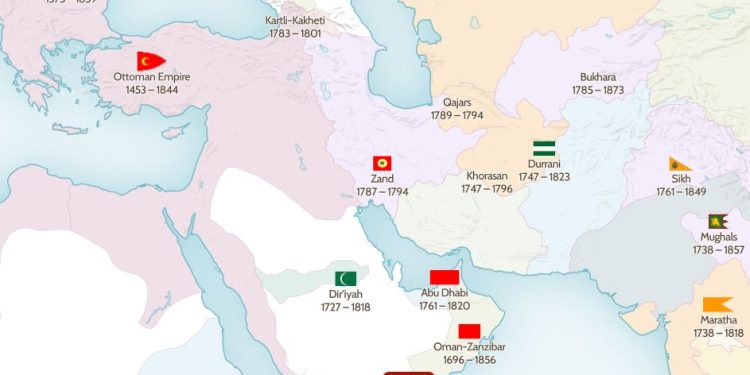
Is there an example of “Lesser Iran” in recent history? The period from the assassination of the ruler of Persia, Nader Shah, in the summer of 1747 until the establishment of the Islamic Republic of Iran in 1979. Imperial Iran shrunk continuously after the collapse of the Afsharid rule of Nader Shah. Iran suffered setbacks again during the Qajar dynasty through two humiliating treaties: Gulistan in 1813 and Turkmenchay in 1828, where Iran shrunk before Russia in the north and lost the parts that made it an empire capable of restoring—even if in a farcical manner—the Achaemenid and Sassanid “Greater Iran.” With the declaration of the Islamic Republic, Iran expanded ideologically without direct military conquests; at the same time, this Iran remained framed within metaphysical Shia forces, believing in the “Major Occultation” of the Imam and the imminent appearance of the Mahdi, or preparing for his appearance.
The presence of Iran masked deeper regional rivalries and coordinated divergent forces against a common adversary. If that regime weakens and retreats into “Lesser Iran,” according to assessments, the region will not stabilize; rather, it will be rearranged. In that rearranged scene, the ambitions of Turkey and the influence of Qatar will move to the forefront, often in direct conflict with Saudi interests, since the tools employed by these parties are political Islam movements. By empowering these parties today, Riyadh risks strengthening the rivals of tomorrow, while the Israel-U.S.-UAE axis continues to consolidate itself, despite being under pressure in its regional spread.